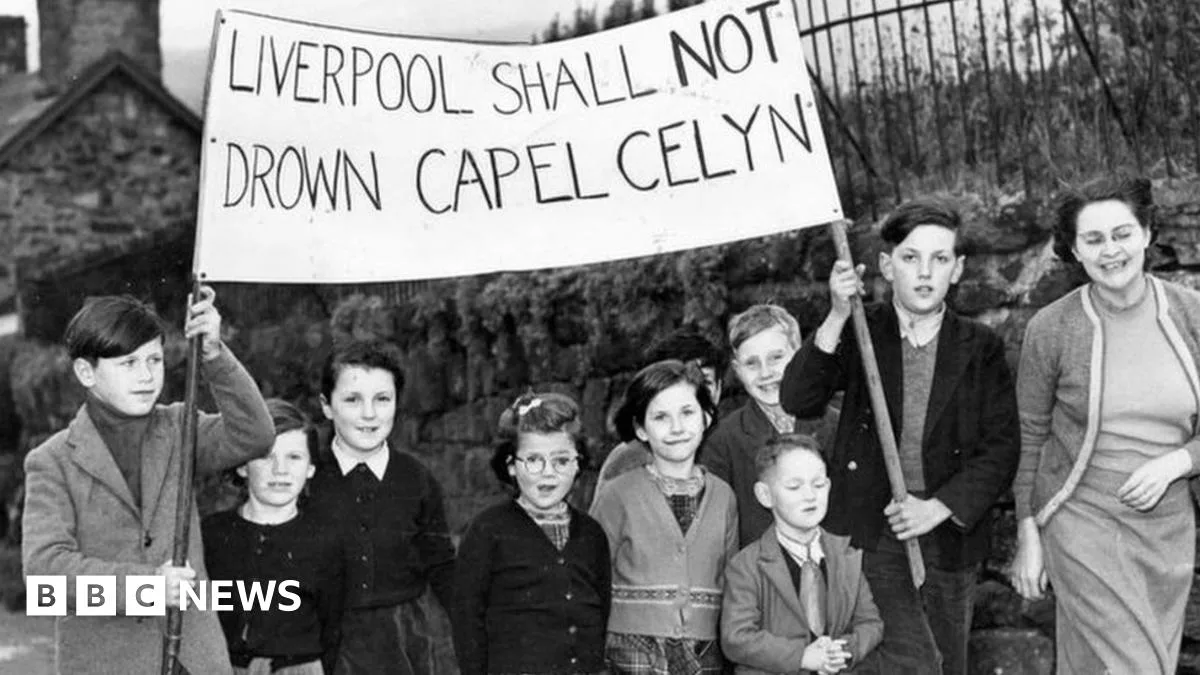
Betsan Powys grew up with the story of how the Welsh-speaking village of Capel Celyn was drowned to provide drinking water for Liverpool. From her decades-long career as a journalist she thought she knew the story. But making a podcast about the drowning and the protests that followed gave her an opportunity to look beyond the passion and the myth.
The drowning of Capel Celyn is an emotive topic in Wales - the passion some feel almost 60 years on should come as no surprise and has been well documented. When speaking to people whose homes were bulldozed and flooded and hearing the stories of those directly involved in the decades of political protest that followed, what struck me most were the nuances and complexities that came to light.
In 1965 - the same year as I was born - the nine-year battle to save Capel Celyn was finally lost and the village was flooded. Growing up, it was talked about at my school in Cardiff, but I would also have heard the story at home. My mother grew up on a farm near the famous graffitied Cofiwch Dryweryn (Remember Tryweryn) wall near Llanrhystud, Ceredigion, and whenever we went to visit my grandparents, we would pass it.
In the summer of 1955, the people of Capel Celyn learnt their homes had been earmarked as the site of a new reservoir to provide water for Liverpool. This would mean destroying houses in the village near Bala, Gwynedd, and rehousing the villagers elsewhere. For almost a decade after the announcement, the villagers fought to save their homes, with protests and marches through the streets of Liverpool. The village could not be saved and in 1965 Capel Celyn was flooded, with 75 people having to leave their homes. Its 12 farms, school, chapel and post office disappeared under water.
Visiting the Liverpool Record Office, it struck me that this is Liverpool's story too of course. Before Tryweryn, Liverpool was already getting its water from Wales - but the city's council argued there wasn't enough of it. The demand for water in Liverpool had been growing, and as local politicians strove to clear poor housing and improve conditions, they saw a need for a bigger, better water supply. Building the Tryweryn reservoir by drowning Capel Celyn was seen as serving a vital and greater good.
I spoke to the songwriter and broadcaster Sir Richard Stilgoe, whose father, John Stilgoe, was Liverpool's chief water engineer. He designed the Tryweryn reservoir, and Sir Richard remembers spending many Saturdays as a teenager visiting the site. While there, he described seeing a mutual respect growing between his father and the people of the valley. It's the fact that Liverpool is in England and Capel Celyn in Wales that turned an honourable attempt to serve 'a greater good' into 'perceived bullying,' he believes.