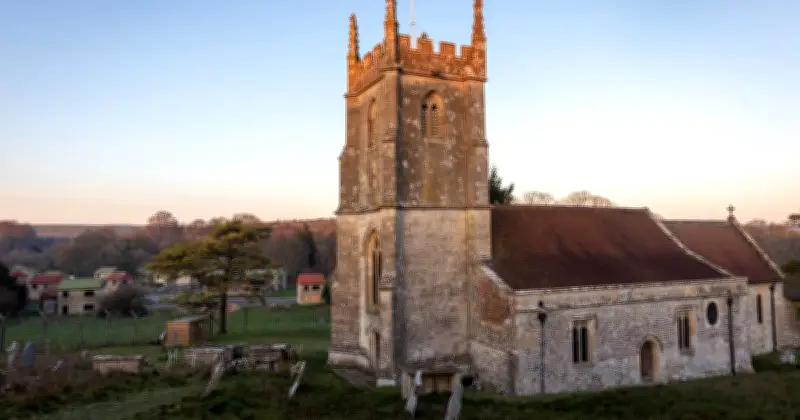
Imber, the UK's only ghost town, is a unique destination where entry is forbidden except on a handful of open days each year. Located on Salisbury Plain in Wiltshire, the village has been empty since the Second World War, when its 152 residents were forced to evacuate. Today, it is owned by the Ministry of Defence and used for military training, with signs warning of unexploded bombs.
A Village with a Long History
The first recorded settlement in Imber was in 967AD, and it is mentioned in the Domesday Book. It was once a flourishing village with two manor houses, two churches, a pub, a school, a blacksmith, and a farm. However, in 1867, the military began to occupy Salisbury Plain, and during the First World War, the government took control of more land around Imber for military usage.
In the Second World War, the War Office chose Imber for military manoeuvres due to its far-flung location. On November 1, 1943, the 152 residents were summoned to the school hall and told they had just 47 days to evacuate by Christmas. They were given a tiny amount of money for moving but no compensation for lost business or alternative accommodation. The villagers were devastated, and Albert Nash, the blacksmith for 44 years, was found crying over his anvil and died within weeks.
The Evacuation and Its Aftermath
The residents were promised they could return six months after the war, but that pledge was never fulfilled. The MoD decided to take charge of the village in perpetuity. Years later, Gladys Mitchell, Albert's daughter, recalled the upheaval: "It was a big upheaval for everyone, but we had to do the best we could. We had to find new jobs and a new home. There was no compensation. It was awful. My youngest girl was so upset she refused to go to her new school."
In 2023, John Williams, another former inhabitant, said the displaced residents should have received national recognition: "They sacrificed everything, they gave up their homes as part of the war effort, and they weren't even given a thank you." A mass rally in 1961 drew 2,000 people, and the matter was questioned in the House of Lords, but a public inquiry concluded the military should continue using Imber.
Imberbus Day
Despite its history, the public can visit Imber on open days, with Imberbus Day taking place this Saturday. The event, co-founded by Lord Peter Hendy, involves a fleet of vintage buses taking passengers 8.27 miles across Salisbury Plain from Warminster to Imber. Lord Hendy said, "Imber is an extraordinary place. It's haunted by the ghosts of the people who used to live there and the ghosts of thousands of military people who've trained there."
The idea was conceived by four transport professionals in a Bath pub in 2009. Michael Meilton, a retired bus scheduler, explained, "We selected Imber because it's so ridiculous! We are all busmen, and as a busman, you have to like a challenge." Last year, more than 4,000 people attended, raising £37,000 for charities. This year, over 40 antique buses will run, including a 1950 London RT model.
Michael recalled a night when a bus broke down in Imber: "When we were waiting on the bus for the engineers to come, suddenly this face appeared at the window and said, 'Could you just stay in here for a moment? We've got some night-vision-goggles exercises going on'. So we just sat there, and about every two minutes, a Land Rover would whizz past." The event has even been featured on Have I Got News for You, with a caption: "Cliff Richard gets lost on his summer holiday."
Imberbus Day runs on Saturday, and Imber is open to the public from August 29 to 31.