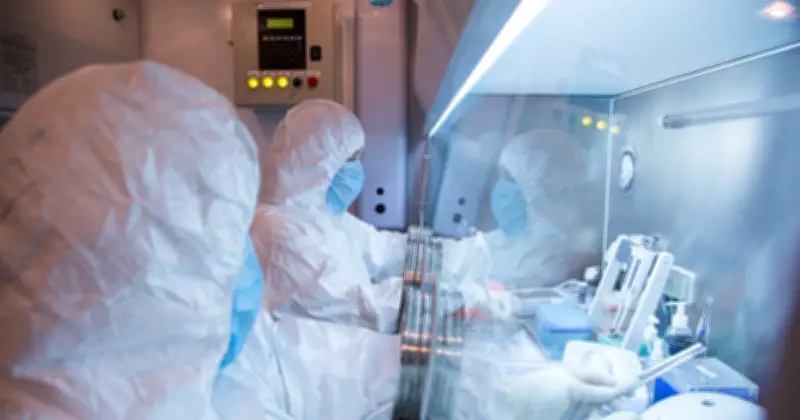
Parts of Russia are reportedly on lockdown following a suspected outbreak of pneumonic plague. More than 200 people have been hospitalised for medical observation, with up to five hospitals enforcing quarantine measures. The move comes after a laboratory worker died of suspected pneumonic plague, a disease associated with the 14th-century "Black Death" pandemic.
Lab worker dies after breaking test tube
Daria Shipilova, 28, dropped and broke a test tube containing a plague pathogen at an anti-plague research institute. She then developed severe pneumonia before being pronounced dead around a week later. Authorities in Russia confirmed she died after contracting "pneumonia of unknown origin" before the national health agency enforced strict measures.
These included locking down local hospitals and observing around 200 people who had come into contact with Shipilova, including 60 of her colleagues. Despite the reported lockdown measures, Russian authorities have issued conflicting messages following the incident in Siberia. Some have avoided the word "plague", instead calling it a "particularly dangerous infection", while others have explicitly urged residents not to travel to the Shelekhov region "because of plague".
How the outbreak started
Local media first reported that Shipilova, a laboratory technician at the Irkutsk Anti-Plague Research Institute in Siberia, accidentally broke a test tube containing the highly contagious pneumonic plague pathogen on September 25. She then fell ill at work and developed severe pneumonia before being pronounced dead overnight between October 1 and October 2.
Following her death, Russia's national public health agency, Rospotrebnadzor, enforced strict anti-epidemic measures. They immediately put around 200 people who had contact with her, including more than 60 of her colleagues, under strict medical observation and isolation. Reports also said that between three and five hospitals in the Irkutsk region, including the Shelekhov District Hospital where Shipilova died, have been put under a three-week lockdown. Both staff and patients have been restricted from leaving the sites. Meanwhile, local authorities in the city of Irkutsk have cancelled public events and introduced a mask mandate at a large local aluminium plant.
Conflicting messages from authorities
Rospotrebnadzor insisted that no emergency situation involving pathogenic microorganisms had been identified. Kremlin spokesman Dmitry Peskov said in a briefing that people should "ignore" rumours about the reported outbreak. He said: "We should rely on official statements from Rospotrebnadzor, without listening to various rumours and speculation." He added that Rospotrebnadzor employs "highly qualified professionals".
Rospotrebnadzor said Shipilova died from "pneumonia of unknown aetiology" but claimed testing found no trace of biological microorganisms associated with her professional work. They also said no other staff members have reported illness in the last 10 days. Irkutsk Governor Igor Kobzev said the situation is "stable" and "under control", adding that quarantined individuals have tested negative for the plague.
However, there has been more mixed messaging elsewhere, with a local administration in the nearby town of Baikalsk warning residents of a "plague" in Shelekhov before the post was deleted shortly after. Likewise, Alexey Tsydenov, the head of the Republic of Buryatia, also claimed she died of the plague, but he soon amended his post to remove the term.
How serious is the suspected pneumonic plague?
The pneumonic plague is a severe and highly contagious lung infection. It directly infects the respiratory system and can spread easily through airborne droplets. The symptoms, which develop within 1 to 7 days after exposure, include fever, chills, headaches, body aches, and rapidly progressing pneumonia. Patients may also have a cough that produces bloody or watery mucus.
Pneumonic plague progresses rapidly and is nearly 100% fatal if left untreated. However, it does respond effectively to standard antibiotics and can be treated if detected quickly. The World Health Organisation says: "Plague is a very severe disease in people, particularly when the bacteria spreads through the bloodstream (septicaemic plague) or infects the lungs (pneumonic plague). It has a case-fatality ratio of 30% to 100% if left untreated. The pneumonic and septicaemic forms are invariably fatal unless treated early."
"Pneumonic plague is especially contagious and can trigger severe epidemics through person-to-person transmission via respiratory particles. Historically, plague was responsible for widespread pandemics with high mortality. It was known as the 'Black Death' during the fourteenth century, causing more than 50 million deaths in Europe. Nowadays, plague is easily treated with antibiotics and the use of standard precautions to prevent acquiring infection."
Global reaction
The US confirmed that it is "monitoring the outbreak and assessing options". Secretary of State Marco Rubio explained that the White House was closely watching events in Russia but noted that it is a "cause for focus" rather than a "cause for alarm".
Meanwhile, President Donald Trump expressed concern, explaining that "germs have really become relatively stronger than they were". He added he has yet to speak directly to Vladimir Putin but insisted that the US is on standby to offer help. However, there has been no official statement from Downing Street regarding the reported outbreak, with the UK currently relying on international health monitoring services.