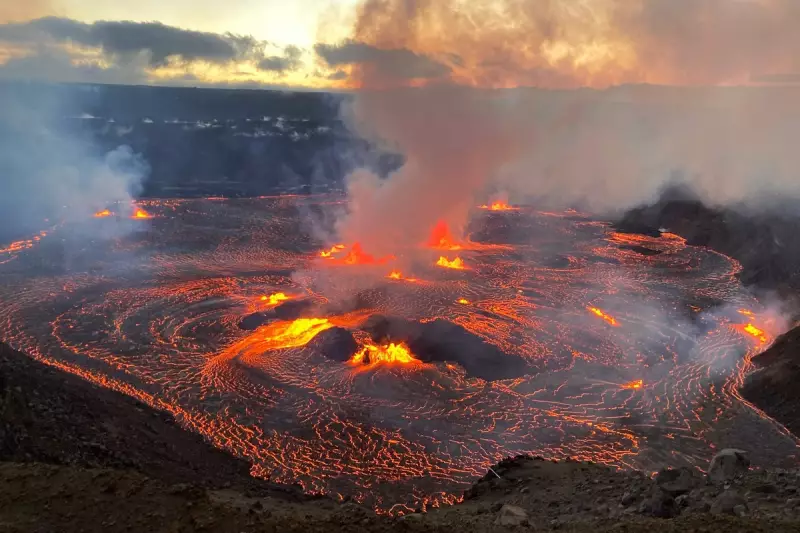
One of the world's most active volcanoes, Kilauea on Hawaii's Big Island, has now been erupting continuously for over a year, producing spectacular and record-breaking displays of raw geological power.
A Year of Spectacular Eruptive Episodes
The current eruptive phase began in December 2024 and has since seen 39 distinct explosive episodes. The most recent, which occurred on 23 December 2025, marked the eruption's one-year anniversary. During these events, fountains of molten lava have routinely been launched skyward, with the US Geological Survey (USGS) reporting heights reaching an astonishing 1,400 feet – taller than the Eiffel Tower.
Episode 39 alone lasted for 5.9 hours and is estimated to have produced around 13 million cubic yards (10 million cubic metres) of lava. Scientists from the USGS Hawaiian Volcano Observatory confirm the ongoing eruption has broken multiple records, including those for the highest lava fountains, the greatest volume of erupted material, and the highest rate of lava effusion.

Scientific Wonder and Public Impact
Ken Hon, the scientist-in-charge at the USGS Hawaiian Volcano Observatory, described the event as the most amazing he has witnessed in terms of Hawaiian volcanism. He noted the formation of a new lava wedge over 200 feet thick on the surface of the summit lava lake, a phenomenon never before seen on this scale.
While the activity is contained within Hawaii Volcanoes National Park, roughly 200 miles south of Honolulu, and poses no direct threat to residential areas, its effects can be far-reaching. The continuous release of sulfur dioxide from the summit creates volcanic smog, or vog, downwind. This haze can lead to respiratory issues and other health problems when concentrations are high.
Tourism Boom and Geological Cycles
The dramatic eruptions have become a major draw for visitors. In November 2025, the park welcomed 157,000 people, representing a 43 per cent increase compared to the same period the previous year.
Geologically, the volcano follows a clear pattern of inflation and deflation. The summit area deflates as stored magma erupts to the surface during active episodes. In the quieter periods between eruptions, it steadily inflates again as magma re-accumulates. Scientists closely monitor these cycles to help forecast the timing of future eruptive events.
The powerful lava fountains have also reshaped the landscape, depositing some 140 feet of tephra and forming a new hill, or puʻu, southwest of the Halemaʻumaʻu crater. As this monumental eruption enters its second year, it continues to offer a breathtaking and potent reminder of the dynamic forces shaping our planet.