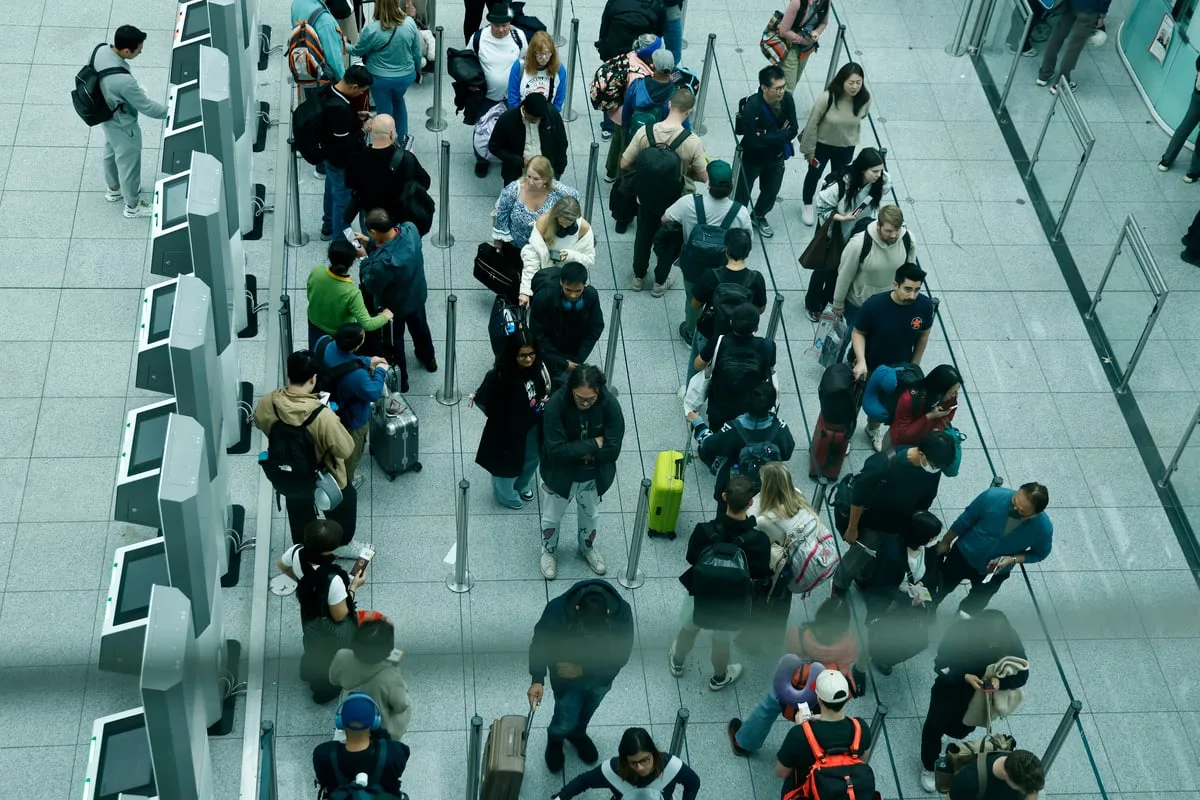
Greece has suspended the use of EU fingerprint and facial scans for British holidaymakers amid queue chaos across Europe. The new biometric security measures, part of the Entry/Exit System (EES) introduced by Brussels, have caused airport delays of up to four hours at some of the continent's busiest airports.
To avoid disruption during the height of summer, Greece has opted out of the checks. Eleni Skarveli, director of the Greek National Tourism Organisation in the UK, said the decision would 'ensure a smoother and more efficient arrival experience in Greece' and 'significantly reduce waiting times' while alleviating congestion.
The EES is intended to replace manual passport stamping and monitor the 90-day visa-free limit, but has resulted in havoc. Earlier this month, more than 120 EasyJet passengers were stranded at Milan Linate Airport after lengthy delays caused them to miss their flight to Manchester. Only 34 of the 156 passengers made it on board.
Passenger Keira, 17, from Oldham, told the BBC she and her boyfriend faced a 20-hour wait for a replacement flight, costing her mother about £520 for new flights. 'We got here at 7.30am for our flight at 11am ... When we got to the front of the queue someone told us our flight had just gone,' she said. She received only £12.25 in compensation.
The Greek Embassy confirmed the exemption: 'As of 10 April 2026, British passport holders are exempt from biometric registration at Greek border crossing points.' The move is seen as strategic, as Greece relies heavily on British tourism, with hotspots like Corfu, Crete and Rhodes seeing over 2,000 UK passengers a day in peak season.
Travel trade organisation Abta welcomed the decision, but warned of ongoing delays elsewhere. A spokesman said Greece is expected to be the fifth most-visited destination by Brits this summer, behind Spain, France, Italy and the USA.