Tesla's Full Self Driving Technology Makes European Debut in Amsterdam
Autonomous vehicle technology has taken a significant leap forward in Europe with Tesla's Full Self Driving (FSD) system now operational on the continent's roads. Following extensive testing across multiple European nations, the Netherlands has become the first country to grant regulatory approval for this advanced driver assistance technology.
Safety Statistics and European Implementation
According to Tesla's data from the United States, where FSD has been available since 2022, users experience seven times fewer collisions on highways and five times fewer incidents off highways. The company estimates this technology could potentially save up to 32,000 lives annually in the US, where road fatalities exceed 40,000 each year.
While Europe has seen various autonomous vehicle trials around London involving companies like Uber and Waymo, Tesla's system represents a new phase of commercially available technology. Crucially, all current autonomous systems require driver supervision, with the human operator remaining legally responsible for the vehicle's safe operation.

Technical Specifications and Operation
Tesla's approach differs from competitors by relying on eight strategically placed cameras rather than radar or lidar technology. These cameras, positioned around the Model Y Rear Wheel Drive vehicle, work in conjunction with GPS systems, onboard maps, microphones, and gyroscopic sensors to create a comprehensive understanding of the vehicle's environment.
The collected data feeds into Tesla's proprietary neural network system, where artificial intelligence processes information into separate streams that control steering and speed systems. This sophisticated technology can account for weather conditions, detect pedestrian movements, and even identify whether pedestrians are wearing headphones.
Amsterdam Test Drive Experience
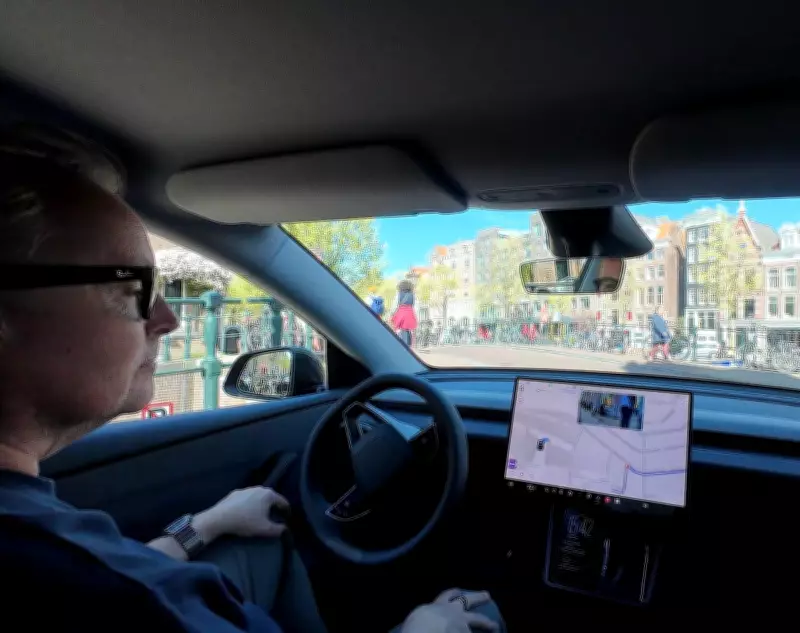
Amsterdam's challenging urban environment, with its narrow cobbled streets, numerous cyclists, trams, tourists, and canal-lined roads, provided an ideal testing ground for FSD's capabilities. During an exclusive test drive, the system demonstrated remarkable competence in navigating these complex conditions.
The vehicle required minimal intervention, with only occasional reminders needed for traffic light changes and one instance requiring manual braking at a malfunctioning intersection. The system's ability to navigate tight spaces and judge vehicle width proved particularly impressive in Amsterdam's confined urban landscape.
Driver Monitoring and Safety Features
A crucial component of the supervised FSD system is the interior camera positioned above the rear-view mirror. This camera continuously monitors the driver's eye movements and hand positions, ensuring they remain "hands ready" to assume control if necessary. The system will issue warnings and eventually disengage if it detects insufficient driver attention.
Activation of FSD is remarkably straightforward: drivers set their destination via the navigation system and engage the feature using either the steering wheel scroll wheel or touchscreen controls. The display shows real-time visualizations of what the vehicle perceives, including road direction, other vehicles, traffic signals, and pedestrians.
Performance and User Experience
The system operates with natural acceleration and smooth cornering, maintaining speed limits more rigorously than many human drivers. It demonstrates intelligent lane-changing behavior when advantageous and consistently prioritizes safety around vulnerable road users like cyclists and pedestrians.
One notable observation during testing was how unremarkable the autonomous driving felt—the vehicle's movements were smooth and predictable, blending seamlessly with regular traffic. Most pedestrians appeared unaware that the vehicle was operating autonomously, though some did double-take when noticing the driver's hands weren't on the steering wheel.
Future Developments and European Expansion
With the Netherlands leading European approval, other EU member states are expected to follow suit in the near future. Tesla continues testing across Europe, including specific challenges like single-track country lanes with oncoming agricultural vehicles.

The technology comes with a subscription model, currently priced at €99 (£89) monthly in the Netherlands. Tesla's ambitious future plans include steering wheel-less Cybercab prototypes and expanding Robotaxi services, with significant corporate incentives tied to achieving ten million FSD subscriptions and one million operational self-driving Robotaxis within the next decade.
While some drivers may prefer traditional control, FSD represents a significant advancement in automotive technology that could transform road safety and mobility, particularly for older drivers who wish to maintain independence while reducing driving responsibilities.