Tech Oligarchs Reshape Humanity While Billionaires of Old Seem Quaint
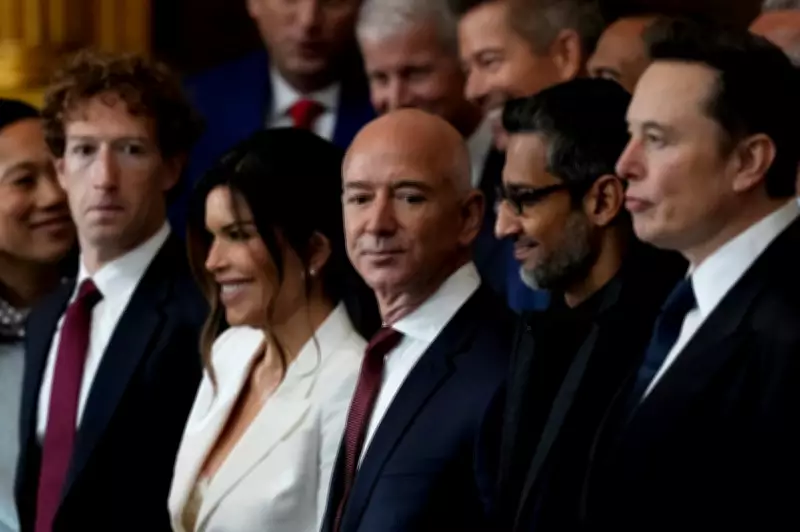
Guests including Mark Zuckerberg, Lauren Bezos, Jeff Bezos, Sundar Pichai, and Elon Musk arrived before the 60th presidential inauguration in the rotunda of the US Capitol in Washington on 20 January 2025. This gathering underscores the immense influence wielded by today's tech titans, who have rapidly ascended to the apex of global wealth and power.
The Evolution of Wealth and Power
When Bill Gates first entered the top 10 on Forbes magazine's billionaires list in 1992, the world was markedly different. Gates joined a diverse group from Japan, Germany, Canada, South Korea, and Sweden, including family fortunes from Britain and America. Industries represented ranged from retail and media to property management and packaging, with total fortunes nearing $100 billion, equivalent to about 0.4% of the US GDP that year.
Fast forward to 2025, and the oligarchy has transformed dramatically. Bernard Arnault of French luxury group LVMH, Amancio Ortega, the Spanish clothing mogul, and Warren Buffett, the US investor, are the only old-school billionaires remaining among the top 10. The rest have amassed wealth primarily from high-tech ventures: Elon Musk, Jeff Bezos, Mark Zuckerberg, Larry Ellison, Steve Ballmer, and Google's Sergey Brin and Larry Page. Collectively, the top 10 now hold over $16 trillion, approximately 8% of US GDP.

Raising Critical Questions About Humanity's Direction
This shift highlights how swiftly new technologies have revolutionized the global economy over the past quarter-century, yet it also reveals a stark concentration of prosperity. A pressing issue emerges: what occurs when a small group of oligarchs, steering the technological revolution from positions of unparalleled wealth and power, dictate humanity's trajectory?
Key inquiries include whether striving for human- or superhuman-level artificial general intelligence is advisable, the implications of such goals, and the resources required. Concerns span business model sustainability, potential eradication of human labor, and the need for redistribution systems if a productivity boom does not materialize.
These consequential decisions appear unlikely to be made through public deliberation or democratic processes. Instead, the elite atop Forbes' 2025 list, along with figures like Anthropic's Dario Amodei, OpenAI's Sam Altman, and tech funder Peter Thiel, will largely guide artificial intelligence as it shapes the world's future.
Problematic Worldviews and Ambitions
The issue extends beyond their billionaire status, which often insulates them from everyday human concerns. Their worldview is rooted in a belief that technology offers the ultimate solution to all challenges—social, political, economic, demographic, biological, psychological, environmental, and beyond. Their envisioned AI-driven future prioritizes technological advancement over mundane realities, showing little patience for slow, messy democratic governance that might impede progress toward utopia.
While not uniformly aligned on traditional political spectrums, their actions speak volumes. For instance, nearly $200 million has been directed to prevent states from imposing AI regulations, signaling a key aspiration: unleashing artificial intelligence to forge the next phase of cosmic evolution, potentially excluding humans as we know them.
Transhuman Visions and Disinterest in Present Concerns
Tech oligarchs are vocal about these ambitions. Larry Page argues that digital life is the natural next step in evolution, advocating for free digital minds. Sam Altman envisions humanity designing its own descendants, with options ranging from merging with digital intelligence to fading into evolutionary history. Elon Musk's Neuralink aims to integrate AI with human minds, while Mark Zuckerberg focuses philanthropy on life extension. Peter Thiel plans cryogenic preservation for future immortality, rejecting the inevitability of individual death.
Despite differing perspectives on personal involvement in this future, they share a common disinterest in pressing issues like housing, healthcare, food prices, or gas costs. The technological oligarchy even challenges human precedence over artificial life forms, with Altman noting the energy-intensive nature of human training compared to AI models.

Unsettling Realities and Nostalgia for the Past
Anthropic has garnered praise for advocating AI regulation and resisting unrestricted Pentagon access to its Claude AI. Yet, its leaders also pursue a transhuman future, training Claude to develop a sense of self, as ethicist Amanda Askell notes. Economists may dismiss this as sci-fi, citing historical technological revolutions that ultimately enhanced human wellbeing. However, the current revolution is uniquely unsettling due to its concentration in the hands of a small, powerful group with high self-regard.
While billionaires have long been debated, today's tech titans evoke a sense of nostalgia for their predecessors. Old billionaires, dealing in Tetra Paks, Japanese real estate, or supermarkets, seem harmless in retrospect. In contrast, modern moguls are far more intimidating, driven to transform human civilization at an unprecedented pace, raising profound questions about who truly decides our collective future.