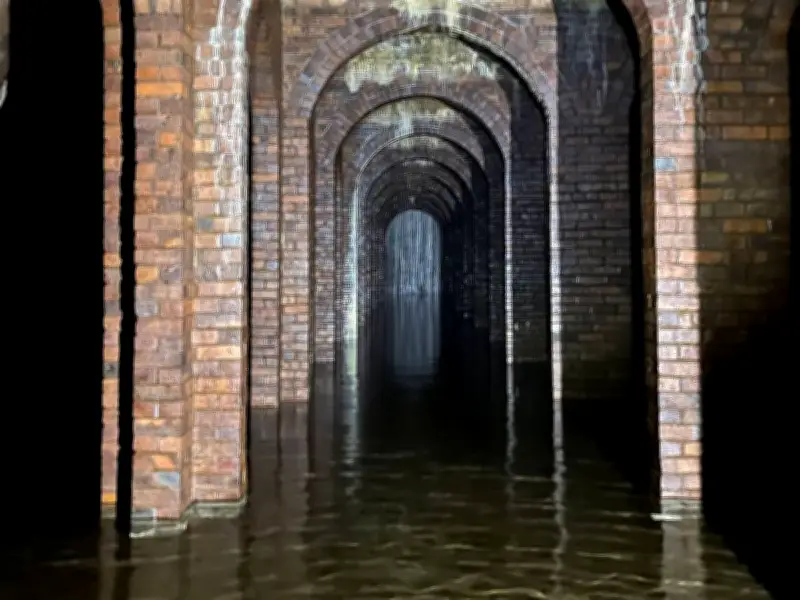
For over a century, visitors to Llandudno's Great Orme have unknowingly walked above a submerged Victorian reservoir, Y Fach, a vast underground chamber with brick columns and arched ceilings that has been compared to an underground cathedral and Istanbul's Basilica Cistern. Now, plans to transform the forgotten structure into a year-round immersive attraction called Llandudno Vaults have moved forward after securing a £20,000 grant, though significantly more funding is needed.
History of the Sunken Palace
Constructed in the 1800s and officially opened by the Prince of Wales on June 17, 1880, Y Fach was part of a programme to address water shortages in the thriving north Wales seaside town. At full capacity, the reservoir reached 12 feet in depth and held 936,000 gallons of water. In 1914, brick arches and a roof were added to blend with the landscaped surroundings, creating a concealed cavern. Over time, the reservoir fell out of use, was drained, and its grassed-over roof became a putting green. It remained sealed off for decades, accessible only via a manhole and ladders.
Comparisons to Istanbul's Basilica Cistern
Y Fach has drawn comparisons to Istanbul's Basilica Cistern, known as the Sunken Palace, which features marble columns and brick arched ceilings. The Basilica Cistern, built under Emperor Justinian I (527-565), spans roughly 10,000 square metres and supplied water to the Great Palace.
Llandudno Vaults: A New Vision
The Llandudno Vaults project proposes a new entrance in the Happy Valley area, blending Victorian engineering, immersive storytelling, and Welsh mythology. Andy White, managing director of Llandudno Vaults, said: "For more than a century, thousands of people have walked across Happy Valley without realising what's beneath their feet. The reservoir is one of north Wales' hidden engineering treasures, and our ambition is to reveal it in a way that respects its history while creating a completely new visitor experience."
The team plans to submit a planning application later this year and is consulting with local businesses and stakeholders. Conwy county councillor Sharon Doleman said: "The Llandudno Vaults project presents an exciting opportunity to unlock a hidden part of the town's heritage and create a truly unique visitor experience. By combining Victorian history and engineering with Welsh culture, mythology and storytelling, it has the potential to become a distinctive year-round attraction that complements Llandudno's existing tourism offer."
Origins and Water Supply
The reservoir's origins trace back to St Tudno, the sixth-century patron saint of Llandudno, who relied on spring water. The spring waters were later used by mining and farming communities. During the 19th century, as Victorian tourism boomed, local officials undertook an ambitious scheme to deliver a "magnificent water supply." Professor Frankland declared in 1880: "It is a most excellent water for dietetic and all domestic purposes. It is wholesome and palatable and contains only a very small amount of vegetable organic matter. It is exceedingly soft and therefore well adapted for washing."
Surface reservoirs were built, including Y Fach, which remained unremarkable for over 30 years until its concealment in 1914. According to the Llandudno Vaults website: "Beneath the Great Orme in Llandudno lies Y Fach, a long-forgotten Victorian reservoir built from red brick arches with vaulting so grand it feels like an underground cathedral. For decades this vast hidden chamber has been locked away, its potential unseen. The Llandudno Vaults project seeks to transform this unusual space into a landmark immersive arts venue, where Welsh myths and creatures are brought vividly to life through storytelling, music, and interactive technology."