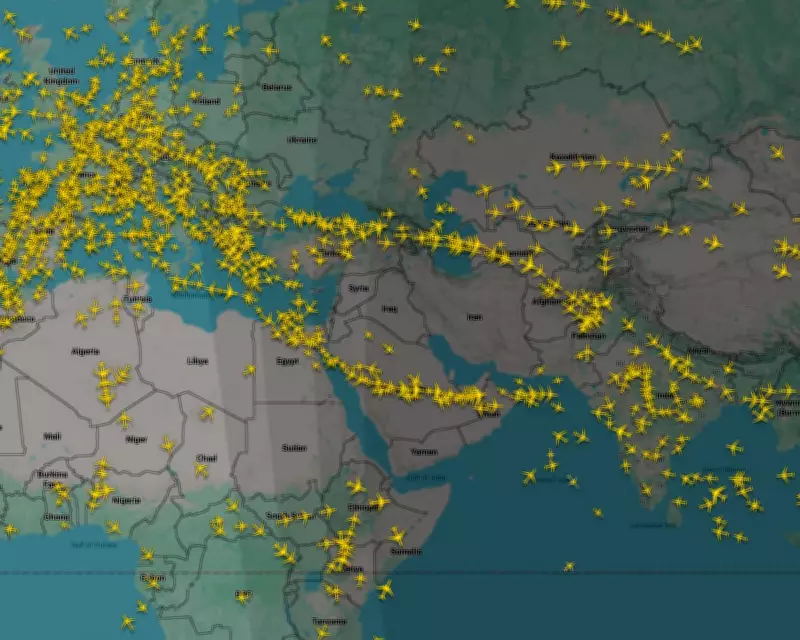
Flightradar24 Reveals Empty Skies Over Middle East Amid US-Israel-Iran Conflict
The Swedish flight tracking service Flightradar24 has become the global go-to platform for monitoring aviation crises, with its latest data showing eerily empty airspace over the Middle East. This dramatic visualisation results from the recent US-Israel military actions against Iran, which have triggered widespread airspace closures and travel chaos across the region.
From Humble Beginnings to Global Aviation Monitor
Flightradar24 originated not as a dedicated tracking tool but as an enhancement to a Swedish flight price comparison portal. Founders Mikael Robertsson and Olov Lindberg added an air traffic charting page to attract more visitors, little expecting it would eclipse their original business. "Very soon this flight tracker became more popular than the price comparison tool itself," Robertsson recalled from the company's Stockholm office.
The platform first captured mass attention during the 2010 eruption of Iceland's Eyjafjallajökull volcano, when millions monitored flight disruptions across Europe. This established Flightradar24 as a real-time window into major aviation events, from the disappearance of Malaysia Airlines Flight 370 in 2014 to the COVID-19 pandemic's travel industry collapse in 2020.

Tracking Conflict-Induced Travel Chaos
Recent days have seen another surge in users as the US-Israel strikes on Iran rapidly cleared Middle Eastern skies. Following retaliatory missile deployments, countries across the region shut their airspace, disrupting hundreds of thousands of travellers. Flightradar24's map clearly displayed the impact, with large swaths showing no air traffic and only two narrow corridors remaining open.
One corridor ran north of Iran through the Caucasus, avoiding Ukraine's closed airspace, while another passed south through Egypt, Saudi Arabia, and Oman. Both appeared crammed with yellow plane symbols representing rerouted flights. "For each big aviation event, we do get a big traffic spike," said CEO Fredrik Lindahl, noting that Saturday's visits more than doubled normal levels before peaking higher on Monday.
How Flightradar24 Operates
The platform functions through a global network of approximately 58,000 radio receivers, including a dozen in Antarctica. It began with just two devices installed by the founders after they discovered airspace monitoring was possible with UK-bought equipment. "It sounded like something impossible," Robertsson admitted, suggesting he might classify such a claim as a scam today.
Every aircraft transmits flight information—callsign, position, direction, speed, and altitude—which receivers collect to populate the real-time map. This crowdsourced aspect relies on aviation enthusiasts worldwide hosting receivers, supported by maintaining a strong free product to attract new contributors.
Building a Business on Intermittent Audiences
Flightradar24 has commercialised its intermittent audience spikes through premium subscriptions, which account for about 70% of revenue, plus commercial packages for industry operators and advertising. The platform typically attracts 60 million free viewers monthly, with paying subscribers exceeding 1.5 million.
No event has drawn more attention than the 2022 journey of the late Queen's coffin from Edinburgh to Northolt, watched by 4.8 million people. However, the Middle East conflict has driven significant recent traffic, with Lindahl confirming March figures will definitely be higher than usual.
In September 2025, the company sold a 35% stake to London-based venture capital firm Sprints Capital, underscoring its growth from a supplementary webpage to a pre-eminent global airspace monitor. As conflicts and crises continue to disrupt aviation, Flightradar24 remains the world's real-time window into the skies.