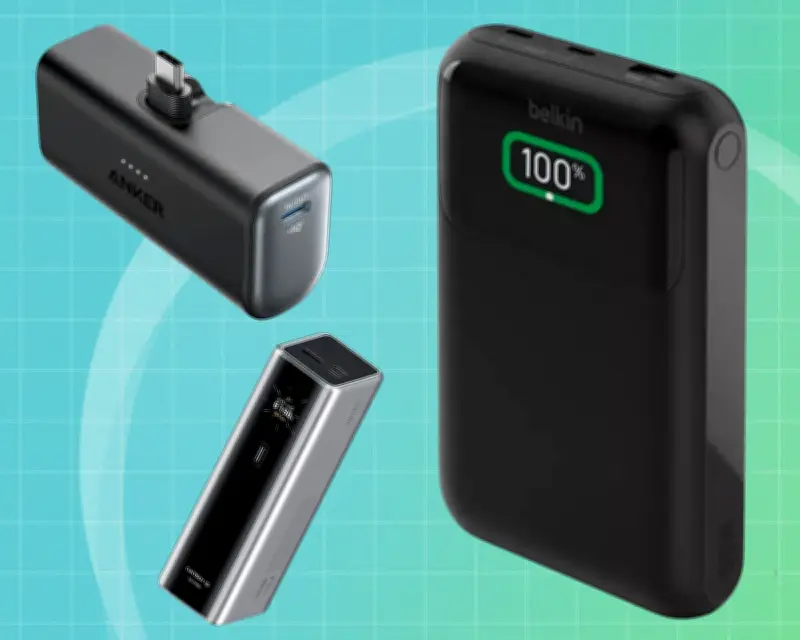
Running out of battery on your smartphone, laptop, or other essential gadget can be disempowering. With a flash of a graphic or a plaintive bleep, you lose a way to entertain yourself, get things done, stay in touch, or even get home safely. While there is a time and place for a digital detox, it is rarely convenient when you are on the go.
Carrying a power bank is your ticket out of electronic oblivion. These pocket-sized cuboids plug into compatible devices and charge them, often via assorted connections, including USB-C and USB-A. Most power banks are designed for charging smartphones and smaller gadgets, such as fitness trackers and earbuds, but some models can also charge power-hungrier laptops and large portable speakers.
More capable still, portable power stations can charge various high-voltage appliances, making them perfect for camping, garden parties, and power cuts.
To find the best power bank for your electrical exigencies, I put 17 top models through their paces, including options from Belkin, Anker, Cuktech, Iniu, Ugreen, Bluetti, Acer, and EcoFlow. Bear in mind that any particular power bank will only be suitable for charging compatible devices based on its power output and connectivity. Before you buy one, check the specs against your smartphone or other devices.
At a glance
- Best power bank overall: Belkin BoostCharge Pro 3-port 20k — £79.99 at Argos
- Best budget power bank: Belkin BoostCharge 10k with integrated cable — £14.99 at Amazon
- Best power bank for portability: Anker Nano — £19.99 at Anker
- Best power bank for smartphones: Anker Nano A1638 — £35.99 at Argos
- Best power bank for speed and power: Cuktech 15 Ultra — £59.99 at Amazon
- Best high-storage power bank: Ugreen Nexode 25000mAh 200W — £52.99 at Argos
- Best power bank for multiple users: Belkin UltraCharge Pro laptop power bank 27K — £149.99 at Belkin
Why you should trust me
I have been reviewing tech products since the mid-2010s. When I am not trying out gadgets, I am often writing about them using my laptop or discussing them with editors and PR contacts on my smartphone. As a result, I spend a lot of time using portable, battery-powered electronic devices. You might say I am just the sort of person who needs a good power bank. I used all of the models featured in this article—even the power hat—while working on the go at libraries, cafes, and on public transport. Not once did my laptop or smartphone run out of battery.
How I tested
I tested 17 power banks by using them to charge various devices with different requirements, including Honor Magic7 Lite, Magic7 Pro, Magic8 Lite, and Magic8 Pro smartphones, as well as Acer Aspire Vero 16 and Lenovo ThinkPad T16 laptops. I timed how long it took for each power bank to charge these devices by 30%. I only charged the laptop with suitably powerful power banks. Thanks to Honor and Acer for loaning the smartphones and laptop for testing.
Some of the power banks have additional features, such as digital displays, integrated cables, and control buttons. I tested these extras where present and also considered the portability and aesthetics of each model. Some brands did not want their power banks back after testing; those models will be donated for fundraising to Cat Action Trust 1977.
The best power banks and portable chargers in 2026
Best power bank overall: Belkin BoostCharge Pro 3-port 20k
From £79.99 — If you need a highly capable power bank that can recharge your laptop as well as your smartphone, this model is a fine choice. Across three charging ports (one USB-A and two USB-C), there is a combined power output of up to 65W, more than sufficient to charge two smartphones at once.
In my tests, the BoostCharge Pro topped up an Acer laptop at speeds I would normally expect from a mains-powered charger. It was no slouch for charging smartphones, nor when I plugged in two devices at once. The power bank is a stout, minimalist device, and considering it can store up to 20,000mAh of charge, it is impressively lightweight. The digital display activates at the press of a button to show its storage level and outputs. It is a shame that the onscreen metrics are slightly less detailed than on rival models, but the information is presented clearly and includes a useful countdown timer.
- Weight: 378g
- Connections: USB-C (x 2); USB-A
- Output wattage: up to 65W (total)
- Capacity: 20,000mAh (approx 5 charges of a Samsung Galaxy S25)
Best budget power bank: Belkin BoostCharge 10k with integrated cable
From £14.99 — It is hard to believe this is a cheap option. The BoostCharge Power Bank 10k has a premium-feel soft finish and speedily charges smartphones, earbuds, and other lower-powered devices via its USB-C outlets. Neatly proportioned and impressively light, it is one of those rare power banks you could happily carry in a jacket pocket. Thanks to the integrated USB-C connector, you do not even need to remember a cable. It is a shame that charging two devices at once reduces the maximum total output from 20W to 15W, so single-device charging is considerably quicker.
- Weight: 218g
- Connections: integrated USB-C cable; USB-C port
- Output wattage: up to 20W
- Capacity: 10,000mAh (approx 2.5 charges of a Samsung Galaxy S25)
Best power bank for portability: Anker Nano
From £19.99 — Fast, convenient, and small enough to carry in a trouser pocket, the Nano is ideal for a quick top-up of a smartphone or earbuds. For me, no other power bank strikes the same balance between charging speed and portability. The Nano is minimalistic, but its features are well realised. I am a big fan of its fold-out USB-C connector, which you can use to plug the power bank directly into your phone. This rules out the risk of charging being impaired by a faulty or below-spec cable. There is also a regular USB-C port on the side. Its 5,000mAh storage capacity is sufficient for giving most smartphones a good top-up, but it might not fully charge the device. It is a shame that you would need something more powerful to charge your laptop.
- Weight: 102g
- Connections: foldable USB-C connector; USB-C port
- Output wattage: up to 22.5W
- Capacity: 5,000mAh (approx 1.25 charges of a Samsung Galaxy S25)
Best power bank for smartphones: Anker Nano A1638
From £35.99 — Released in 2025, this Nano A1638 model is one of Anker's latest compact power banks, and it takes the brand's outstanding product design to new heights with a slick, sheeny finish and a seamlessly integrated digital display. This little power bank packs a winning combination of handbag-friendly portability and charging capability. You can charge up to three devices at once. The retractable USB-C output cable extends to a generous 70cm, making it ideal for tabletop charging. I would not recommend this power bank for charging a laptop, but it is perfect for topping up smartphones, tablets, and smaller accessories such as headphones. It is a shame that the product information text printed on the back wears away easily through repeated use.
- Weight: 232g
- Connections: USB-C (x 2); USB-A
- Output wattage: up to 45W (total)
- Capacity: 10,000mAh (approx 2.5 charges of a Samsung Galaxy S25)
Best power bank for speed and power: Cuktech 15 Ultra
£59.99 — This power bank was difficult to test because it charged devices so exceptionally quickly that I struggled to get to my stopwatch in time. The Cuktech 15 Ultra is light years ahead of the competition in terms of charging speeds, and with three ports (two USB-C, one USB-A) delivering up to 210W, there is incredible potential to charge multiple high-energy devices. Its 20,000mAh capacity is enough to charge the average smartphone at least three times. With great power comes somewhat lower portability; this is undeniably a weighty power bank. Still, the 15 Ultra is a well-made, smart-looking device. The TFT display provides lots of detail, and you get nice accessories, including a 3.2ft charging cable and a soft carry case. It is a shame that the characters on the TFT display are small, which may not be ideal for users with impaired vision.
- Weight: 595g
- Connections: USB-C (x 2); USB-A
- Output wattage: up to 210W
- Capacity: 20,000mAh (approx 5 charges of a Samsung Galaxy S25)
Best high-storage power bank: Ugreen Nexode 25,000mAh 200W
From £52.99 — Rapid charging, impressive capacity, and a welcome sprinkling of geek appeal come together in the Ugreen Nexode power bank, which is designed to charge laptops, smartphones, and other portable devices at up to 140W. The connections are simple but powerful: a pair of USB-C ports (140W and 100W) and a USB-A port. The Nexode passed my tests with flying colours, charging my test laptop and smartphones at impressive rates. It also has a touch of charm, courtesy of the robot animation that welcomes you to its digital display. There is lots of intel on the screen, including voltage and wattage output metrics for each charging port. Rubber strips on the base help it stay securely in place. It is a shame that the shape and weight make it relatively cumbersome; it will fit inside a backpack but may be too bulky for a handbag.
- Weight: 588g
- Connections: USB-C ports (x 2), USB-A port
- Output wattage: up to 145W
- Capacity: 25,000mAh (approx 6.25 charges of a Samsung Galaxy S25)
Best power bank for multiple users: Belkin UltraCharge Pro laptop power bank 27K
From £149.99 — Built for professionals, the Belkin UltraCharge Pro laptop power bank's two USB-C outputs can deliver charge at a combined 240W, meaning it can charge two laptops at the same time. This sets it apart in professional contexts where multiple team members need a top-up or during family trips. As a freelance writer, I greatly appreciated its laptop charging prowess; it rapidly topped up my Lenovo ThinkPad, allowing me to work without plugging into the wall. The UltraCharge Pro was reasonably quick at charging smartphones, too, although it is a little bulky for that purpose alone. I was extremely impressed with how quickly this model recharged from the mains, receiving input wattage at up to 100W. It is a shame that the digital display does not give feedback on metrics such as battery temperature and port usage.
- Weight: 584g
- Connections: USB-C (x 2); USB-A
- Output wattage: up to 240W (total)
- Capacity: 27,000mAh (approx 6.75 charges of a Samsung Galaxy S25)
The best of the rest
Iniu SnapGo magnetic power bank P781
£54.99 — Best for magnetic iPhone charging. This ultra-slim power bank attaches magnetically to compatible phones and charges them wirelessly. It worked a treat with my friend's iPhone 14. The supplied USB-C cable clips on and doubles as a finger loop. It did not make the final cut because it was quite slow to recharge from the mains relative to its storage capacity.
- Weight: 210g
- Connections: Qi2 wireless, USB-C (x2, with one cable)
- Output wattage: up to 25W (wireless), up to 45W (wired)
- Capacity: 10,000mAh (approx 2.5 charges of a Samsung Galaxy S25)
Bluetti AC50B portable power station
From £239 — Best for high-power portable charging. This portable power station has multiple ports, including two USB-C, one USB-A, DC, and AC outlets. With a total maximum power output of 700W (rising to 1,000W in power-lifting mode) and a 448Wh storage capacity, it is ideal for garden parties, camping, or off-grid renovation work. It charges devices rapidly and has a simple interface. It did not make the final cut because most buyers will not need something so powerful or feature-rich.
- Weight: 6.7kg
- Connections: 700W AC outlet, USB-C (x 2), USB-A, 120W cigarette lighter port
- Output wattage: up to 1,000W (lifting) or 700W (continuous)
- Capacity: 448Wh (approx 22 charges of a Samsung Galaxy S25)
Acer 600W portable power station
£499.99 — Best for powering devices in the garden. Simple, user-friendly, and equipped with enough storage and connectivity to run or recharge numerous energy-intensive devices. It is reasonably light for its type, and the fold-down carry handle distributes weight nicely. The integrated strip LED is perfect for outdoor entertaining after dark. It did not make the final cut because its price is too high for many users.
- Weight: 7.35kg
- Connections: AC outlet (x2), USB-A (x 2), USB-C (x 2), cigarette lighter port, DC5521 (x 2)
- Output wattage: up to 600W
- Capacity: 512Wh (approx 25.6 charges of a Samsung Galaxy S25)
Anker Solix PS30 portable solar panel
From £39 — Best for on-the-go solar charging. This portable solar panel charger incorporates four solar panels and a charging hub with USB-A and USB-C ports (up to 30W). In clear, bright conditions, it could charge smartphones in around double or triple the time of a decent power bank. It is a valid alternative for users who value economic, low-environmental-impact charging over raw speed. It did not make the final cut because it is less versatile than a power bank, as it does not store charge and will not work without sunlight.
- Weight: 1.1kg
- Connections: USB-C port, USB-A port
- Output wattage: up to 30W (total)
- Capacity: no storage
EcoFlow Rapid Magnetic 10,000mAh
From £85.99 — Best for eye-catching design. This chic power bank features a USB-C output and magnetic charging via the speedy Qi2 protocol. It charged smartphones quickly in tests and proved capable of giving a laptop an emergency top-up. The mirror-finish display pairs retro-futuristic pixelated read-outs with charge status information. There is also a fold-out kickstand for watching films on the train. It did not make the final cut because it is not as versatile as some similar-spec models.
- Weight: 258g
- Connections: Qi2 magnetic, USB-C connector
- Output wattage: up to 30W
- Capacity: 10,000mAh (approx 2.5 charges of a Samsung Galaxy S25)
EcoFlow Power Hat
From £99 — Best for charging devices at a festival. This delightfully eccentric hat conceals an array of solar panels within its brim, powering a USB-C and USB-A charger underneath. Compared with a conventional power bank, charging was slow, but when you are relaxing outdoors, that may not matter. Using solar saves money on electricity, and the hat's UPF 50+ material helps keep you safe. It did not make the final cut because its charging performance is highly weather-dependent, and this is a UK publication.
- Weight: 370g
- Connections: USB-C, USB-A
- Output wattage: STC12W (+/-1W)
- Capacity: no storage
What you need to know
Which power bank specifications really matter?
There are a few crucial specs to consider when choosing a power bank. The wattage tells you how much power it can deliver, so it needs to match the requirements of your devices. Voltage is equally important. If a power bank has multiple ports for charging devices simultaneously, check both the maximum power output per port and the total output when charging several devices at once. Higher-wattage power banks are typically heavier, bulkier, and more expensive.
A power bank's inputs and outputs are also crucial. Most power banks feature ports that connect via USB-C or USB-A. Some models can also charge compatible devices wirelessly. For Apple device users, certain power banks feature a Lightning cable and port.
Capacity (mAh) tells you how much electrical charge the power bank can hold. If a smartphone has a 6,000mAh battery and your power bank holds 20,000mAh, you should be able to charge the phone fully at least three times without running out of power.
How long should a power bank last?
Like all devices that use lithium-ion batteries, power banks gradually lose capacity over time. A full charge and discharge counts as one cycle, and most power banks are rated for about 300 to 1,000 cycles. Depending on how often you use your power bank, that could mean anything from a year to several years. Good usage habits can preserve the condition of your power bank's battery. Very-low or very-high charge levels put the most stress on batteries, so try to keep your power bank moderately charged most of the time. It is also best to avoid storing it in very hot, cold, or humid places.
What to do with your old power bank
Avoid putting old electrical items in the rubbish bin, especially those containing lithium-ion batteries, due to the risk of fire. Instead, take your power bank to a local recycling centre, where it can be sorted into a WEEE (Waste Electrical and Electronic Equipment) bin. Materials such as lithium, cobalt, and nickel can then be removed and used in the production of other items. For guidance or to find a recycling centre, head to Recycle Your Electricals.
Pete Wise is a journalist with more than a decade's experience covering everything from global development and social causes to technology and music. He has written extensively on portable tech, including laptops, smart speakers, and drones. Reviewing power banks was a natural fit for Pete's days out of the house as a remote worker, as he charged from bus to train, to library, to coffee shop. This article was originally published on 10 April 2025 and was amended on 17 June 2026; five power banks were added after testing, and prices were updated throughout.