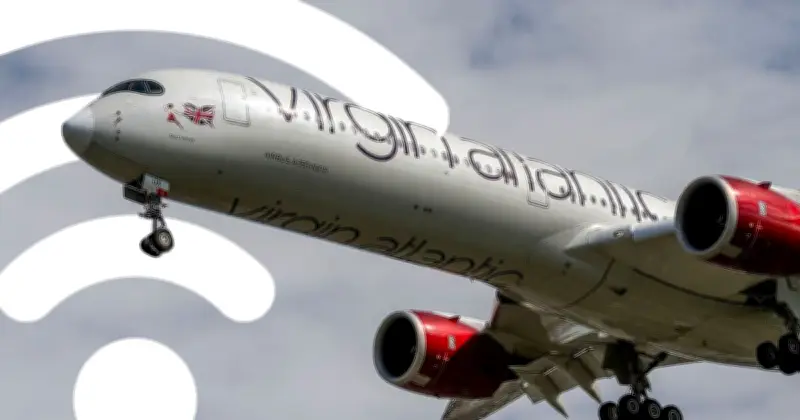
Anyone who has ever taken a flight across the Atlantic Ocean knows the struggle of staying online. Despite most airlines offering onboard Wi-Fi, internet connectivity can be incredibly hit and miss due to slow speeds and constant dropouts. Now, in a bid to keep passengers connected at 38,000 feet, Virgin Atlantic has begun fitting some of its planes with Elon Musk's Starlink technology, which promises downloads in excess of 200Mbps.
First Impressions of Starlink on Virgin Atlantic
With so many technology firms based in the US, I regularly find myself heading across the Atlantic. Not having any Wi-Fi for 10 hours can be extremely stressful, as my job requires me to be constantly online and fully connected. Getting on-board internet access can also be very expensive, with Virgin charging some customers over £25 to switch on full Wi-Fi. That is a high price to pay for a service that is often pretty substandard.
So, when I found out I was travelling on one of the airline's recently updated Airbus A350 aircraft, I was excited to see if it is finally the end of being offline when strapped into an airline seat. These planes have now been fitted with Elon Musk's Starlink system, which uses a massive network of satellites orbiting Earth to keep people connected.
Seamless Connectivity from Gate to Gate
Once onboard, I instantly checked for the Wi-Fi connection. To my surprise, Virgin's new internet service was available before we had even taken off. That was especially helpful given the hour-long delay I faced at the start of my journey. As long as you have a Flying Club account, logging in is completely free and only takes a few minutes.
Whilst sat on the ground at London's Heathrow airport, I streamed the first hour of the F1 race from Monaco and continued to watch the action during taxi and takeoff. Incredibly, the stream never stuttered or stopped, and I watched the entire race without a single glitch.
Speed Test Results: Faster Than Home Broadband
Using Ookla's speed test app, I then measured the Wi-Fi speeds throughout my entire 11-hour journey to San Francisco, and the results were pretty impressive. Although there were moments where things dropped to around 20Mbps, I also witnessed downloads in excess of 200Mbps – that is faster than some home broadband can muster.
With things running smoothly, I was able to work, keep in touch with home and stream videos without any issues. Even when we landed in the US, the Wi-Fi continued to work, and I remained connected right until the seatbelt signs were switched off.
Comparison with Older Aircraft
What made me realise just how good Starlink is was when I got on board Virgin's 787 Dreamliner for my return flight home. These are yet to be upgraded, which meant I had to suffer slow downloads, areas where the internet simply does not work and a bill of £29 for the privilege.
Other airlines, including BA and United, are also rolling out Starlink across their fleets, so it seems getting decent Wi-Fi in the sky will soon be just as good, if not better, than logging in at home. Next time I travel, I am going to check if it is on Virgin's A350 as I never want to fly on another aircraft without Starlink again.