

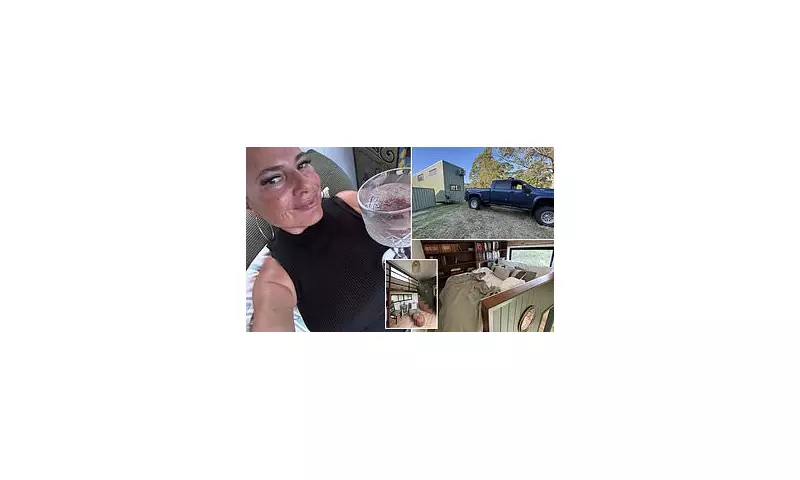
When Eva Bantin and her husband Michael decided to end their 22-year marriage, the prospect of her eventually residing in a compact dwelling at the bottom of his garden seemed far-fetched. Yet, this is precisely the unconventional, yet perfectly functional, arrangement the 50-year-old now enjoys, offering both financial freedom and seamless co-parenting for their two teenage children.
An Amicable Split and a Shared Priority
Eva explained to the Daily Mail that the decision to separate from Michael was mutual, born from a realisation that they had grown apart and cherished different dreams. Following the sale of their four-bedroom family home in Thirroul, New South Wales, in mid-2025, they divided the profits. The central challenge was finding two separate homes that allowed them to effectively co-parent their daughter Stella, 17, and son Jed, 13, without uprooting the children's lives.
"I knew I wanted to explore the world and didn't want to be tied down or put all my money into a mortgage. But I also needed somewhere near the kids," Eva stated, highlighting the dilemma faced by many separating parents.

The Birth of a Backyard Solution
The innovative answer emerged in late 2025 when Michael found a new property with a generous plot in nearby Bulli. While viewing it together, they simultaneously recognised the potential of the spacious backyard. It was the ideal spot for a tiny house—a concept of compact, efficient living that had long fascinated Eva.
These small dwellings, typically between 10 and 50 square metres, have surged in popularity as housing costs soar. For Eva, buying a tiny home and placing it in her ex-husband's garden solved two problems at once: it provided an affordable housing solution from her divorce settlement and kept her immediately accessible for the children.
"It was great for the kids, because it meant we didn't need to be shifting them from house to house, or doing week-on, week-off, or packing a bag or furnishing two places," she said.
Making the Tiny House a Home
Eva connected with The Tiny Agency, whose specialist Bridget Rose put her in touch with Casa Tiny Homes. They had a readymade model that instantly captured Eva's heart. She paid $150,000 for the house, plus $3,000 for delivery and $4,500 for cement footings. The most significant extra cost was $10,000 to plumb the toilet into the main sewer. She now shares utility bills with the main house, while her hot water comes from large LPG gas tanks she changes herself.
Remarkably, no council approval was needed as the structure is technically classified as a caravan. "The only rule is you must be a family member to live in it permanently," Eva noted, advising others to check local regulations which vary by council.
The 9m x 2.4m home is both stylish and practical, featuring:
- A well-equipped kitchen with a stovetop and oven.
- A bathroom with a shower, vanity, and flushing toilet.
- A bedroom with a king-sized bed and a study nook for her remote recruitment business, Eva Bantin Talent.
- An upstairs loft, tall enough to stand in, which holds another king bed and storage for her designer shoes and handbags.
"I had to do some serious Marie Kondo-style decluttering before moving in. Now, everything has its spot and cleaning is easy - the whole house takes 15 minutes flat to clean," she shared.
Boundaries, New Partners, and Future Dreams
To ensure clarity, Eva and Michael signed a formal contract outlining the terms of their living arrangement. They maintain mutual respect and privacy, always texting before visiting each other's space. This setup faced its first test when Michael began a new relationship. His girlfriend was initially apprehensive but, after meeting Eva and understanding the dynamic, her concerns were alleviated.
With no mortgage or rent and minimal bills, Eva feels financially liberated. She now dreams of buying a villa in Italy and splitting her time as a digital nomad between Europe and her Australian tiny house.

Eva acknowledges this solution won't work for every separated couple, but for her family, it has been ideal. "Especially the kids. They love having me out the back. It's meant I'm right here for them. I'm present," she reflected. "My husband has his independence, and I have mine - and it works for our family unit."





