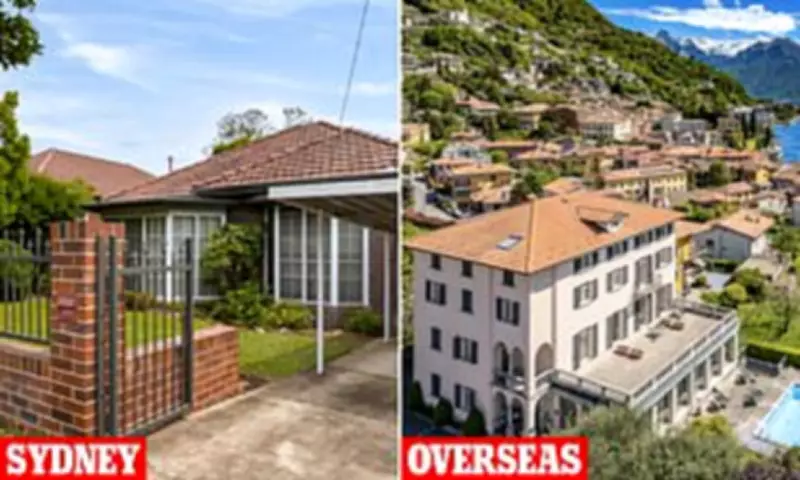
Lake Como Hotel Listing Exposes Stark Contrast with Sydney's Inflated Property Market
A charming 18-room hotel situated on the iconic shores of Italy's Lake Como has been listed for sale at just $3.3 million, a price point that starkly illustrates the extraordinary distortion within Sydney's property market. Lake Como, renowned globally as a playground for billionaires, celebrities, and luxury brands, continues to attract significant investment in high-end tourism. Even smaller boutique properties in its quieter villages are experiencing heightened demand, making this particular offering especially notable.
Postcard-Perfect Italian Hotel Versus Suburban Sydney Home
The hotel presents a fully operational business set against breathtaking Italian scenery, where guests typically pay premium nightly rates at establishments bearing names like Marriott or Ritz-Carlton. For the same $3.3 million, Sydney buyers face a dramatically different reality. Australia's most expensive housing market now sees median house prices exceeding $1.76 million, a figure that increasingly secures only unremarkable suburban family homes.
In numerous Sydney suburbs, $3.3 million might barely purchase a tired property requiring significant renovation on a modest land parcel. The contrast was highlighted recently when a three-bedroom, one-bathroom home in Concord's inner-west sold for exactly $3.3 million. This property featured boldly retro interiors steeped in a 1960s-1970s aesthetic, with real estate agents primarily promoting its location rather than its condition.

Australia's Deepening Housing Affordability Crisis
This dramatic comparison underscores how far buyers' money can stretch overseas while highlighting Sydney's worsening affordability crisis. The 2025 Demographia International Housing Affordability Report ranked Sydney as the world's second-most expensive city for home purchases, trailing only Hong Kong and surpassing Melbourne, Adelaide, and Perth. Alarmingly, the report warned Sydney is on track to overtake Hong Kong this year, potentially becoming the planet's most expensive housing market.
Cotality head of research Gerard Burg revealed Australian households now need to devote approximately 45% of their income to service a new 30-year mortgage. The median price-to-income ratio has ballooned from about 4:1 in 1991 to a record 8.2:1 today. 'Today's challenge is very much directed towards the size of the loan, and by association, the size and time required to save the deposit,' Mr Burg explained, noting this reflects how rapidly home values have increased relative to incomes.
Broader Australian Property Market Pressures
The affordability crisis extends beyond Sydney. In Melbourne, even humble beach boxes—basic sheds by the sand with no power or water, where permanent occupation is prohibited—now command seven-figure price tags. Last month, one such structure sought expressions of interest around $1 million. In April, another beachfront shack sold for $1 million after a bidding war between five buyers pushed the price $350,000 above initial expectations.
Mr Burg noted some Sydney suburbs have increased tenfold in price since 1991, including Leichhardt, Strathfield, and Auburn, severely impacting homeownership pathways. 'Various studies in recent years have shown that the average first home buyer is getting older in Australia,' he said, attributing this trend to house prices growing faster than incomes, requiring longer deposit-saving periods and typically dual incomes to support mortgages.
Generational Shifts and International Alternatives
Homeownership has declined steadily for decades, with nearly one in three Australians now renting. Alarmingly, three out of five renters believe they will never afford their own home. Futurologist Rocky Scopelliti observed that for the first time, young Australians expect to live smaller, not better, than their parents. 'As younger Australians realise they are inheriting both a broken housing market and an ageing fiscal system, the sense of intergenerational inequity is deepening,' he stated.

Meanwhile, in parts of Europe and countries like Japan, house prices have fallen as shrinking birth rates and affordability pressures reduce buyer demand. NSW man Anthony Randall, 52, found owning property in Australia an 'unreachable' goal and purchased an abandoned house (akiya) in Joetsu, Japan, for just $5,000, with stamp duty costing a mere $2. He attributed this opportunity to Japan's declining population, housing oversupply, and rural-to-urban migration leaving millions of properties vacant.
The Lake Como hotel listing serves as a powerful symbol of global property disparities, emphasising the severe challenges within Australia's housing market and the growing perception among Australians that homeownership is becoming an increasingly distant dream.