Glasgow's Historic Union Street Building to be Demolished After Devastating Fire
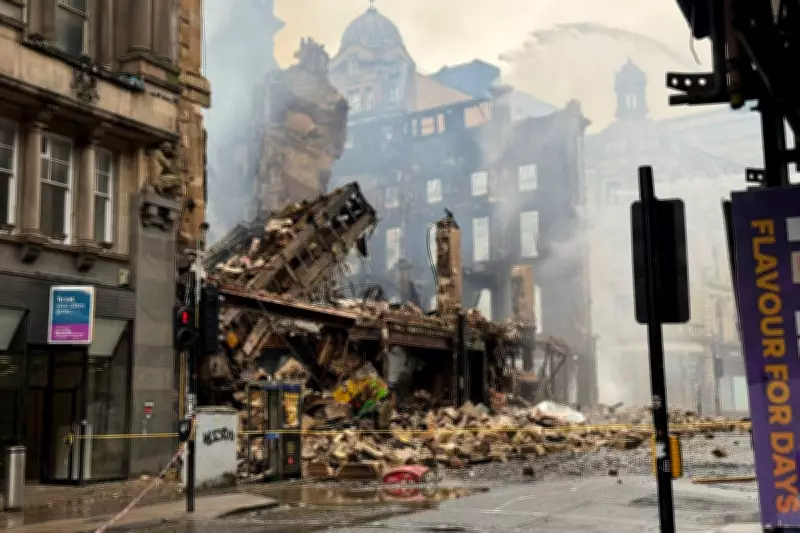
Glasgow City Council has confirmed that the historic Victorian building gutted by a major fire in the city centre will have to be demolished. The B-listed structure on Union Street, adjacent to Glasgow Central station, has continued to collapse in the days following the blaze that broke out on Sunday, March 8, 2026.
In a statement issued on Thursday, March 12, the council announced that after conducting a full and final assessment of the remaining structure, its building standards team determined demolition is necessary in the interests of public safety. "We are now in control of the Union Street site, and after a full and final assessment of the remaining structure, our building standards team have decided that demolition must happen in the interests of public safety," the council stated.
Structural Collapse and Safety Concerns
The fire, which began in a vape shop on Union Street, spread rapidly through the building and around the corner, leaving only the facade at the junction with Gordon Street standing. In the subsequent days, parts of the southern gable collapsed on Tuesday night, demonstrating the ongoing instability of the structure.

The Scottish Fire and Rescue Service remains on site to manage remaining hot spots while preparations for demolition proceed. The blaze forced the closure of neighbouring Glasgow Central station, Scotland's busiest railway hub. While the lower level has resumed services, authorities confirm the main part of the station will remain shut for the remainder of the week.
Political Fallout and Business Support Questions
The fire sparked significant political debate during First Minister's Questions on Thursday. Scottish Conservative leader Russell Findlay pressed First Minister John Swinney on what support the Scottish Government would provide to affected businesses, describing the "inferno" that had "ripped through" the building as "devastating."
"The immediate focus must be on local businesses who already face severe pressure," Mr Findlay stated, calling for clarity on "what support will be provided and when." Mr Swinney responded that the government is in active discussion with Glasgow City Council, which is gathering information from affected businesses, though he could not yet specify what financial support would be available.
Fire Service Resources Under Scrutiny
Scottish Labour leader Anas Sarwar raised serious concerns about fire service capacity, noting that cuts have reduced high-reach appliances across Scotland from 26 to 16, with Glasgow's allocation dropping from six to two. He revealed that both of Glasgow's high-reach appliances were unavailable on Sunday due to annual inspection, requiring one to be called from Edinburgh.
"More than 1,200 firefighter jobs have been lost since the national service was set up in 2013," Mr Sarwar stated, calling for an immediate investigation into whether reduced capacity affected the response. He questioned "why that was ever allowed to happen" and urged the First Minister to "commit to an immediate investigation into any potential impact."
Government Response and Recovery Efforts
In response to the crisis, a cross-Government ministerial board has been established to coordinate the Scottish Government's immediate and longer-term response. Chaired by Justice Secretary Angela Constance, the group will oversee development of a support package for recovery.
The board includes Glasgow City Council leader Susan Aitken and multiple Scottish Government ministers: Deputy First Minister Kate Forbes, Finance Secretary Shona Robison, Transport Secretary Fiona Hyslop, Housing Secretary Mairi McAllan, and community safety minister Siobhian Brown.
Ms Constance emphasized: "The fire has left a scene of ruin in the heart of Glasgow and I am determined that the Scottish Government will stand with the city as it recovers." She acknowledged the challenges of making the site safe, recovering the transport network, and supporting affected businesses, noting that "undoubtedly this will take time" and require "significant effort across Government."

Fire Service Defends Response
Scottish Fire and Rescue Service Assistant Chief Officer David Farries strongly refuted suggestions that inadequate resources hampered the response. "We strongly refute any suggestion that we did not have the necessary resource in place to respond to what was a large and complex building fire," he stated.
He explained that the first high-reach appliance arrived from Coatbridge within 19 minutes, though it wasn't required for external firefighting until almost two hours later, with additional vehicles coming from Johnstone and Kilmarnock. "It is both inaccurate and alarmist to suggest that the provision of our fleet of high-reach appliances had any negative impact on our operational response to this incident," Mr Farries asserted.
The fire service emphasized that high-reach appliances are national resources strategically placed across Scotland, and that incidents of this scale naturally require drawing resources from wider areas—a benefit of having a national service. Mr Farries praised crews who "worked tirelessly in challenging conditions" to prevent further damage to nearby buildings including Glasgow Central station and adjacent hotels.