
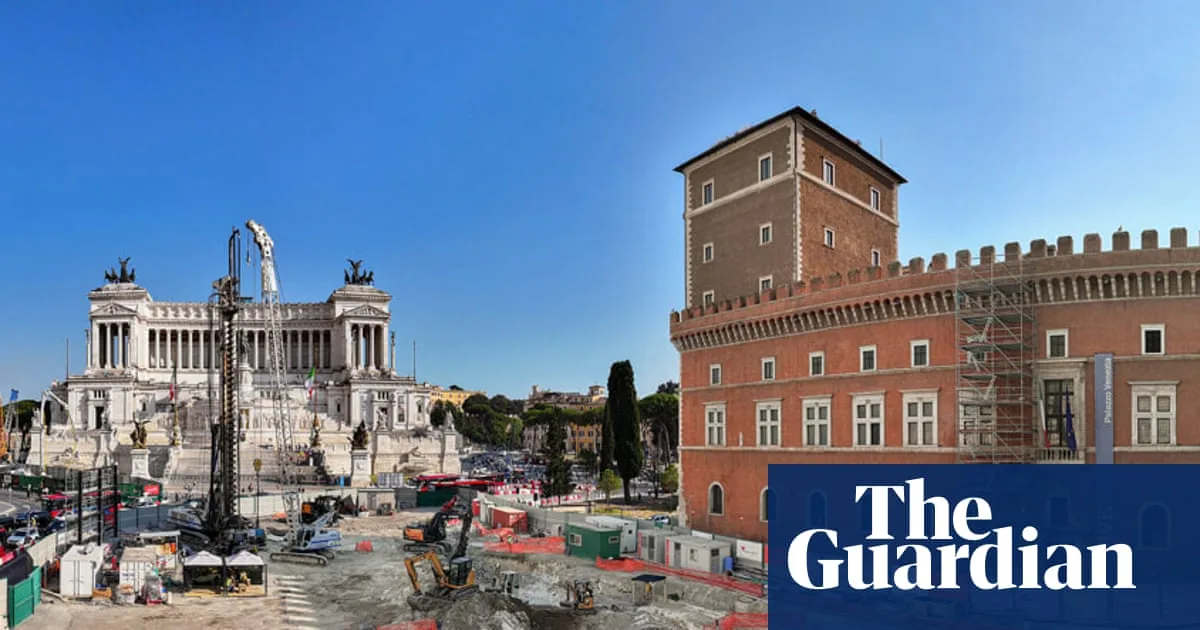
Archaeologists have uncovered the remains of homes believed to have been inhabited by working-class Romans during the early empire, during construction of a new underground station in the heart of the Italian capital. The relics were found beneath the bustling Piazza Venezia, where work began in 2023 on the station that will form part of Rome’s Metro C line.
Experts said the structure appeared to resemble a multistorey complex that would have contained shops and homes occupied by imperial Rome’s working class, dating from between the late Roman republic and the early empire, a period spanning the second and first centuries BC. It is the first archaeological discovery to emerge from the site since construction started.
Daniela Porro, Rome’s special superintendent, said: “Once again, the construction of a metro station makes us rediscover our city’s past.” Marta Baumgartner, an archaeologist involved in the project, added that the discovery “represents an extraordinary opportunity to learn about the historical topography of central Rome”.
The station at Piazza Venezia was first envisaged 25 years ago as part of the Metro C extension, which will connect Rome’s suburbs with San Giovanni. Progress had previously been delayed by corruption inquiries, a lack of funding and the discovery of relics including the remains of Emperor Hadrian’s auditorium. New funding has revived the project, which is being built by a joint venture between Webuild and Vianini Lavori, with stops at the Roman Forum-Colosseum before reaching Piazza Venezia and later heading towards the Vatican.
The line’s extension is designed to relieve traffic-clogged streets in central Rome. The station will also feature an 85-metre-deep underground museum filled with archaeological objects found during construction. It will include 27 escalators, six lifts and corridors connecting the above-ground Palazzo Venezia, the Vittoriano and the ruins of the Roman Forum. The project is expected to be completed in nine years.




