

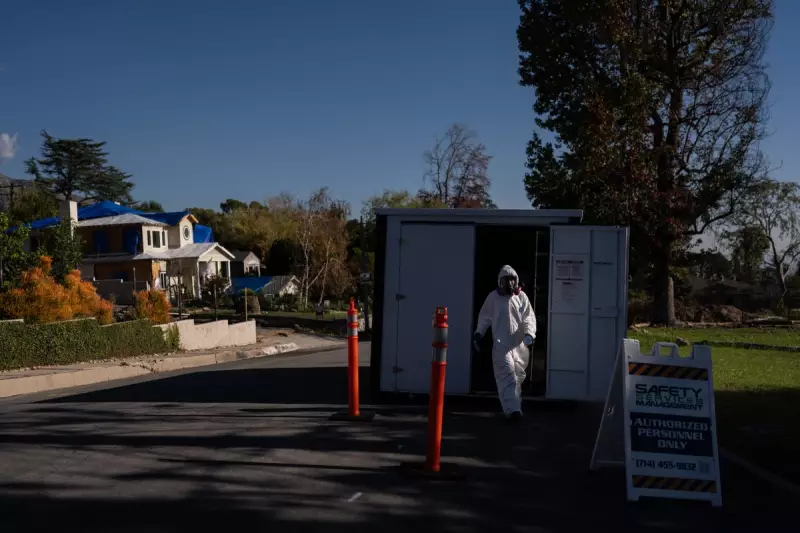
Residents of Los Angeles are confronting a persistent and invisible threat one year after the most devastating wildfires in the region's history tore through communities. While the flames have long been extinguished, a toxic legacy of lead, asbestos, and dangerous chemicals continues to poison homes that survived the blazes, creating an ongoing public health emergency.
A Home Turned Hazard Zone
In the neighbourhood of Altadena, signs warning of 'DANGER: Lead Work Area' are a common sight on front doors. The warnings are stark, noting risks of fertility damage, harm to unborn children, and central nervous system damage. For homeowners like Nina and Billy Malone, whose house of two decades was infiltrated by smoke and ash, these are not abstract warnings but a daily reality. Despite professional cleaning, recent tests found dangerous levels of lead still present on their wooden floors.
Forced to move back last August after their insurance stopped covering temporary housing, the couple now suffers from constant health issues. Nina experiences daily sore throats and headaches, while Billy's wheezing and congestion have worsened, requiring an inhaler. Their bedroom, Nina says, permanently smells "like an ashtray has been sitting around for a long time." Their story is tragically common.

Data Reveals Widespread Contamination
A November report from the volunteer group Eaton Fire Residents United paints a grim picture of the scale of the problem. Based on data from 50 homeowners who have cleaned their properties, the study found that six out of ten smoke-damaged homes still contain hazardous levels of cancer-causing asbestos, brain-damaging lead, or both.
Alarmingly, 63% of those homes had lead levels exceeding the US Environmental Protection Agency's safety standard, with average readings nearly 60 times higher than the limit. The contamination stems from a 'toxic soup' of incinerated materials—cars, electronics, paints, and plastics—that settled as ash. Experts believe lead from old paint, common in homes built before 1979, is a primary culprit.
"For individuals that are pregnant, for young children, it’s particularly important that we do everything we can to eliminate exposure to lead," emphasised Dr. Lisa Patel, a paediatrician and executive director of the Medical Society Consortium on Climate and Health. She stressed the same urgent approach is needed for asbestos, as no level of exposure is safe.
Insurance Battles and a 'Gruelling' Recovery
The physical cleanup is only half the battle. Homeowners are locked in exhausting disputes with insurance companies over what constitutes a proper remediation. Many insurers are refusing to pay for comprehensive contamination testing or for cleaning up toxins that are not federally regulated.
Zoe Gonzalez Izquierdo, a mother of two young children in Altadena, cannot get her insurer to fund an adequate cleanup despite tests showing dangerous lead levels. "They can’t just send a company that’s not certified to just wipe things down so that then we can go back to a still contaminated home," she stated.
This leaves residents like the Malones facing impossible choices. Their insurance won't pay the $10,000 needed to retest their home, and even if they pay themselves and find more toxins, coverage may only extend to regulated substances like lead and asbestos. "I don't know how you fight that," said Nina, who is considering therapy for her anxiety.
Annie Barbour of the non-profit United Policyholders, a survivor of the 2017 Tubbs Fire, witnesses the profound mental health toll. Many who were initially relieved their homes stood are now in "their own special kind of hell," navigating a labyrinth of insurance claims and living in fear.
As resident Julie Lawson poignantly summarised, "We have to live in the scar." The community faces years of rebuilding, both structurally and socially, with the trauma of the fires replaced by the chronic stress of an unresolved toxic crisis. For thousands in Los Angeles, the disaster is far from over.






