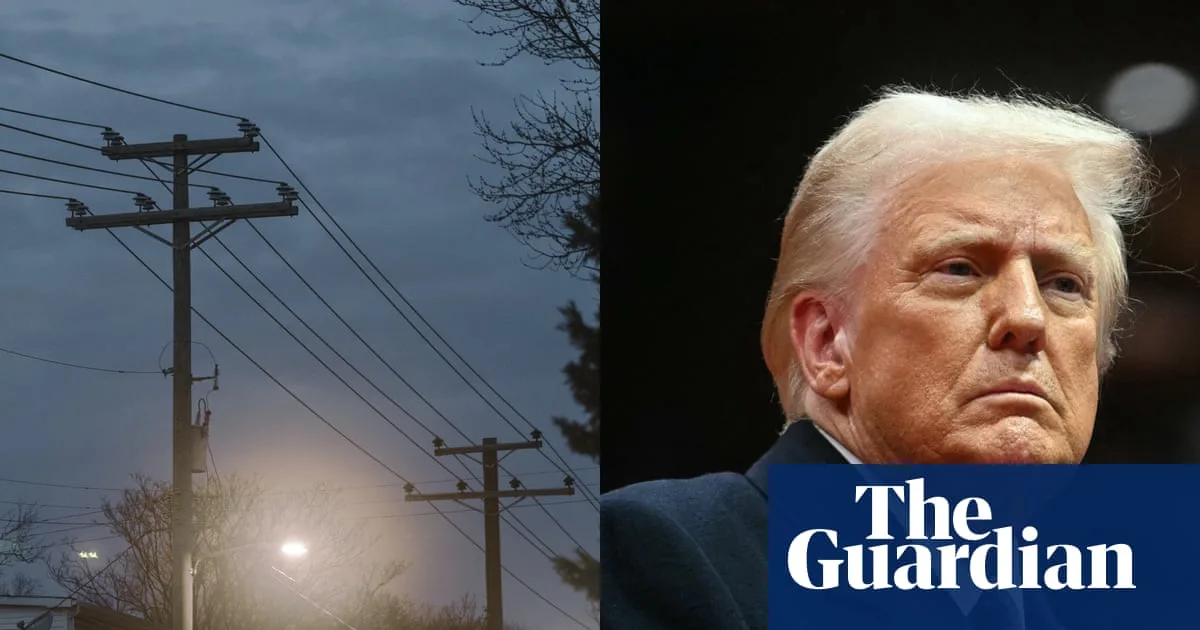
Donald Trump has comprehensively failed to meet a key election promise to slash Americans’ energy bills in half within the first year of his presidency, with power prices instead surging across the US. The average household electricity bill in the US was 6.7% more expensive in 2025 compared with the previous year, according to a Guardian analysis of data from the Energy Information Administration (EIA). The increases meant that, on average, US households paid nearly $116 more across 2025 than they did in 2024.
The power bill increases have been extreme in many parts of the US, with residents of Washington DC experiencing the biggest increase, a 23% jump in electricity costs, followed by Indiana, with a 17% rise, and then Illinois, with a 15% increase, the EIA data shows. The midwest is the region of the US that has been hit by the steepest bill rises, which include utility costs laden on top of an underlying 4.9% average increase in the unit cost of the electricity itself.
On top of soaring electricity bills, US households have also been confronted by rising gas prices, which have jumped 5.2% on average in the past year, according to the EIA. As a result, there has been a spike in power disconnections for unpaid bills across many states – in New York the rate of disconnections rose fivefold from a year previous – with some households having to forgo other essentials in order to keep the lights on.
This all means that, with just days until the first anniversary of his inauguration, Trump has missed his self-imposed target of cutting bills in half in his first year. The president’s promise to slash power bills was, along with similar pledges to cut grocery costs and to reduce immigration to the US, a key pillar of his 2024 election triumph.
“You have some states where the power bills are instead up 10% or 20%, which is why so many people are angry about this now,” said Mark Wolfe, executive director of the National Energy Assistance Directors Association (NEADA). “Instead of reducing electric bills by 50%, the president’s actions have raised the cost of home energy for all Americans. It used to be the poorest Americans who struggled with their power bills, but now we are seeing more and more middle-income families who have to make sacrifices to avoid being shut off.”