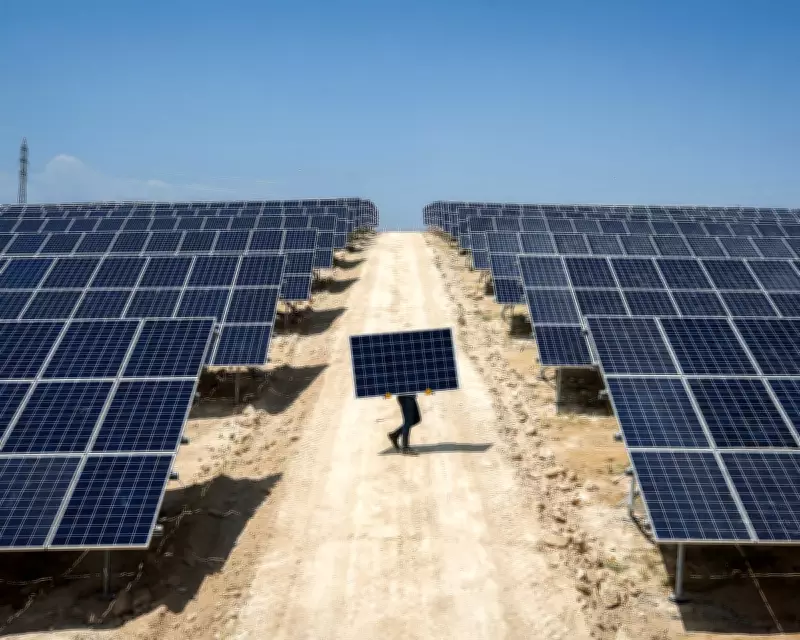
Turkey Outpaces EU in Battery Storage Approvals for Clean Energy Grid
Turkey has granted approval for more battery storage capacity to support its electricity grid than any European Union member state, according to a recent report. This development highlights a shift where developing nations are accelerating their clean technology adoption, potentially leaving richer countries behind in the global energy transition.
Massive Investment in Battery Capacity
Since 2022, Turkey has approved over 33 gigawatts (GW) of battery capacity, as reported by the climate thinktank Ember. In contrast, leading EU countries such as Germany and Italy, which began deploying battery storage earlier, have a combined planned and operational capacity of only 12-13GW. This disparity underscores Turkey's aggressive push to enhance its renewable energy infrastructure.
Ufuk Alparslan, an analyst at Ember and author of the report, noted that policy decisions in Turkey have created a "massive investment signal" in battery storage, surpassing its European peers. He stated, "If delivered, Turkey's battery pipeline will be the backbone of a new, clean regional energy hub."

Driving Factors Behind Turkey's Battery Boom
The surge in battery projects stems from a 2022 mandate that provides preferential grid access to renewable energy sources paired with equivalent storage capacity. Of the 221GW of battery storage in submitted applications, Turkey has approved 33GW, which is equivalent to 83% of its current wind and solar capacity. Romania is the only EU country with a higher ratio of approved storage relative to renewables.
Batteries play a crucial role in amplifying the benefits of weather-dependent renewable technologies, such as wind turbines and solar panels. By storing electricity for release during cloudy or windless periods, they reduce reliance on fossil fuels and enhance grid stability.
Global Context and Economic Opportunities
Greg Nemet, an energy researcher at the University of Wisconsin-Madison, highlighted that the "dramatic" growth of solar and batteries in countries like Turkey has been driven by a nearly 90% cost reduction over the past decade. He explained, "Cheap solar and batteries create a tremendous opportunity for creating a cheap, clean, and reliable energy system. Countries like Turkey are taking advantage of that."
Turkey currently generates about one-fifth of its power from wind and solar, exceeding any country in the Middle East or Central Asia but still below the European average. However, it continues to support coal, which accounted for 34% of its electricity last year due to extensive subsidies. The country aims to increase its installed wind and solar capacity from 40GW to 120GW by 2035, though it fell short of its annual target by adding only 6.5GW last year instead of the required 8GW.
Challenges and Future Prospects
Despite the progress, Turkey faces several hurdles in realizing its battery storage ambitions. These include permit bottlenecks and a reliance on spot electricity market prices. Additionally, Turkey has a less urgent need for large-scale batteries compared to many European countries, thanks to its extensive hydropower dams that provide clean base-load power.
Alparslan commented that Turkey's approach appears "somewhat overcautious, rather than fully forward-looking," but emphasized that the country has nonetheless sent a strong investment signal that exceeds those of its European counterparts. This comes as Turkey prepares to host the Cop31 climate summit in Antalya in November, where early drafts of its action agenda have notably omitted mention of fossil fuel phaseouts discussed at previous summits.
European energy experts have called for increased investment in electricity grids and battery storage to cut pollution, lower bills, and reduce dependence on foreign autocrats. These calls have gained urgency following recent geopolitical tensions, such as the Iran war, which have exacerbated fossil fuel crises.
In summary, Turkey's rapid approval of battery storage capacity positions it as a leader in the clean energy transition, outpacing EU nations and setting a precedent for other developing countries to follow in leveraging falling technology costs to build sustainable energy systems.