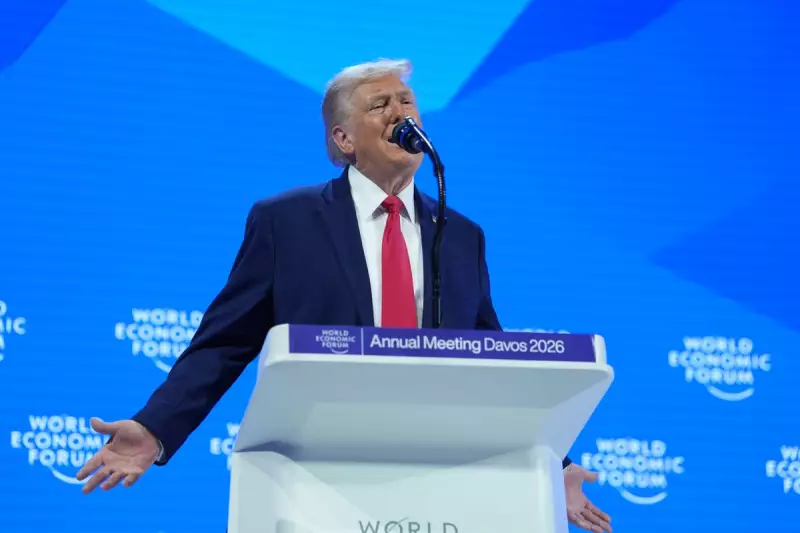
Former United States President Donald Trump has delivered a blistering critique of Britain's approach to energy production and immigration policies during his appearance at the prestigious World Economic Forum in Davos, Switzerland. The controversial political figure, who has repeatedly denounced what he terms the green energy "scam," specifically targeted Sir Keir Starmer's administration for its handling of North Sea oil and gas resources.
Energy Policy Under Fire
In a wide-ranging address to international delegates gathered in the Swiss Alps, Mr Trump claimed that the United Kingdom government has created conditions that make it "impossible" for petroleum companies to properly exploit North Sea reserves. The former president presented dramatic statistics to support his argument, asserting that Britain now produces merely one-third of the total energy from all sources compared to 1999 levels.
"They're sitting on top of the North Sea, one of the greatest reserves anywhere in the world, but they don't use it," Mr Trump told reporters during his Davos appearance. "That's one reason why their energy has reached catastrophically low levels, with equally high prices."

Controversial Claims About Reserves
The former American leader challenged conventional wisdom about North Sea depletion, making the extraordinary claim that the region contains sufficient resources to last five centuries. "They like to say, 'Well, you know, that's depleted'. It's not depleted. It's got 500 years. They haven't even found the oil, the North Sea is incredible," he stated emphatically.
Mr Trump further criticised what he described as excessive taxation and regulatory barriers, alleging that the UK government takes 92% of revenues from oil companies. "They don't let anybody drill, environmentally, they don't let them drill. They make it impossible for the oil companies to go," he argued, suggesting this approach has led energy firms to conclude "We can't do it."
Environmental Campaigners Respond
Environmental organisations have swiftly condemned Mr Trump's remarks, with Greenpeace UK's Lily-Rose Ellis describing his knowledge of North Sea oil and gas as "a tottering pile of lies." She added that "The UK Government can safely ignore advice from a climate denier bankrolled by the fossil fuel industry."
Friends of the Earth's Mike Childs offered a similarly critical perspective, stating: "The only people who benefit from backtracking on climate action are the polluters, billionaires and powerful vested interests profiting from fossil fuels."
Broader Critique of European Policies
Beyond energy matters, Mr Trump's occasionally rambling address included sharp criticism of European immigration policies, suggesting that mass migration has fundamentally altered the continent's character. "Certain places in Europe are not even recognisable, frankly, anymore. They're not recognisable," he claimed, adding that friends return from European destinations saying "I don't recognise it" in what he characterised as a negative context.
The former president expressed concern about what he described as conventional wisdom in Western capitals promoting "ever-increasing government spending, unchecked mass migration and endless foreign imports." He particularly criticised what he termed the replacement of affordable energy with "the green new scam" and the notion that countries could be sustained by "importing new and entirely different populations from far away lands."
Transatlantic Tensions
Mr Trump's comments have further highlighted the growing transatlantic divisions that have emerged during his political career, particularly regarding trade policies and his previously stated ambition to acquire Greenland. Despite these criticisms, he maintained that "I love Europe and I want to see Europe go good," while simultaneously asserting that the continent "is not heading in the right direction."
The Davos appearance also provided the former president with a platform to highlight what he described as significant achievements during his initial years back in the White House, though these claims were juxtaposed against his pessimistic assessment of European policy directions.