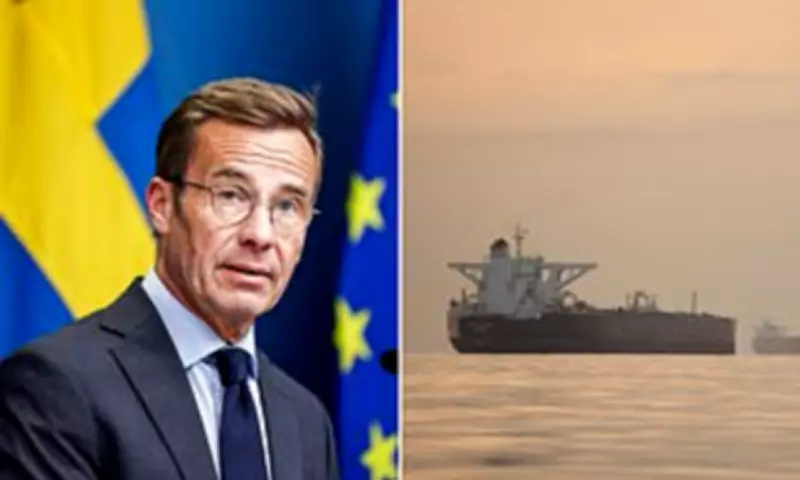
Sweden's government stated on Thursday that the country might need to ration fuel in the coming months as the war in Iran has a 'significant impact' on the economy. Speaking at a press conference, Prime Minister Ulf Kristersson said: 'We're not planning right now for any rationing. But we are prepared for that possibility, and in such case we will provide information well in advance.'
He noted that the effects of the Iran war on the Swedish economy had escalated from 'limited impact' to 'significant impact'. Kristersson warned of risks of higher inflation and a slowdown in growth. Finance Minister Elisabeth Svantesson described the situation as 'the worst crisis in a very, very long time when it comes to energy.'
The government has already implemented measures to cushion the economic blow for households, including sharp cuts in taxes on petrol and diesel. No new measures were announced on Thursday, but Svantesson stated that if the war persists, 'fuel rationing could be a possibility, but first we would issue a recommendation to conserve fuel' and prioritize public transport. She also mentioned that Sweden may need to boost its own energy production from solar, wind, hydro, and nuclear power.

Global Energy Crisis Intensifies
The escalating standoff in the Strait of Hormuz, a critical passage for about a fifth of the world's oil and gas, has driven oil and gas prices to soar, affecting economies worldwide. Global concerns over energy security have prompted some countries to adopt mitigating strategies since March to combat rising fuel prices.
Egypt announced last month that shops, restaurants, and shopping malls would close early each night for at least a month to reduce costs. Sri Lanka introduced a four-day working week to conserve fuel. Bangladesh imposed rolling blackouts and adjusted holiday schedules, while the Philippines limited non-essential travel for public sector workers.
Slovenia became the first EU member state to introduce fuel rationing due to shortages caused by stockpiling linked to the Iran war. Fueling at individual service stations was restricted to 50 litres per day for private vehicles and 200 litres for companies and priority users such as farmers.
UK and EU Face Fuel Shortages
Last week, a former BP boss urged UK ministers to encourage working from home amid looming shortages. Professor Nick Butler, a former adviser to Gordon Brown and ex-Vice President of BP, warned that Britain could face shortages within weeks as the Strait of Hormuz remains partially closed. He criticized Labour for being 'complacent' and failing to outline a plan to address potential shortages, noting that other countries are taking action.
Meanwhile, holiday plans have been disrupted as two major European airlines cancelled hundreds of flights due to soaring fuel costs from the Middle East war. Lufthansa announced that its regional subsidiary, Lufthansa CityLine, would suspend operations from Saturday due to high kerosene prices and a labor dispute. KLM cancelled 160 flights in the next month for similar reasons.
The International Energy Agency (IEA) warned that Europe has 'maybe six weeks' of jet fuel remaining amid continued instability. The EU is now considering requiring countries to hold stockpiles of jet fuel and potentially redistribute it based on regional needs, according to Europe's energy policy chief Dan Jorgensen. 'We will be able to, if necessary, introduce redistribution tools and other things that we don't normally do in this sector,' he said in an interview.
Escalation in the Strait of Hormuz
The standoff in the Strait of Hormuz has effectively shut down the waterway. Earlier this week, Donald Trump extended his ceasefire with Iran for the fourth time without setting a deadline but maintained an American blockade of Iranian ports. In a new escalation, Trump demanded the US Navy 'shoot and kill' any Iranian boat laying mines in the Persian Gulf. He wrote on Truth Social: 'I have ordered the United States Navy to shoot and kill any boat, small boats though they may be (Their naval ships are ALL, 159 of them, at the bottom of the sea!), that is putting mines in the waters of the Strait of Hormuz. There is to be no hesitation. Additionally, our mine “sweepers” are clearing the Strait right now. I am hereby ordering that activity to continue, but at a tripled up level!'