Oil Prices Surge Past $114 a Barrel as Iran War Disrupts Middle East Supply
Crude oil prices have surged dramatically, surpassing $114 per barrel on Monday, as the intensifying conflict in Iran continues to severely disrupt oil production and shipping operations across the Middle East. This marks the first time since 2022 that prices have reached such elevated levels, driven by escalating hostilities that threaten critical energy infrastructure.
Sharp Increases in Benchmark Crude Prices
The price for a barrel of Brent crude, the international benchmark, surged past $114 when trading resumed on the Chicago Mercantile Exchange. This represents a substantial 23% increase from its Friday closing price of $92.69. Similarly, West Texas Intermediate, the light, sweet crude oil produced in the United States, was also selling for approximately $114 a barrel, which is 25% higher than its close on Friday at $90.90.
These sharp increases follow a week of significant volatility, with U.S. crude prices jumping by 36% and Brent crude rising by 28% last week alone. The war, now in its second week, has ensnared numerous countries and regions that are vital to the production and transportation of oil and gas from the Persian Gulf.

Disruption to Critical Shipping Routes
Roughly 15 million barrels of crude oil, accounting for about 20% of the world's daily oil supply, typically pass through the Strait of Hormuz each day, according to independent research firm Rystad Energy. However, the threat of Iranian missile and drone attacks has effectively halted tanker traffic through this crucial strait, which is bordered to the north by Iran and serves as a key conduit for oil and gas exports from Saudi Arabia, Kuwait, Iraq, Qatar, Bahrain, the United Arab Emirates, and Iran itself.
In response to the reduced ability to export crude, countries such as Iraq, Kuwait, and the UAE have cut their oil production as storage tanks reach capacity. Additionally, attacks on oil and gas facilities by Iran, Israel, and the United States since the war began have further exacerbated supply concerns.
Impact on Global Markets and Inflation
The global surge in oil prices, triggered by the initial attacks on Iran by Israel and the U.S. on March 1, has rattled financial markets worldwide. There are growing fears that higher energy costs will fuel inflation and reduce consumer spending, particularly in the United States, where consumers are a primary driver of economic activity.
Tokyo's benchmark Nikkei 225 index plunged more than 7% early Monday, while other international markets also experienced significant declines. In the U.S., stock index futures, which serve as a bellwether for market performance, fell late Sunday, indicating that Wall Street's main indexes were poised to open lower on Monday. The future for the S&P 500 was down 2.2%, the Dow's future fell 2.3%, and the Nasdaq composite future dropped 2.6%.
Rising Fuel Prices and Economic Concerns
In the United States, the average price for a gallon of regular gasoline rose to $3.45 on Sunday, an increase of approximately 47 cents from the previous week, according to AAA motor club. Diesel fuel was selling for about $4.60 a gallon, marking a weekly increase of around 83 cents.
Energy Secretary Chris Wright, speaking on CNN's "State of the Union," expressed optimism that U.S. gas prices would return to under $3 per gallon "before too long." He added, "Look, you never know exactly the time frame of this, but, in the worst case, this is a weeks, this is not a months thing." However, some analysts and investors warn that if oil prices remain above $100 per barrel, it could place unsustainable pressure on the global economy.
Human Toll and Further Supply Threats
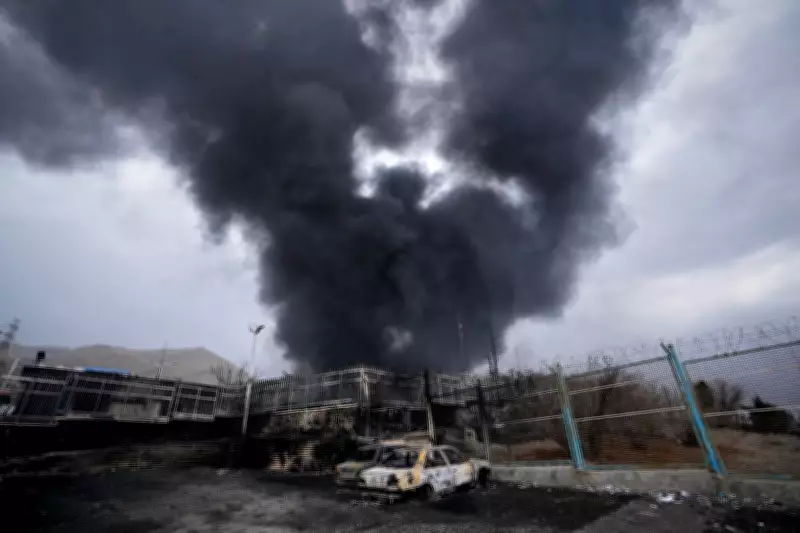
The war's toll on civilian targets escalated early Monday, with Bahrain accusing Iran of striking a desalination plant crucial to drinking water supplies. Additionally, oil depots in Tehran were left smoldering following overnight Israeli strikes. Iranian authorities reported that these strikes killed four people, while Israel's military claimed the depots were being used by Iran's military to fuel missile launches.

Mohammad Bagher Qalibaf, the speaker of Iran's parliament, warned that the war's impact on the oil industry could spiral further. Iran exports roughly 1.6 million barrels of oil daily, primarily to China. If these exports are disrupted, China may need to seek alternative suppliers, potentially driving energy prices even higher.
Broader Energy Market Effects
The price of natural gas has also climbed during the conflict, though not as sharply as oil. It was selling for about $3.33 per 1,000 cubic feet late Sunday, which is 4.6% higher than its Friday closing price of $3.19, after rising approximately 11% over the previous week.
This situation echoes the last time Brent and U.S. crude futures traded near current levels, which was in 2022 following Russia's invasion of Ukraine. The ongoing volatility underscores the fragility of global energy markets in the face of geopolitical instability.