The Skoolie Revolution: Americans Swap Houses for Converted School Buses
In an era of escalating property prices and financial pressures, a remarkable trend is gaining momentum across the United States. A growing number of Americans, particularly from younger generations, are abandoning traditional brick-and-mortar homes in favour of a more nomadic existence. They are transforming decommissioned yellow school buses – fondly remembered from childhood – into fully functional, mobile living spaces. This movement, known as the "skoolie" lifestyle, represents a creative response to the housing affordability crisis sweeping the nation.
Escaping the Housing Crunch
The driving force behind this unconventional shift is stark economic reality. Official data reveals a daunting gap between incomes and property values. The national average home price in the U.S. reached $522,200 in May 2025, according to the U.S. Census Bureau and Department of Housing and Urban Development. This stands in sharp contrast to the median household income of $83,730 recorded in 2024. For many millennials and Gen Z individuals, the dream of homeownership feels increasingly out of reach, prompting a search for viable and affordable alternatives.
The skoolie phenomenon has flourished online, with thousands of enthusiasts documenting their conversion projects on platforms like TikTok, YouTube, and Reddit. These digital narratives often paint an idyllic picture of low-cost, carefree living, untethered from mortgages and permanent addresses. However, those who have embarked on this journey reveal a far more complex and demanding reality.

Personal Journeys onto the Open Road
The paths to bus life are as varied as the individuals who choose it. For some, it begins with a specific dream. Jessica Krupski and Daryl O'Brien, both 39, were motivated by a goal to visit every national park in the United States. After considering various vans and recreational vehicles, they settled on a school bus, attracted by its durability, low mileage, and affordable price tag of $4,500, sourced via Facebook Marketplace.
For others, like 30-year-old travel nurse Alyssa Peterson, the decision was pragmatic. Seeking a living arrangement that could move with her between short-term hospital assignments, she flew from South Dakota to San Diego with $8,000 in cash to purchase a bus she found listed on Craigslist.
Not every story starts smoothly. Influencers Jess Elena and Jake Gomez, both 25, faced significant early setbacks. After deciding a van was too small, they turned to a government auction for old school buses. Their first purchase suffered a catastrophic engine failure just 20 miles from the auction site. A second bus failed inspection, presenting them with a daunting $20,000 estimate for an engine replacement, all without a warranty.
The Daunting Reality of DIY Conversion
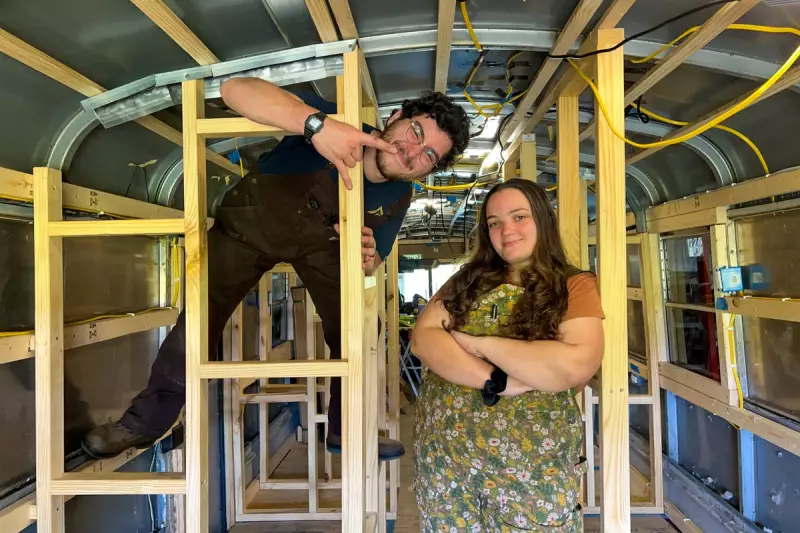
Regardless of their starting point, a common thread unites these skoolie pioneers: a near-total lack of prior experience in vehicle conversion. The process invariably begins with a complete gutting of the bus. "We tore everything out," Krupski explained. "The flooring, the walls, the insulation. We took out every single window, resealed them, cleaned them up, made sure they were functioning, and then we started building."
This monumental task forces owners to become jacks-of-all-trades. While O'Brien had a background in electrical engineering and plumbing, neither he nor Krupski had carpentry skills. They, like many others, turned to a patchwork of resources. "I started with a book called The DIY Skoolie Guide," O'Brien said. "It was dated, but it gave us a starting point. Then YouTube and other creators showed us different approaches we could adapt."
Elena and Gomez also relied on trial and error, with only Elena's background in college set design offering a slight advantage. "Every step on a bus project is equivalent to a technical profession," Elena noted. "You have to spend hundreds of hours researching just to make sure you don't set your bus on fire — or that it's structurally sound."

Life on Wheels: Freedom and Friction
After four and a half years of intensive construction, Elena and Gomez were eager to finally inhabit their mobile home. While they cherished the freedom bus life offered, practical challenges emerged immediately. They prioritised installing a shower to avoid public facilities and soon grappled with issues of stabilisation while driving, as drawers flew open and furniture shifted.
Parking proved to be one of the most persistent headaches. "Can we even get the bus there?" Elena questioned. "What's the road like? Is it uphill? Full of potholes? Are there sharp turns? Is there room for another car to pass? That was the real problem."
For Alyssa Peterson, the constraints of her nursing career ultimately made bus life unsustainable. The need to park within commuting distance of hospitals severely limited her options. "I was really restrictive on where I could park," she admitted. "If I had a different career and a more vagabond lifestyle, it might've worked, but I had to be in specific places at specific times." She eventually transitioned to a fifth-wheel trailer, though she expresses no regret about her two-year skoolie experiment.
More Than Just a Home
The skoolie movement transcends mere economics. While often portrayed online as a simple, low-cost alternative, the lived experience demands immense resilience, burgeoning technical skill, and constant problem-solving. For its adherents, the converted bus is not just shelter; it is a profound experiment in self-reliance and independence. This lifestyle fundamentally reshapes one's relationship with space, stability, and the very definition of living freely. It represents a bold, hands-on rejection of conventional norms in pursuit of a life designed on one's own terms.