

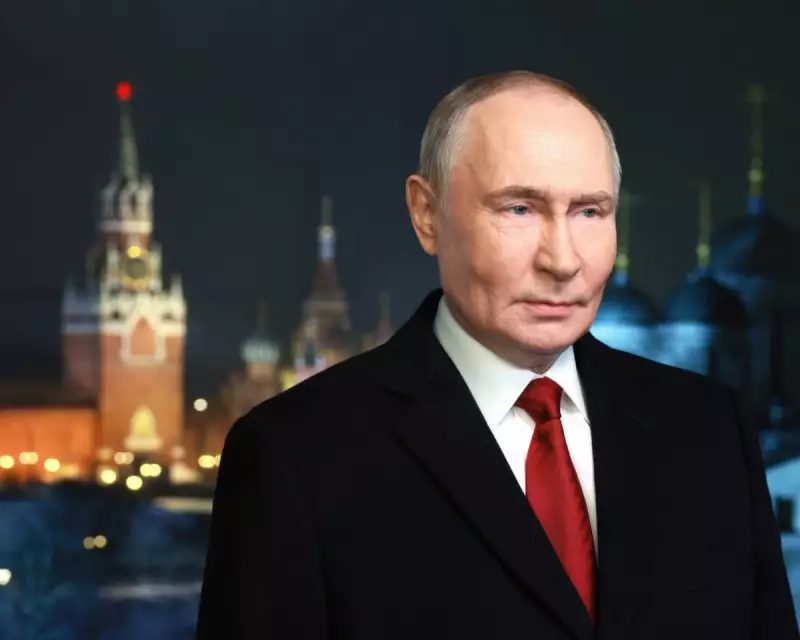
As Vladimir Putin paced the Kremlin on New Year's Eve, global events far beyond Moscow's borders held significant implications for Russia's financial fortress. The potential revival of Venezuela's vast oil industry, spurred by US political manoeuvres, threatened to flood the market and depress the crude prices that have long lubricated the Russian state.
The Illusion of a House of Cards
For years, optimists predicting the downfall of Putin's regime have portrayed the Russian economy as a precarious house of cards, vulnerable to the right gust of economic pressure. They argue that after four years of conflict in Ukraine, a combination of tougher sanctions and lower oil prices could catastrophically squeeze Moscow's ability to fund its war machine.
On the surface, the indicators seem to support this view. Economic growth, initially spurred by rampant military spending, has slowed to almost zero as the government battles the inflation that expansion caused. The International Monetary Fund projects a meagre 0.6% growth for 2025. Interest rates stand at a punishing 20%, taxes are rising, and a severe labour shortage—exacerbated by military conscription and a brain drain—has pushed unemployment down to just 2%.

The Kremlin's Economic Rewiring
Yet, this analysis fundamentally underestimates the Kremlin's drastic and largely successful efforts to rewire its economy for wartime endurance. While oil revenues have indeed fallen from 50% to 25% of state income, Putin has plugged the gap by turning inwards, imposing higher taxes on households and businesses to fill the void left by spent reserves.
Richard Connolly of the Royal United Services Institute (RUSI) thinktank notes the critical shift in narrative: "The Kremlin has succeeded in selling the war, not as a battle with its near neighbour... but as a war with the west." On the impact of sanctions, he adds, "We are not near the economy being a decisive factor in the Kremlin's thinking about how to pursue the war."
The broader Russian strategy resembles a medically induced coma—deliberately slowing economic activity to insulate the state from external shocks. Key metrics remain surprisingly robust by international standards:
- Debt-to-GDP ratio is below 20%, compared to the UK's ~95%.
- The annual spending deficit is set to hit 3.5%, modest against the UK's 11% deficit during the Covid pandemic.
- Inflation, which soared post-invasion, has been tamed to around 6%, nearing the central bank's 4% target.
Sanctions Pressure and the Shadow Fleet
Western efforts have not been without effect. Following the 2022 invasion, Russia assembled a vast "shadow fleet" of over 400 secondhand vessels to circumvent oil shipping sanctions. However, this fleet's capacity has halved since 2024, forcing greater reliance on European-insured vessels. A tougher line from financial centres like London on insurance could severely hit Russian oil revenues.
Furthermore, traditional partners are wavering. India is beginning to turn away under a stricter sanctions regime, though China remains a steadfast buyer and North Korea a supplier of military kit. The recent US sanctions on giants like Rosneft and Lukoil have also bitten.
Ultimately, Putin is milking the Russian economy to aid the war effort, creating a junkyard of ageing industry with little regard for the long term. But in the short term—this year and likely next—he possesses the internal resources to continue funding the conflict without fearing economic collapse. The message for Europe is clear: while tightening the tourniquet on Russian trade is essential, hoping for economic collapse is a delusion. The focus must remain on bolstering Ukraine's military resistance to bring a decisive end to the war.






