

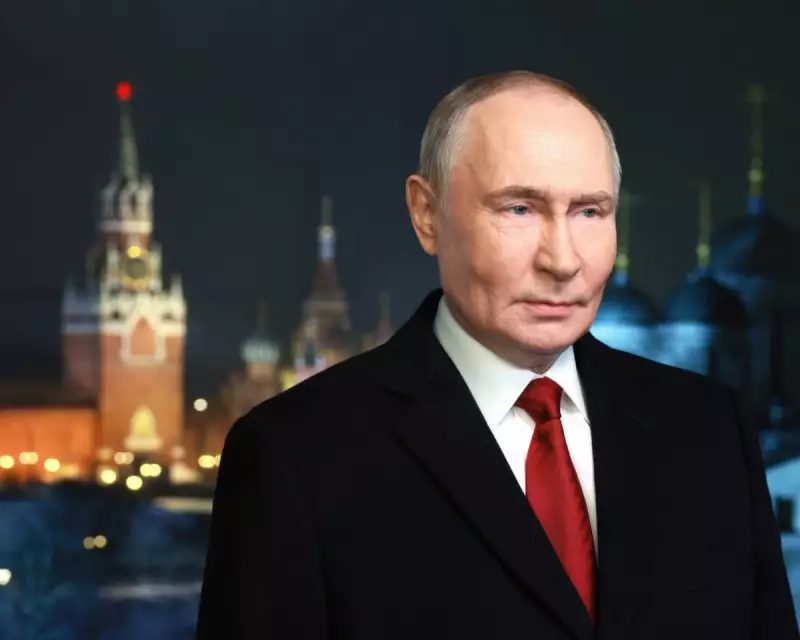
As Vladimir Putin paced the Kremlin on New Year's Eve, global attention was diverted by events in Venezuela. Yet for the Russian president, the potential implications for the world oil price were likely a more pressing concern. For decades, crude oil has been the primary lubricant for Russia's economic engine, far surpassing revenue from gas exports to Europe. The prospect of falling prices, triggered by US moves to control Venezuelan oil rigs, represents a significant threat to Moscow's war chest.
The Precarious House of Cards Theory
Optimistic analysts in the West have long portrayed the Russian economy as a fragile house of cards, vulnerable to concerted economic pressure. They argue that after four years of conflict in Ukraine, Putin's financial position is increasingly precarious. A sharp decline in oil prices, they contend, could catastrophically impair his ability to fund the ongoing war and wear down Ukrainian resistance.
The economic indicators appear to support a narrative of strain. Growth, initially spurred by massive government military spending, has slowed to almost zero as the Kremlin attempts to curb the resulting inflation. The International Monetary Fund predicts a modest 0.6% growth for 2025 and 1% for 2026. Interest rates remain punishingly high at nearly 20%, with further tax rises planned for this year. A severe labour shortage, exacerbated by military conscription, a demographic decline, and an exodus of families, has pushed unemployment down to an artificial low of around 2%.

Household incomes, boosted by welfare spending, are now expected to stagnate. Analyst Marek Dabrowski of the Bruegel thinktank notes that recent budget cuts have shifted burdens to regional governments and reduced pension spending, with education also facing reductions. The business climate offers little incentive for investment.
Kremlin's Economic Rewiring and Resilience
However, this analysis largely ignores the Kremlin's successful, if brutal, rewiring of the national economy. The administration has proven more adept at managing domestic finances and politics than it initially was at military strategy. While optimists correctly note that government reserves are depleted and oil revenues have halved from 50% to 25% of state income, Putin has mobilised internal resources to fill the void. This has been achieved chiefly through significantly higher taxes on both households and businesses.
As Richard Connolly of the Royal United Services Institute (RUSI) states, "The Kremlin has succeeded in selling the war, not as a battle with its near neighbour... but as a war with the west." On the impact of sanctions, he adds, "We are not near the economy being a decisive factor in the Kremlin's thinking about how to pursue the war."
Key macroeconomic metrics remain surprisingly robust by international standards. Russia's debt-to-GDP ratio sits just below 20%, and its annual spending deficit is approaching 3.5%. This compares favourably with the UK's 11% deficit during the peak of Covid and a debt-to-GDP ratio near 95%. Inflation, which soared after the 2022 invasion, has been tamed and is falling towards 6%, only modestly above the central bank's 4% target.
The Shadow Fleet and the Long Game
The West's strategy has involved tightening sanctions, notably on oil shipping. Since the full-scale invasion, Moscow assembled a shadow fleet of over 400 secondhand vessels to circumvent restrictions and ship oil to Turkey, India, and others. This fleet's capacity has reportedly halved since 2024, forcing Russia to rely more on European-insured vessels. A tougher line from European financial centres, especially London, on insurance could severely hit Russian oil revenues.
Yet, Putin retains crucial international lifelines. China remains a steadfast friend and buyer of oil, while North Korea supplies munitions and equipment. Even if traditional partners like India turn away under stricter sanctions, alternatives exist. The current Russian strategy resembles a medically induced coma—deliberately slowing growth to insulate the economy from external shocks.

Ultimately, Putin is cannibalising Russia's long-term economic future, creating a junkyard of ageing industry to feed the war machine. But in the short term—this year and likely next—he possesses sufficient reserves to continue funding the conflict and paying soldiers. The recent launch of hypersonic Oreshnik missiles signals a stark escalation and a clear message.
The conclusion for Europe is unambiguous: while further sanctions may not trigger an immediate economic collapse, every possible economic pressure must be applied. Simultaneously, military support for Ukraine must be sustained to push back against Russian advances, calling Putin's nuclear bluff. Four years of relatively weak sanctions afforded Moscow time to reorganise. The window for a decisive economic impact, though narrowing, remains open if action is swift and unified.





