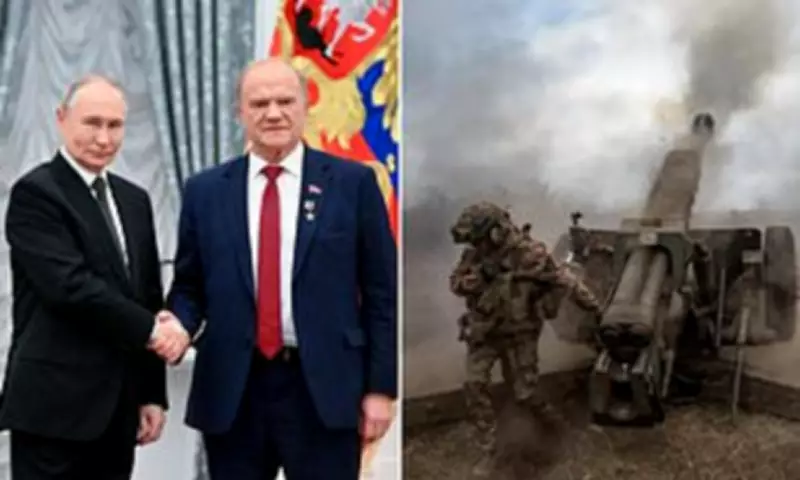
A Kremlin veteran has issued a stark warning to Vladimir Putin, asserting that his leadership is at risk of being overthrown due to escalating regional tensions and a deteriorating Russian economy. Gennady Zyuganov, leader of Russia's Communist Party, made these remarks during a speech in parliament, where he accused the government of prioritizing 'influencers from Monaco' over the concerns of its own citizens.
Zyuganov, a Putin loyalist, was referring to Monaco-based Russian blogger Victoria Bonja, who recently gained attention for criticizing Russia's leadership over an internet ban across the country. She also highlighted how four years of war with Ukraine have battered the federation with rising food prices, higher taxes, and inflation. Zyuganov stated that these issues have been discussed in parliament for a long time, but the government is not paying attention to them.
Although Zyuganov's party is the second largest in parliament and the main successor to the Soviet Communist Party, it has long backed Putin and his core policies, offering carefully calibrated criticism of the ruling United Russia party. He urgently warned that failure to adopt new policies immediately would trigger an economic collapse comparable to the 1917 communist revolution, leading to widespread chaos and mass uprisings across the country.

Zyuganov was careful not to blame Putin personally, instead appearing to take aim at the government, the central bank, and the ruling party, whose ratings are under pressure according to state opinion polls. 'We're doing everything we can to support (President Vladimir) Putin and his strategy and policies, but you (the government) are not listening,' he said in comments made on Tuesday.
Putin is more unpopular than he has been in years, with a poll by the Kremlin-affiliated FOM polling institute showing only 71 percent of Russians trust their president—the worst result in seven years. Dissent in Russia is being crushed, with those speaking out against Putin and the war in Ukraine facing imprisonment in penal colonies, while public opposition, including protests against internet censorship, is severely stifled.
Putin, in power as either president or prime minister since the end of 1999, has repeatedly promised stability and spoken of the destructive nature of revolutions. However, the leader himself recently admitted that Russia's economy was performing below his expectations. While the country has seen a jump in oil revenue due to the conflict in the Middle East, the president has since admitted that it would be short-lived.
Putin last week said that Russia's GDP fell by 1.8 percent in January and February, while Russian central bank governor Elvira Nabiullina recently said that 'external conditions are now getting worse on an almost constant basis—for both exports and imports.' The head of Sweden's Military Intelligence and Security Service, Thomas Nilson, said that Russia will struggle to continue financing its invasion of Ukraine as the war enters its fifth year, leading to a 'financial disaster.'
Speaking to the Financial Times, Nilson said that Russia is 'living on borrowed time' and explained that the country's economy can only end in one of two scenarios: 'Prolonged decline or a shock. Either way, they continue their downward spiral towards financial disaster.' He highlighted that Russia's economic faults have spread to the defence sector, noting that 'it's not a sustainable growth model to produce material for the war that is then destroyed on the battlefield.'
Nilson also believes that Russia is manipulating data to make Ukraine's allies believe that Russia is doing better economically than it is, despite the country being on the brink of a financial crisis. He said the situation is even worse than what Russian officials depict and that the central bank is downplaying inflation, leading Putin to be unaware of how bad the economic situation really is. 'If you have created a system like Putin has, he might not know how bad the economic situation really is. But even with the false info he gets, you ultimately can't run from all of this,' Nilson said.

The intelligence chief's remarks come after Russia was forced to reduce its oil output in April due to Ukrainian drone attacks on ports and refineries, as well as a halt to crude supplies via the only remaining Russian oil pipeline to Europe. In what could be the sharpest monthly decline in Russian output in six years since the Covid-19 pandemic, Russia may have cut production by about 300,000 to 400,000 barrels per day in April from the average level seen in the first months of the year.
Oil, pumped mostly from fields across the Western Siberian basin, is the lifeblood of Russia's $3 trillion economy, so a decline in output cuts revenue for the world's second-largest exporter. The potential losses, though, may be cushioned by the Iran war, which has triggered a supply and production crisis for the global oil market. Russia's Finance Minister Anton Siluanov said last Thursday that high prices would help reduce the budget deficit.
Ukraine, over recent weeks, unleashed a wave of drone attacks on Russia's biggest Western oil ports, triggering vast blazes, while attacking refineries. 'Against the backdrop of ongoing attacks on Russia's ports and refineries, it will be difficult to place oil without cutting output, especially with upcoming spring maintenance shutdowns,' one of the sources told Reuters on condition of anonymity due to the sensitivity of the situation. Russian oil production peaked in the late 1980s but cratered after the 1991 collapse of the Soviet Union due to a lack of investment. It then recovered in the 2000s and 2010s, reaching a post-Soviet peak in 2019 just before the pandemic.