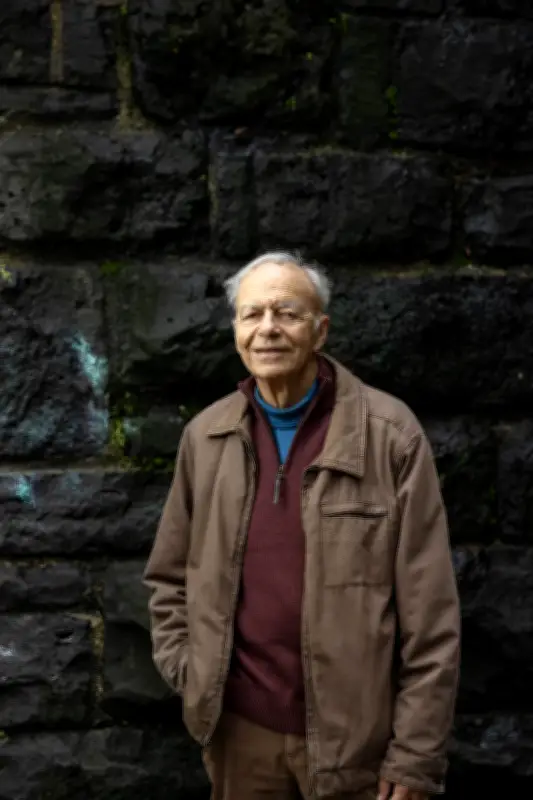
Peter Singer, the world-renowned moral philosopher once dubbed “the most dangerous man on Earth” by critics, has returned to Australia after two decades in the US. He now lives in Melbourne’s urban centre, walking along the “fairly natural” scrubby bushland track beside Merri Creek.
“I think they’ve done a pretty good job here,” he says approvingly. Singer’s manner is dry with a hint of bemusement, still with that same flat Australian accent. He discusses mind-bending ethical dilemmas with a pragmatic delivery that’s almost disarmingly casual but softens when he briefly explains why he’s left the bay behind. “Our kids live near here,” he says – “and they wouldn’t move to us!” Ranging in ages from 12 to 20, his grandchildren are “now all in this same little pocket, and they come for dinner usually once a week, sometimes we play cards.”
Retirement from Princeton
After calling time on his stint as professor of bioethics at Princeton’s University Center for Human Values, Singer delivered a final lecture at the end of 2023. His PowerPoint presentation began by quoting the horrified reaction to his controversial appointment in 1999 (a former alumni likened it to a sign of the “decline of western civilisation”). This was, after all, the man once dubbed the “most dangerous man on Earth” by critics for his views on issues such as voluntary euthanasia, abortion and advocating for parents’ right to selective euthanasia of their disabled newborn babies.
The presentation touched on his 2021 launch of the Journal of Controversial Ideas, the “sad” demise of disgraced crypto billionaire and proponent of effective altruism Sam Bankman-Fried (with a slide entitled “Be good but don’t be sketchy!”) before plugging his website and ending with a disarmingly casual line, “OK, that’s about it guys …” The final slide featured a photo of Singer in a wetsuit, board under one arm and the caption: “Bye, I’ve gone surfing.”
Surfing and politics
The man widely recognised as a foundational thinker for the modern animal rights and effective altruism movements says he’s been too busy to devote proper time to the hobby he took up in his 50s after “graduating from boogie boarding”. The 80-year-old might have stopped teaching but is not exactly retired (in the last few years he has launched a podcast, a global alliance for corporate philanthropy and an AI version of himself). But he does have a favourite break at a beach south-west of Melbourne. “I like being out there in the ocean and waiting for the right wave,” he says. “Looking at where it’s going to keep breaking and trying to get there.”
The southern beaches of the Surf Coast of Victoria seem a long way from Princeton, but Singer was more than ready to call time on America, even before Trump’s second term. “It was during Biden’s presidency … and I didn’t really expect Trump to be president again at that time but, certainly, the whole climate was getting more polarised, the fact that he was a major figure … made it bad enough.”
At the time, Singer railed about then president Joe Biden’s reluctance to bow out of the presidential race. Of his own decision to retire from teaching at a similar age he says “some professors at Princeton stay on too long, and sure they may still be being good teachers when they’re 80, but sometimes it’s good to make space for younger teachers.” He still marvels at the fact that Trump was voted in a second time. “I think they were tired of the Democrats,” he says. “They wanted somebody who would throw the system up, throw it up in the air, and it would come down differently.”
Singer has never shied away from weighing in on politics. In 1996, he stood unsuccessfully as a Greens candidate for the Australian Senate and that same year co-wrote a book, The Greens, with party founder Bob Brown. He cuts a cracking pace as we tackle a steep hill, but asked if there’s any part of him that wishes he was still in the US to witness the Trump presidency a second time, he defers to a one-word answer. “No.” Catching our breath at the top, he’s grimly matter of fact: “I couldn’t have made any difference. It’s less painful in a way.”
Animal Liberation and its impact
We stop at the Merri Creek stone labyrinth, when Singer notices a particularly bright orange, extremely ugly fungus in the grass and stoops over to poke at it. He identifies it, as a stinkhorn. Singer, it turns out, knows his mushrooms, and doesn’t mind the occasional forage in a pine plantation (“though you can find field mushrooms round here”.) He’s more likely to scan the ground when he walks than the canopy. “I mean, I like looking at birds, magpies for instance are wonderful and I love the call of the currawong but, you know, I’m not going to eat them,” he quips.
That, of course, brings us to the work that Singer is most well known for. First published in 1975 after Singer and his wife, Renata, were inspired to become vegetarians themselves, Animal Liberation argues that sentience is the crucial consideration that obligates humans to give equal consideration to the interests of animals. In 2023, Singer updated the book that launched a generation of animal activists and in the process rewrote almost three-quarters of it, including more about climate change and “whether the animal movement has made progress”.
Animal Liberation is widely credited for inspiring millions of people to become vegetarian and vegan, but he waves that impact away. “I wanted people to know they shouldn’t be buying factory farmed products. But it’s still a niche group of people which took that on, which is very disappointing,” he says. He doesn’t dwell on it, but he does dismiss the book’s significance: “You have to say, looking at it, my book has not succeeded in what I wanted it to do.”
Effective altruism and capitalism
Singer may not be satisfied, but his thinking has made an enormous impact. Underpinning all of it is the theory of utilitarianism, a school of thought that states the most ethical choice, in any situation, is the one that provides the greatest good for the greatest number. Or, more specifically when it comes to Singer’s approach, reducing avoidable suffering. More recently, it has driven him to tackle social problems such as solving poverty through strategic effective giving. This inspired a polarising school of thought dubbed effective altruism, inspired by his early essay “Famine, Affluence, and Morality”, which argues that affluent people have a moral duty to donate a significant portion of their income to effective charities to prevent suffering. The essay famously deploys the “drowning child” thought experiment – if you’d wreck a pair of expensive shoes to save a child that was drowning in front of you, then by that rationale you should spend less on luxuries and donate that money to save lives, including the ones that aren’t right in front of you.
We reach the roaring waters of Dights Falls and take a seat to talk capitalism. Singer has been criticised by some for engaging with the system rather than blowing it up. “I’ve come to accept that we’re not going to get rid of capitalism any time soon. We ought to try and improve it, patch it up, fill the gaps because … capitalism is still the most productive economic system that has ever existed.”
Singer has previously set up non profit organisations such as The Life You Can Save, which recommends rigorously vetted, high-impact charities. But it’s when he starts talking about his latest venture, Profit for Good, a growing global alliance of businesses committed to donating at least 10% of their net profits to highly effective charities, that he really lights up. “We need to divert some of the profitability of the capitalist economy to fixing the cracks in the system.” Inspired by the likes of ticketing business Humanitix (which gives away 100% of proceeds) and Australian toilet paper company Who Gives A Crap (50%), Singer’s scheme doesn’t rest with the better angels of “sketchy” billionaires like Bankman-Fried – it focuses on building giving into the business model.
“It would have been a lot better if Sam (Bankman-Fried) had adopted my ideas and succeeded in what he was doing and lived up to the ideals, and had $25bn or more to give … but yes, you don’t want to put all your eggs in one basket anyway, or even in three or four billionaires’ baskets.”
As we watch a pair of kayakers tackling a slalom course at the bottom of the falls, Singer concurs he’s sometimes treated like something between a fortune teller and a wise sage. There is a temptation to shake him down for the meaning of life. “Some people want to discuss it, and I’m happy to talk, maybe not about the meaning of life but about how to live well, and I really enjoy talking to people about how they do that.” (In fact, he co-hosts a podcast on the subject, he is mindful to point out.)
But on the future? “Somebody asked me to contribute to a book about what the world would be like in 2050. I said no, I don’t have any particular expertise in knowing what the world will be like … I’m very sceptical that many people have much expertise there. I’m very unlikely to be around to see the world in 2050 anyway, so I do try to stick to the issues I’ve thought about.”
Does he worry for his grandkids? Singer pauses – and then one of the world’s most famed thinkers defaults to the same setting as most any grandparent. “I generally have a somewhat optimistic temperament. I’m … reasonably hopeful that they’ll be OK.”