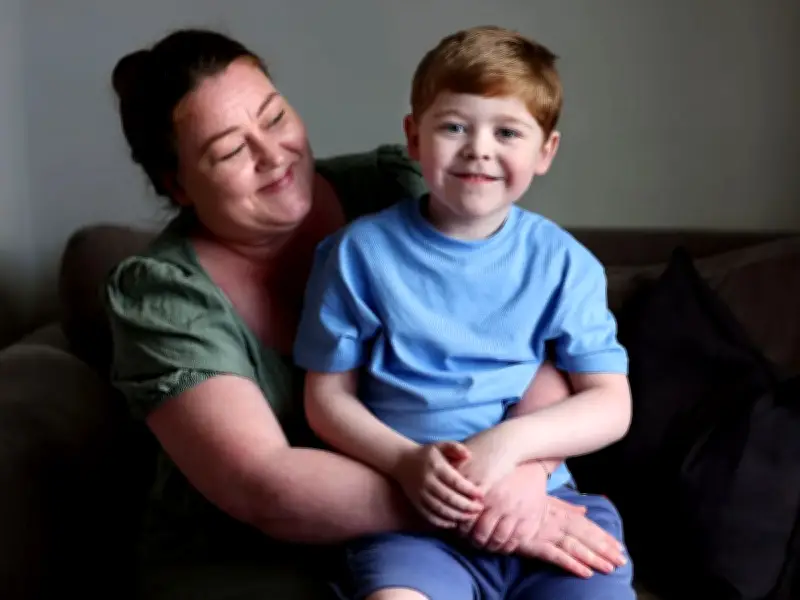
A six-year-old boy from Merseyside who has not eaten a proper meal in four years is surviving on a diet of Hula Hoops and Jacob's Crackers. Max has suffered dramatic weight loss, hospital admissions, and minor surgeries, but is not getting the support he needs, says his mum Kate Hesketh, because of a "glaring gap" in targeted health services in the region - something accepted and acknowledged by NHS bosses.
Kate, who lives in Prescot, told the ECHO Max had issues with food from an early age, which became so pronounced she sought help from the local GP. Since then, Max has been checked for numerous allergies, been referred to dieticians and nutritionists, and was even thought to be a fussy eater. In reality Max was living with avoidant/restrictive food intake disorder (ARFID).
"Sadly, a lot of kids with ARFID go through the same process, until the situation hits crisis point", said Kate.
What is ARFID?
ARFID is classified as an eating disorder by the NHS, but is not caused by beliefs about weight or body shape. It is characterised by people avoiding certain foods and limiting how much they eat and - in some cases - people may refuse to eat food all together.
The NHS said the possible reasons for people developing ARFID are varied and complex. They include negative feelings over the smell, taste or texture of certain foods, not feeling hungry or just a lack of interest in eating.
Kate said: "Max has had feeding problems pretty much from birth, but they manifested as suspected allergies, stomach upset, reflux, stuff like that. Then as he's grown, we moved onto solids, and he would gag and spit them out.
"As soon as we got onto chunkier textures, that's when he really started struggling, and age two, he wouldn't eat anything that he couldn't pick up with his hands, and it would have to be what's called beige food, which is quite typical for ARFID kids. But whenever he got sick, we'd lose a food."
Impact on Max's health
According to NHS guidance, children with ARFID don't tend to eat when they get hungry, but stay hungry and then eat less overall. Over time, the list of foods an ARFID child eats can significantly reduce, and items can be 'lost' off the list due to several reasons, including a sensory shift, a bad memory and/or association like a change in taste, texture, brand, or a vomiting episode.
Kate continued: "By October last year, we had lost so many foods that Max was living exclusively on Pom-Bears and Potato Pops. We lost the Potato Pops quite quickly and Max just wouldn't touch them anymore, which was difficult because that was a high-calorie food, so when that went, Max lost lots of weight really quickly which was really worrying and things became much more serious.
"We're at a stage now where Max's sensory profile relating to food is dry and crispy, and all he eats orally now are Hula Hoops and Jacob's Crackers, nothing else.
"As a parent of a child with ARFID, you have to find a food that's similar to the ones the child can eat, and try and introduce it gradually. But it can take years, and when you've got dramatic weight loss, they're not growing, and they're nutritionally compromised, you haven't got years to do those things.
"You need targeted, in-depth support which just doesn't exist in the region and that needs to change."
ARFID is a highly complex condition, but treatment for ARFID is not included in the National Institute for Health and Care Excellence (NICE) guidelines for eating disorders. This means the availability of services varies across the UK.
Postcode lottery for services
The Liverpool ECHO understands that NHS Cheshire and Merseyside Integrated Care Board (ICB) recognise there is a 'gap' in ARFID pathways across the region, with only one specialist ARFID service at Alder Hey. This service is only available in Liverpool and Sefton, meaning only patients registered to a GP in those areas can be referred or make a self-referral.
Kate added: "Some people will call it fussy eating, but it's not. Fussy eating and ARFID are really different, and therein lies some of the problem, because there's a lot of misconceptions.
"The condition is really life-limiting. Max has been admitted to hospital because of his weight and it has associated health implications, as well as an impact on his development more generally.
"ARFID is a recognised condition, recognised by the NHS, but at the moment, there's no diagnostic pathway for ARFID children and therefore, getting a diagnosis and the appropriate support is almost impossible.
"As a result, there's simply no data to show how big the demand is but I have spoken to medical professionals who say they are seeing more and more cases and they acknowledge there's a gap in their services."
The ECHO approached NHS Cheshire and Merseyside ICB to ask about the availability of ARFID services in the region, as well as Kate's calls for the establishment of a diagnostic pathway.
A spokesperson told us: "As this relates to an individual patient's care, it would not be appropriate for us to comment on the specific circumstances of the case due to our commitment to confidentiality.
"We recognise that access to specialist ARFID services is currently limited across the region and the country.
"We are working with partners to improve access to support for children and young people with eating disorders, including ARFID, helping to ensure families can access the help and care they need more easily, wherever they live."