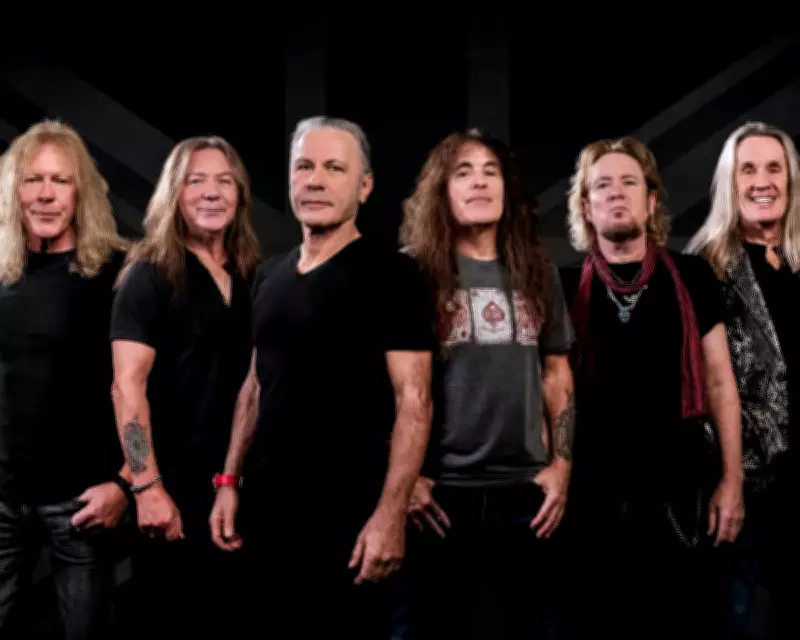
Iron Maiden bassist and founder Steve Harris sounds bewildered when asked about the band's longevity, now spanning over half a century. 'It's gone so quick. You go on tour for a few months and it seems to fly, but so much happens. Our whole career is an extension of that – for 50 years,' he says.
Harris is reflecting on steering one of the most influential and idiosyncratic British bands in history. Catapulted to the premier league of 1980s metal with albums like The Number of the Beast, Powerslave, and Seventh Son of a Seventh Son, Iron Maiden not only survived the mid-90s slump but grew heavier and more ambitious.
Last year, they celebrated their 50th anniversary with the Run for Your Lives tour, continuing until November and including their biggest UK headline shows at EddFest in Knebworth in July. Next month, the documentary Burning Ambition hits cinemas, featuring rare archival footage and interviews with Tom Morello, Chuck D, Lars Ulrich, and Javier Bardem.

From the New Wave of British Heavy Metal to Stardom
Formed in London in 1975 by Harris, Iron Maiden went through multiple lineup changes before settling on Paul Di'Anno as vocalist in 1978. They clawed to the forefront of the new wave of British heavy metal (NWOBHM) through constant gigging. The NWOBHM was a roughshod movement typified by eccentric theatrics and DIY ethics, playing in backstreet pubs to crowds in denim and leather during the punk heyday.
Bruce Dickinson, who joined in 1981 after Di'Anno left due to burnout, recalls the scene: 'The one thing metal did adopt [from punk] was the idea of 'Let's just do it ourselves.' People released their own singles, got deals with indie labels. Then punk morphed into new wave and new romantic, but we didn't morph into anything – we just cracked on.'
Maiden's self-titled debut entered the UK charts at No. 4 in 1980. Dickinson, then 21, was grossly overconfident: 'Of course I'm going to get the gig, because I can do exactly what you want and a whole lot more.' He brought a visceral narrative style, with literary references from Samuel Taylor Coleridge to Aldous Huxley, becoming a hallmark of the band.
The Golden Cage and Near-Quits
The gruelling World Slavery Tour in support of Powerslave (1984) left the band fried, especially Dickinson. 'That was definitely a wobble for me. I had no life. It started to feel like a golden cage. I was thinking of packing it in to become a fencing teacher,' he says. He worried about losing connection with 'the reason why I got into music in the first place: because it was a form of dramatic storytelling.'
By 1990, heavy music was changing. After Seventh Son of a Seventh Son, guitarist Adrian Smith left, citing creative differences. Dickinson also left in 1993, feeling the band was off the zeitgeist. Harris admits communication was lacking: 'It was almost: 'All right, I'm leaving.' 'Oh, OK – well that's it then.' We didn't really talk about it.'
The 1990s were difficult for Maiden, who soldiered on with new singer Blaze Bayley. Albums like The X Factor and Virtual XI were strong, but the band struggled in the US. 'It was difficult in America. Metal was struggling everywhere. With a long career you learn to go up and down with the waves, but you carry on regardless,' says Harris.
Reunion and Renewed Vitality
Dickinson and Smith rejoined in 1999, recording the majestic Brave New World. A secretive meeting between Harris and Dickinson was arranged by management at a yacht club in Brighton marina, with the area cleared for privacy. The reunion led to a tight, energised Iron Maiden headlining Rock in Rio 2001 in front of 250,000 people.
Since then, albums have come at a less frenetic pace, but quality remains high, with a progressive, slow-building element. Post-millennial albums like The Book of Souls (2015) and Senjutsu (2021) prove the band remains vital. Harris says, 'Anyone can harp on about the early stuff, but what's the point in doing Run to the Hills Part Two?'

Dickinson, now sipping coffee in a posh hotel, exudes the same confidence as his younger self: 'Any song on the planet, if you give it to Iron Maiden it'll always sound like Iron Maiden. That's incredible. Don't ask me how, don't ask me why, don't ask me where the magic comes from – at that point my analysis skills go in the dustbin. It just is.'
Iron Maiden: Burning Ambition is in cinemas from 7 May. Eddfest is at Knebworth, Hertfordshire, on 10 and 11 July.