
Scientists believe they have solved the mystery of hundreds of giant stone jars scattered across northern Laos, concluding that they were used as family crypts in ancient mortuary rituals. The jars, some weighing several tons, are found on the Plain of Jars in Xieng Khouang Province and have baffled experts for decades.
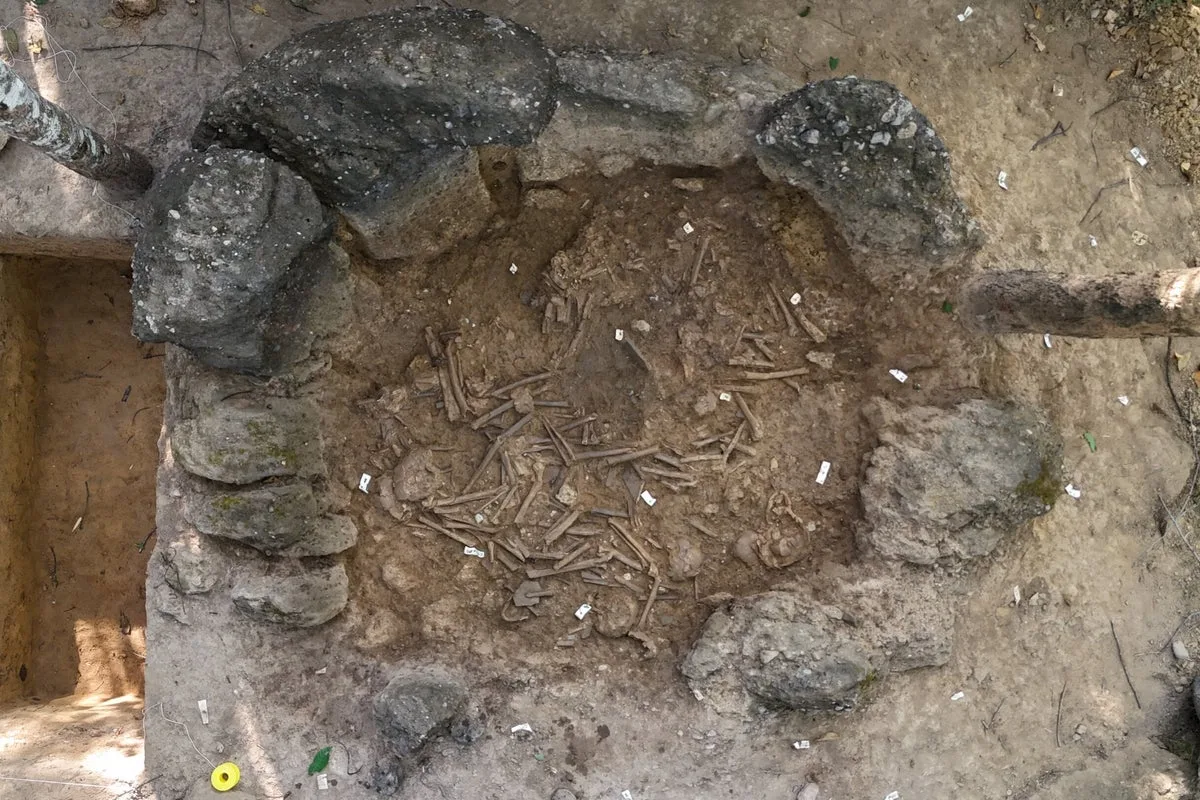
A new study published in the journal Antiquity reveals that one jar, over a metre high and two metres wide, contained the remains of at least 37 individuals. Researchers from James Cook University and the Lao Department of Heritage excavated the site near Phonsavan and found densely packed human bones, indicating secondary interment after initial decomposition elsewhere.
Lead archaeologist Nicholas Skopal said the jar was used over a period of up to 270 years, between the 9th and 12th centuries AD. “We determined that it was an example of secondary internment… in which human remains were deposited after an initial period of decomposition elsewhere,” he explained. Skopal described the discovery as a rare moment where everyone became quiet, noting the unexpected density of intact body parts.
The findings challenge earlier assumptions that the jars date to the Iron Age (500 BC–500 AD) and were final resting places. Instead, researchers believe jar interment was one stage in a multi-step funerary sequence, likely owned by family groups who performed ancestral rites over generations. Skulls and long bones were carefully arranged, suggesting the jars served as ossuaries for families or close communities.
Artefacts found with the bones include iron tools, earthenware, stone slabs, a copper bell, and glass beads. Chemical analysis of the beads revealed they originated from South India and Mesopotamia, indicating previously unknown trade links between the Laotian highlands and Southern and Western Asia during a period of increasing trans-Asian connectivity, possibly facilitated by the Song Dynasty and Khmer Empire.
“The preservation encountered here offers an exceptional window into past mortuary practices,” Skopal said, adding that many comparable sites may still await discovery. Continued investigation could transform understanding of the cultural and social dynamics that shaped the region.




