Call it 'tip-creep'. Or 'tipflation'. Or just call it an appalling manipulation of the British people's inherent but quiet generosity – an American import that's alien, insulting and deeply embarrassing. Yes, it's the ever-expanding tyranny of the service charge.
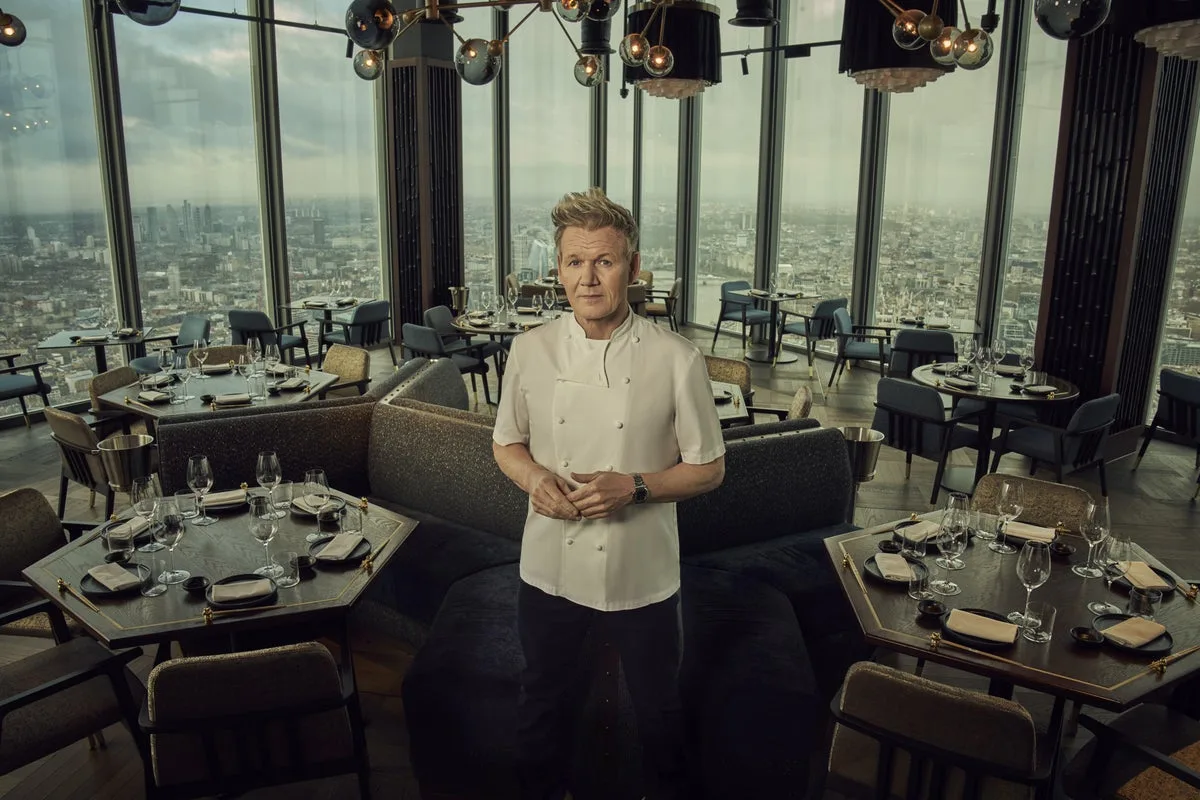
The man who has most recently stoked the flames of this burning issue is Gordon Ramsay, having just introduced an 'optional' 20 per cent service charge at his Asian-themed restaurant, Lucky Cat, in the City of London – causing all hell to break loose.
Lucky Cat occupies the 60th floor of a skyscraper. It's the highest restaurant in the capital and now commands the highest service charge.
Full disclosure: I'm no great fan of Ramsay, who has almost as many restaurants in America, the tipping capital of the world, as he does in the UK. When I was the restaurant critic of a national newspaper, he recognised me at what used to be Foxtrot Oscar, a louche but wonderful establishment in Chelsea, which he had just bought and was about to ruin. I questioned politely why he felt it necessary to make so many radical changes to such a much-loved institution, that had long been frequented by a raffish but fiercely loyal clientele. He took it badly. At the time, I was dining with my wife and one of her sons. 'When do you think your stepfather will get a proper job?' Ramsay asked him.
But let's be fair, because some of the facts have been lost in a row that has generated more heat than light. Ramsay's 20 per cent service charge is only applied to seasonal menus, such as at Christmas and New Year. For the rest of the time – and consistent with most of his other UK restaurants – it drops to 15 per cent, which, admittedly, is still more than the traditional 12.5 per cent.
Even so, the consensus is that tipping has got out of hand and that we will soon find ourselves in a situation no different from what they have in the US. Just last week, Daily Mail columnist Andrew Neil stirred the pot by telling the story of what happened when he had a run-in with a waiter at a New York restaurant 14 years ago. Apparently, the 'server' wasn't happy with Mr Neil's 15 per cent tip, which amounted to $150 (£110) after a slap-up dinner with friends, and made his feelings known. 'Was there something wrong with the meal or the service, Mr Neil… because the tip is a bit light?' asked the waiter. Mr Neil begrudgingly produced a few more dollars and handed them over. But, unfortunately for the waiter, Mr Neil knew the owner of the restaurant and called him to complain. The waiter was given his marching orders the very next day.
Who benefits when you leave a tip?
In Britain, the Employment (Allocation of Tips) Act – which stipulates that tips in restaurants, pubs, bars, cafés, beauty salons, casinos and elsewhere must be passed on to workers without any deductions from the employer – came into effect in October 2024. It's a law that is designed to benefit two million workers in England, Scotland and Wales, but does it? There is evidence that some employers have reacted by offering staff lower wages in the knowledge that the tips will increase their take-home pay.
How does tipping work in practice?
Badly. While a restaurant typically adds a service charge of 12.5 per cent to the bill, that is not always the end of the matter. When you're handed the card reader, there's often an unwanted invitation to add a further tip of 10 per cent, 15 per cent, 20 per cent or even 25 per cent. What a nerve. But how many of us protest and decline the request? And it's a practice that's becoming increasingly common. The number of customers presented with a so-called 'tip screen' has increased by 78 per cent in the last couple of years, according to the contactless payment firm SumUp. The bad news is that all manner of other businesses – from pharmacies to gyms – are jumping on this bandwagon. Indeed, the percentage of businesses applying a suggested tip on their card machines has risen by more than a third, says SumUp. It's painful. The cashier may look away and pretend that the choice is yours – but it's not. You're trapped. And, strangely, it's easier to ignore the 'Would you like to give £1 to charity' than it is a 10 to 25 per cent tip charge.
Which services should we tip?
'Tipping is a noxious system… and a tip is not a substitute for saying thank you,' wrote the late Drusilla Beyfus in her book, Modern Manners. Her list of people who traditionally expect a tip includes: hairdressers, shampooists, beauty specialists, chiropodists, manicurists, taxi drivers, waiters, hotel porters and cloakroom attendants. In addition, dustbin men and postmen should be tipped at Christmas unless they've refused to empty your bin because it was overloaded, or persistently delivered your mail to the wrong address. But why stop there? Why should a man who merely opens your taxi door outside a hotel receive something, when a chambermaid who has cleaned your room, more often than not gets nothing? Why, in London, are we expected to tip a black cab driver and not an Uber driver? Why don't we tip a plumber who has just fixed a boiler?
Why tip... and what happens if we don't?
The idea is that we are recognising good service but a recent Which? magazine survey of 2,134 adults revealed that one in four of us leave a tip despite poor service because we'd be embarrassed not to. One in five said they tipped, despite having a bad experience, because they believed the discretionary service charge was non-negotiable. It's a tyranny of sorts. A few years ago, I was sent to New York by the Daily Mail for 48 hours. During the first 24 hours I was under instructions not to tip anyone for anything. For the second 24 hours I was to be Mr Big, tipping all and sundry, as if I were an oil baron. Day One was excruciating. First, the taxi driver who drove me into Manhattan from the airport gave me a killer look as I handed over the exact fare and nothing more. Then, when I checked into the trendy Gansevoort Hotel in the Meatpacking District, I was greeted enthusiastically – at first. But by the time I had not tipped the doorman, not tipped the man who escorted me to the room and not tipped the woman who brought me a club sandwich from the room service menu, I was persona non grata. The chirpy, meet-and-greet chappy on the door practically turned his back whenever he saw me. Suffice to say that when I then checked into the nearby Standard Hotel the next day and started throwing dollar bills around like confetti, I was everyone's friend.
A World of Confusion About Proper Etiquette
Woe betide you if you're splashing the cash in Japan, where it's insulting to tip – good service need not be rewarded because good service is expected. In Poland, saying 'thank you' before getting your change implies that staff can keep it. Bills in French restaurants come with a 15 per cent 'service compris' charge, which is non-negotiable, whereas a 'pourboire' (literally 'for drinking') can be left as an additional tip. Porters in posh hotels in America expect $5 a bag, whereas in Europe €5 for up to three bags is perfectly acceptable. In Greece, it can be as little as €1 per bag. 'If you want to tip particular people, cash allows them to keep it,' says Kate Nicholls, chair of UKHospitality. 'Leaving a tip on the bill or on the table benefits the whole team, from front of house to chefs and kitchen porters.' In theory, at least.
Why 'no tipping' has become a selling point
I remember going on a cruise a few years ago and the night before disembarking we received three envelopes into which we were to put tips for the crew from various departments. It came with a guide that recommended what percentage to pay per day. I needed to consult a calculator, which is not what you want on holiday. It's no wonder all-inclusive holidays – whether at the bargain or high end of the market – are becoming increasingly popular. What a relief it is when staff are not expecting a tip, but you are still at liberty to give one should you wish. Cruise lines today now use 'no tips' as a marketing tool to attract passengers and it seems to be working. Saga, for example, makes clear that 'gratuities to all on-board crew' are included in the price. All-inclusive hotels are adopting the same strategy. 'All resort team members are trained to deliver world-class service as a standard, not as something which is earned through gratuities,' says Karl Thompson, managing director of Unique Vacations UK, representing Sandals Resorts. 'Our no-tipping policy ensures that every guest receives the same level of exceptional service, which is never transactional. Compensation is factored into team member's salaries, rather than having them rely on tips.'
What's going on psychologically?
Quite a lot. 'The discomfort many British people feel over tipping may be a clash of cultural conditioning,' says Meghan Mitchell, an instructor at the mental health organisation, Headspace. 'In the UK, discussing money has historically been seen as vulgar and the recent tip-creep feels like you're being forced into a public negotiation that you never signed up for.' Ms Mitchell adds that, at the end of a long and jolly meal, our cognitive resources are low and so 'when a card machine presents a pre-set percentage, it offers a path of least resistance. In these moments, we often aren't clicking 15 per cent out of gratitude; we are doing it to avoid social shame.' How absurd is that?
When big spenders get to flash the cash
There's a suspicion that some people enjoy advertising how rich they are by leaving huge tips. Johnny Depp is known to be a good tipper. During the filming of 2009 crime thriller Public Enemies, he and other members of the cast visited Gibson's Steakhouse in Chicago. Their meal turned into a three-hour session that included several bottles of $500 wine, after which Depp left a tip of $4,000. The truth is we all know that money talks. In the 1939 film, Ninotchka, there's a salient moment when Greta Garbo, as the title character, gets into conversation with a luggage porter. 'Why should you carry other people's bags?' she asks. 'Well, that's my business, Madame,' says the porter. 'That's no business. That's social injustice,' says Ninotchka. 'That depends on the tip,' says the porter.
Have we reached the tipping point at last?
Far from it. Tipping is becoming a way of life in the UK and it's going to take a massive rearguard action to stop it. But the solution is in our own hands. If enough people press the 'no tip' button on those grim card readers after a 12.5 per cent service charge (or 15 per cent or 20 per cent) has already been added to the bill, perhaps we will eventually return to the days when tips were truly at the discretion of the customer rather than the result of guilt-driven coercion.