China's Dual Economic Plans Reveal Tech Ambitions and US Rivalry
Two major economic strategies unveiled at the annual meeting of China's legislature outline top priorities with distinct implications for the global economy. The government's plan for 2026 places "building a robust domestic market" as the primary task, followed by accelerating technological progress. However, a longer-term five-year plan gives greater prominence to achieving advances in technology, highlighting the government's delicate balancing act.
Tech Crucial to China's Future
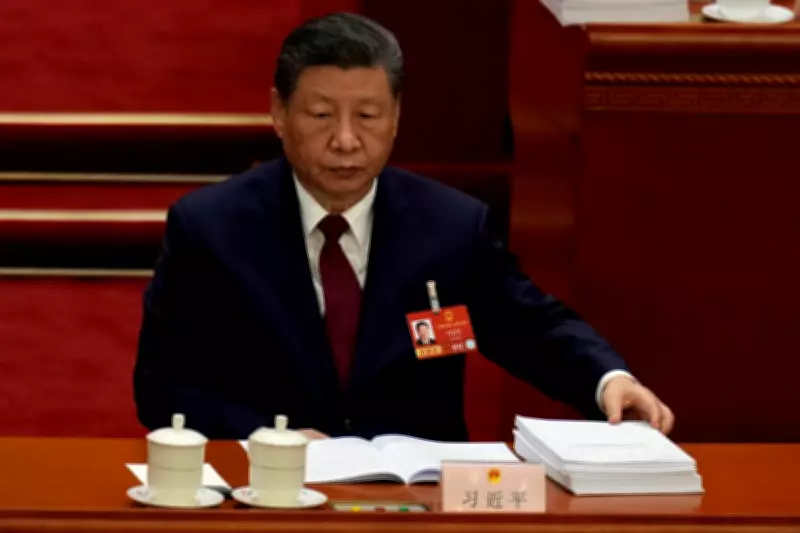
Analysts believe technological prowess remains a far more critical goal for Chinese leader Xi Jinping, who envisions building the nation into a major power capable of contending with the United States on issues ranging from trade to Taiwan tensions. Speaking to a provincial delegation at the National People's Congress, Xi called for new breakthroughs, original innovation, and "seizing the strategic high ground of science and technology," according to state media reports.
China's rapid growth into the world's second-largest economy has elevated it to middle-income status. To sustain advancement, Xi has promoted policies shifting the economy into higher-value industries. For instance, a government-backed push into electric vehicles has transformed China into an emerging player in the global auto industry, aligning with national climate goals.

The five-year plan vows to "target the frontiers of science and technology," accelerating development in areas such as:
- Artificial intelligence
- Quantum technology
- Biotechnology
- New energy
Moves Toward Self-Sufficiency
This push has expanded and evolved as technology becomes a key area of competition with the US, with significant national security implications. The US has restricted Chinese companies' access to advanced technologies, including semiconductors essential for AI, citing concerns over potential military applications. In response, China is pouring resources into developing these components domestically and engineering ways to remain competitive with less advanced parts.
China must "fight the battle for key core technologies," the five-year plan states. Specific goals include advancements in:
- Semiconductors
- Batteries
- Biomedicine
- 6G mobile networks
The plan also pledges to expand production of China's homegrown passenger jet, the C919, and achieve breakthroughs in developing its own commercial jet engine. This follows a temporary cut-off of Western-supplied engines for the C919 last year during an escalation in the trade war with the US. Additionally, rare earths—where China leads globally—are highlighted as an area to maintain competitive edge as the US and others seek to develop their own supplies for advanced tech and military products.
Trump's Tariffs and Domestic Focus
Even as China's economy has cooled domestically, rising exports have sustained overall growth. However, tariffs imposed by former US President Donald Trump have exposed risks of over-reliance on overseas markets. China shifted exports to other markets, but this faces challenges as its record trade surplus of nearly $1.2 trillion raises alarms about threats to factory jobs and broader economies in other countries.
This has added impetus to China's push to boost consumer spending, making the economy less dependent on external forces. "Facing a complex and challenging international environment, we must remain committed to the strategy of expanding domestic demand," the annual economic plan asserts. Despite strong rhetoric, analysts note the effort seems aimed at keeping the economy afloat rather than boosting it, with a growth target of 4.5% to 5% for 2026, potentially down from last year's 5%.

Meanwhile, the government is poised to offer substantial subsidies for high-tech advances in manufacturing. "Technological development and self-sufficiency remain central priorities, and industrial policy will continue to be deployed as an essential tool to achieve them," economists at Capital Economics noted. Similar subsidies in wind and solar industries led to manufacturing oversupply exported at low prices, undercutting overseas competitors. This could exacerbate imbalances between China's immense manufacturing capacity and weaker domestic demand, further driving up exports.