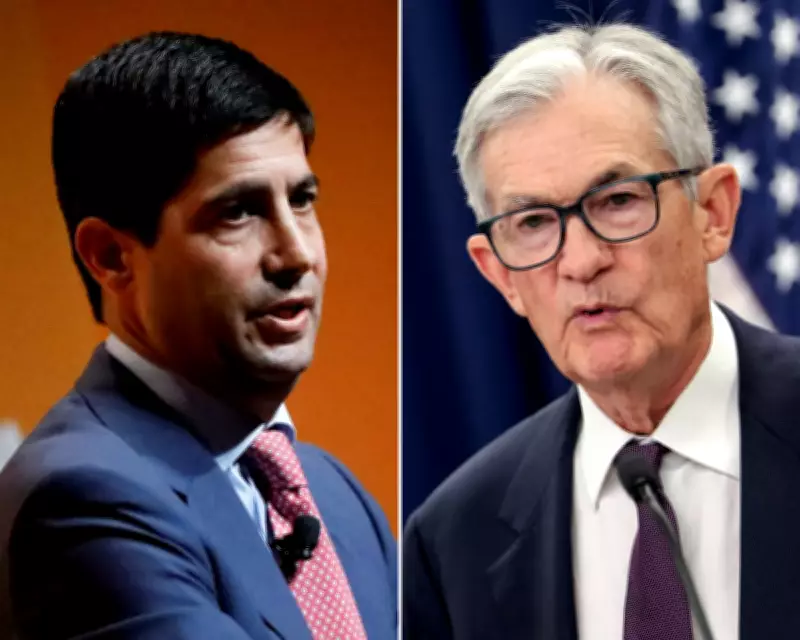
In a significant move that could reshape American monetary policy, former President Donald Trump has officially nominated Kevin Warsh as his choice to lead the Federal Reserve, replacing the current chair Jerome Powell. The announcement, made on Friday, marks Trump's latest attempt to install a central bank leader more aligned with his economic vision after years of public conflict with Powell.
A Strategic Shift in Federal Reserve Leadership
The nomination represents a calculated political manoeuvre by the Trump administration, which has grown increasingly frustrated with Powell's steadfast commitment to the Fed's traditional independence. Trump's relationship with Powell has deteriorated dramatically since their initial collaboration, with the former president recently describing the current Fed chair using derogatory terms and expressing a desire to remove him from office.
Trump's selection of Warsh appears designed to bridge the gap between his demand for interest rate cuts and the need for a nominee acceptable to both financial markets and congressional Republicans. Warsh, who served as a Fed governor from 2006 to 2011, brings established credentials within central banking circles while having recently expressed views more sympathetic to Trump's economic agenda.

From Hawk to Potential Dove
Warsh's monetary policy history reveals an interesting evolution. During his previous tenure at the Fed, he established a reputation as a hawkish voice, consistently emphasising inflation concerns even during periods of labour market weakness. This traditional conservative approach to monetary policy typically favours higher interest rates to control price increases, potentially at the expense of employment levels.
However, in recent months, Warsh has publicly articulated positions much closer to Trump's economic philosophy. In a notable Wall Street Journal opinion piece published in November, he praised what he termed Trump's "pro-growth policies" and echoed the former president's criticism that the Federal Reserve had unnecessarily restrained economic expansion through maintaining elevated interest rates.
This apparent shift has raised questions among financial analysts about whether Warsh's current dovish stance represents genuine philosophical evolution or strategic positioning. Research analysts at Renaissance Macro Research expressed scepticism, suggesting that "his dovishness today stems from convenience" and warning that "the president risks getting duped" if Warsh reverts to more traditional hawkish policies once confirmed.
The Confirmation Battle Ahead
Warsh's nomination faces significant hurdles before he can assume the powerful position of Fed chair. The confirmation process requires Senate approval, where key Republican figures have expressed growing concern about the administration's treatment of Powell and the broader implications for central bank independence.
Republican Senator Thom Tillis has already indicated that while he supports Warsh's nomination, he will block confirmation proceedings until the Justice Department's criminal investigation into Powell is resolved. This investigation, which emerged two weeks before Warsh's nomination was announced, has generated widespread backlash and complicated the political landscape surrounding the Fed leadership transition.
Institutional Protections and Uncertainties
Even if confirmed, Warsh would inherit a complex institutional framework designed to protect the Federal Reserve from political interference. The Fed chair does not unilaterally determine interest rates; instead, decisions require consensus among the twelve voting members of the Federal Open Market Committee (FOMC).
Seven of these voting members are Fed governors serving fourteen-year terms, providing substantial insulation from presidential influence. The Supreme Court has shown willingness to protect these positions, as demonstrated in its apparent readiness to shield Governor Lisa Cook from Trump's attempts to remove her.

Further complicating the transition, Powell's term as a Fed governor extends until 2028, meaning he could potentially remain on the board even after his chairmanship concludes in May. While most chairs traditionally resign from the board after their leadership term ends, Powell has declined to comment on whether he will follow this precedent, creating additional uncertainty about the Fed's future composition.
The Fundamental Question of Independence
At the heart of this leadership transition lies the crucial issue of central bank independence. During a recent press conference, Powell emphasised the foundational importance of maintaining public trust in the Fed's decision-making process, stating that if people lose faith that decisions are made "only on the basis of our assessment of what's best for everyone," it would be "hard to retain" institutional credibility.
Powell specifically warned about the dangers of monetary policy being used to influence electoral outcomes, noting that "it would be hard to restore the credibility of the institution" should such politicisation occur. These comments, delivered just days before Warsh's nomination, underscore the high-stakes nature of the leadership change and its potential implications for global financial stability.
Global markets responded relatively calmly to the nomination announcement, with figures like former Bank of England governor Mark Carney expressing support for Warsh. However, the true test will come during the confirmation process and, if successful, in how Warsh navigates the delicate balance between presidential expectations and the Fed's traditional role as an independent economic steward.