
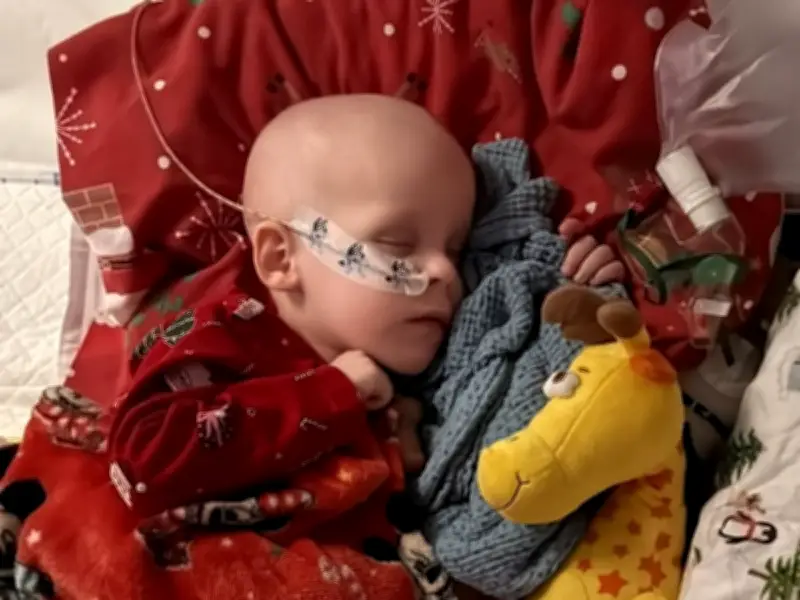
A Welsh family are among the first people to face paying hundreds of thousands of pounds for a crucial cancer treatment for a rare childhood cancer after it was suddenly pulled from the NHS.
Three-year-old Teddy Sloman has been undergoing intense cancer treatment for neuroblastoma for a year. After relearning to walk three times and consistently defying the odds, Teddy had been nearing the end of his first year of treatment when the family were told the devastating news that the NHS could no longer provide the next stage of his treatment.
In June 2025, Sarah and Kramer Sloman were just starting to get back to normal after the traumatic premature birth of their six-month-old baby Joey in the previous December. The family from Griffithstown, in Torfaen, were finding their feet again when they started to notice something was wrong with their then two-year-old Teddy.
Initial Symptoms and Diagnosis
Sarah, who works as a paediatric nurse, noticed her two-year-old was much more lethargic than normal, taking two to three hour naps each day, and struggling to eat or keep fluids down. After raising her concerns at The Grange Hospital, they were initially sent home with constipation medication. However, while performing the stomach massages Sarah had been advised to carry out to relieve what the doctors believed was constipation, she felt a mass in his abdomen.
She was told that it was probably the trapped excrement, but with Teddy showing no signs of improvement, Sarah made a last minute dash to her GP one evening and she was referred back to The Grange straightaway. "Even if this is behavioural, it's not normal for a two-year-old to just suddenly stop eating and do all those things," the doctor told her.
Teddy was kept in overnight and immediately sent for an x-ray and ultrasound the following morning. Sarah recalled: "We had the ultrasound scan, and the sonographer walked me back to the ward. The images were that bad, that we had a personal escort back to the ward, they told the doctors, and within minutes they asked Kramer to come in and if somebody could look after Joey because he was only six months at the time."
Kramer came into the room, and, again, within minutes of arriving, the doctor, a nurse and a student nurse came in. They said: 'I'm very sorry, it's cancer. We're transferring you immediately to Cardiff.'
Intensive Treatment Journey
After they were transferred to the University Hospital of Wales, Sarah recalls everything being a complete whirlwind because of how poorly Teddy was. She said: "When they did the imaging, that mass that I'd felt a couple of weeks before was the tumour. It filled his entire abdomen and it was wrapped around all the major vessels. It was compressing his stomach, which is why he was vomiting. At one point it was compressing his lungs too."
For the next couple of weeks Teddy was so unwell he lay in his hospital bed only moving his eyes. Sarah and Kramer would sleep in the hospital with Kramer staying next to Teddy and Sarah sleeping upstairs in the on-site accommodation. "I would go upstairs and pump through the night to give the supplies to my mum and dad because I was still breastfeeding Joey," Sarah said.
What followed in the immediate aftermath of his diagnosis was intensive chemotherapy treatment from July to September with a rotation of different drugs. In October 2025, he was then transferred to the Birmingham Children's Hospital to undergo extremely high risk surgery aimed at removing as much of the tumour as possible.
Sarah said: "It was a significant surgery, and they weren't sure if he was going to make it through. If he was going to make it through, they didn't know if he'd make it with all his organs because the tumour had wrapped around all the major blood vessels, and his kidneys." The surgery was completed over two days and Teddy was kept in intensive care overnight. The tissue was harder than they hoped to remove, meaning the surgeons were only able to chip away at it. They removed as much as possible but some residual tissue was left behind. Thankfully he kept all his organs and survived, but the residual tissue caused further side effects.
After the surgery Teddy returned to Cardiff where he went onto a high dose chemotherapy which caused yet more serious problems, including veno-occlusive disease in his liver. After getting through that he faced further challenges at the start of this year when he suffered with a very serious lung infection called pneumocystis pneumonia. Once the infection was treated, Teddy and his parents travelled to London for him to undergo specialist radiotherapy. In April, he started a course of immunotherapy which he is still undergoing now.
The Blow: US Company Withdraws NHS Drug
Throughout the treatment, Sarah and Kramer had known that after the immunotherapy would come a course of maintenance which would involve an oral drug being taken over multiple years. The family hoped that once they were onto the maintenance, they would be able to get a degree of normality back. However, a couple of months into the immunotherapy treatment they were given the devastating news that the maintenance drug they had been due to have next had been withdrawn from the NHS by the American-owned company.
Having received the news that after Teddy's immunotherapy he will not be able to pursue his maintenance on the NHS, Sarah and Kramer have set up a fundraiser in a bid to raise the money to allow him to still access the treatment. As long as the scans show there is no active disease, Teddy's immunotherapy will end in September and he will need to begin his maintenance shortly after. Sarah said the challenge of raising £250,000 in such a tight timeframe felt extremely daunting.
The family are hoping they will be able to buy the drug, which was previously available on the NHS, directly from the American company and have it in the UK under the supervision of local doctors. The maintenance would involve taking the drug twice a day for two years to stop the chance of Teddy relapsing. If they aren't able to sign up for this, other options involve travelling to New York or Rome for the next stage.
Family's Plea for Help
"We are fully aware that it's not a magic wand and it's not guaranteed, but it's our best chance of getting Teddy through this nightmare," Sarah said. "It appears that we're one of the first families in the UK to be at the time scale that we are, where we are looking to start it since the change. It means that no health board has done this yet, so we've got nobody to base it on."
"We've had to ask anybody and everybody that is willing to help because it is an absolutely astronomical figure that we need to try and achieve and in such a short space of time. The fact that we've got all these time pressures makes it feel so daunting and impossible right now."
"We've been that small chance and yet at every turn Teddy has defied all the odds to get to this point. We've been completely broken as a family, I was breastfeeding Joey, whilst he was living with my mum and dad, and we were living in the hospital, and my parents have had to completely put their lives on hold to travel back and forth every single day. Now just as we thought we were coming to the end of it and thought September was in sight. We thought we were coming to the end of treatment, and we were gonna get our lives back, now there is this. We just cannot catch a break."




