
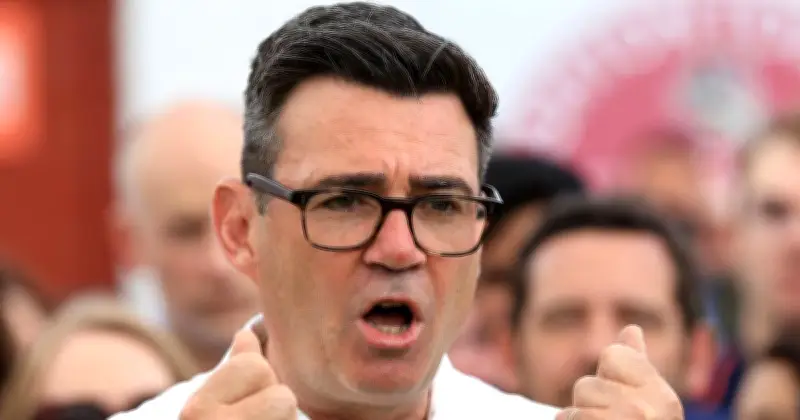
Experts have warned that Brits could face higher household expenses, increased mortgage costs, more taxes, job losses, and disruption to the housing market if Andy Burnham removes Rachel Reeves as Chancellor. Burnham, the former Mayor of Greater Manchester, is the favourite to succeed Sir Keir Starmer, who announced his resignation on Monday. Reeves has faced criticism for policies including raising employer National Insurance contributions and freezing income tax thresholds, as well as tweaking pensions and inheritance tax, insisting people pay their 'fair share'.
Reeves 'Hammered Households'
John O'Connell, chief executive of the TaxPayers' Alliance, said: 'Rachel Reeves has already hammered households with a high-tax agenda, so taxpayers should not assume her replacement will bring any relief. Andy Burnham's record points to higher property taxes, more borrowing and fresh raids on wealth and inheritance. Changing the face in No 11 will mean nothing unless Labour abandons its addiction to taxing working families.'
Household Expenses Could Rise
Andrew Prosser, Head of Investments at InvestEngine, suggested mortgage and loan costs could rise, tax rises would come back into focus, and everyday prices could increase. He said: 'If investors believe a new Chancellor is more likely to loosen the fiscal rules, increase borrowing or delay difficult tax and spending decisions, gilt yields could rise. That can matter for anyone taking out a mortgage, remortgaging, using a personal loan, financing a car or running a small business. People already locked into fixed-rate mortgage deals may not feel the impact straight away, but those coming to the end of a deal could face higher rates if market borrowing costs rise.'
Prosser also noted that the new Chancellor may want to reassure markets without cutting spending, making tax rises more likely. He added: 'Burnham has reportedly backed Labour's pledge not to raise income tax, VAT or employee National Insurance, while also supporting Rachel Reeves' fiscal rules. But he has floated some changes to income tax. He has proposed raising the personal allowance, currently £12,570, which would mean people can earn more before income tax kicks in. That could give lower and middle earners a boost to take-home pay. At the same time, he has previously backed restoring the 50% top rate of income tax, up from 45%. That would not affect most workers, but it would mean higher tax bills for the highest earners.'
Reeves leaving the Treasury would 'not automatically mean an economic crisis', Prosser noted, 'but it would raise the stakes for household finances. The immediate risk would be uncertainty: higher mortgage rates, more expensive loans, a weaker pound and stickier inflation. The longer-term impact would depend on who replaces her, whether they stick to the fiscal rules, and whether markets believe their tax and spending plans add up.' He added: 'The pound could also come under pressure if markets become nervous about the UK's economic direction. A weaker pound makes imports more expensive. That can feed into the price of food, fuel, clothes, electronics and holidays abroad. It can also make inflation harder to bring down, which could make the Bank of England more cautious about cutting interest rates. For households, that could mean the cost of living feels stickier for longer, even if headline inflation is lower than it was during the peak of the crisis.' However, Burnham's focus on lowering the cost of essentials 'could partly offset this pressure', Prosser said. 'He has been associated with plans to bring water and energy under stronger public control, shift some green levies away from electricity bills and keep local transport costs down. In theory, that could help reduce some everyday costs. But if markets see those plans as expensive or underfunded, sterling could weaken, making imported goods more expensive.'
Tax Expert's Verdict
Andy Wood, tax expert at Tax Barrister UK, said the biggest question for financial markets after Reeves' removal would be whether her successor remains committed to the government's existing fiscal rules. He specified the first potential impact could be on borrowing costs: 'Financial markets have generally viewed Rachel Reeves as a supporter of fiscal discipline, and any suggestion that a replacement Chancellor would increase borrowing significantly could push up government borrowing costs. In turn, that can feed through to higher mortgage rates and borrowing costs for households.' He also expects changes to future tax policy: 'A new Chancellor may take a different approach to how the government raises revenue, whether through adjustments to inheritance tax, capital gains tax, business taxation or other measures. For households, this could ultimately affect disposable income and long-term financial planning.' Thirdly, he considered public spending and support for households: 'A successor may choose to prioritise additional spending on infrastructure, public services or cost-of-living support schemes. While that could provide some relief for families in the short term, it would need to be balanced against the government's wider fiscal position.'
Depends on Who Burnham Picks as Chancellor
Professor Len Shackleton, Editorial and Research Fellow at the Institute for Economic Affairs and Professor of Economics at the University of Buckingham, said what happens depends on who succeeds Reeves. If Ed Miliband becomes Chancellor, higher taxes are to be expected, as 'the markets will probably preclude any significant increase in borrowing'. Shackleton also expects a wealth tax linked to housing, perhaps an increase in capital gains tax, and 'windfall taxes' on any sector where profits are temporarily high. 'The effects on consumers will not be immediately apparent, but I would anticipate job losses and a gummed-up housing market,' he said, adding that there would be no cuts in benefits or in spending on net zero. Wes Streeting, however, is 'more market-friendly', he added, and would not want to increase borrowing. Streeting might also be 'more sceptical' on net zero and NHS spending. Shackleton said: 'He is known to favour equalising capital gains tax rates with income tax rates, a policy which would damage entrepreneurship and slow the housing market. While he would probably exempt most home owners, at least initially, landlords and second home owners would be reluctant to sell houses and flats and would prefer to wait for another government.' Yvette Cooper would be best-qualified for the role, Shackleton said, as a trained economist and former financial journalist, married to Ed Balls, who worked closely with Gordon Brown. 'Cooper would be one of the most experienced members of a Burnham team. She would try to maintain fiscal controls, and is perhaps the only one of this crew who might seriously try to find ways to cut public spending. She would, I think, be against tax increases that would hit the middle classes and might also look at welfare reform.' But she has little support within the Parliamentary Labour Party, he noted.
Josh Saul, Chief Executive of The Pure Gold Company, said: 'Whilst the media's attention is focused on the race for Number 10, many investors are paying closer attention to who will ultimately control the Treasury. A new Chancellor can alter the investment landscape overnight through changes to taxation, pensions, capital gains, inheritance rules, borrowing and public spending commitments. Customers tell us they are concerned that an incoming administration may be forced to make difficult fiscal decisions to address weak economic growth, elevated government debt and ongoing pressure on public finances. The possibility of unexpected policy announcements or tax changes is encouraging some investors to increase their allocation to physical gold (especially tax-free gold) as a precautionary measure whilst the political and economic picture becomes clearer.'




