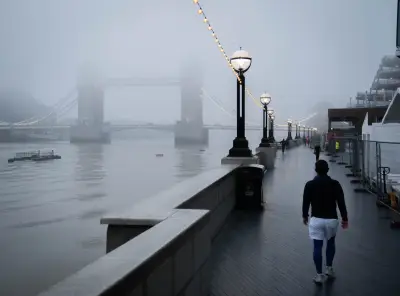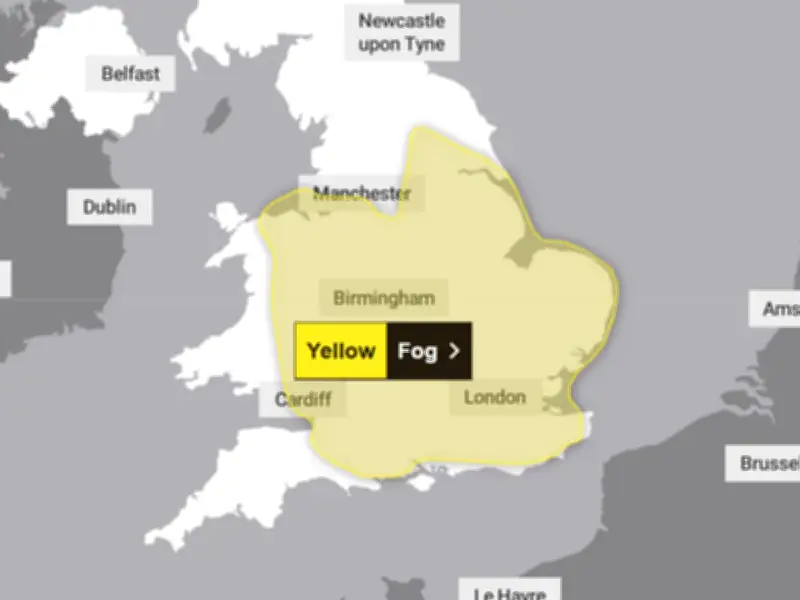
The Met Office has issued a yellow warning for fog affecting 85 UK areas, including Greater Manchester and other parts of north west England. The warning comes into effect at 6pm on Sunday (November 8) and remains in place until 11am on Monday (November 9).
The warning covers parts of the East Midlands, East of England, London and south east England, north west England, south west England, Wales and Yorkshire and Humber. It follows thick fog that caused widespread issues across Greater Manchester last night, with flights diverted, major fireworks displays obscured, and TV coverage of Altrincham FC's FA Cup match affected.
Travel conditions and visibility
The Met Office has warned that fog will lead to "difficult travel conditions" and "possible delays." The warning states: "Fog patches will form readily again during Sunday evening and overnight becoming extensive by Monday morning."
It continues: "Some dense patches of fog are expected with visibility down to around 50 metres or less in some places. Fog thinning slowly later on Monday morning."
Advice for affected areas
The Met Office has urged people in affected areas to "check" road conditions before setting off and to "leave extra journey time." The warning advises: "Make sure you know how to switch on your fog lights, and check they are working before setting off on your journey."
It adds: "Bus and train services, as well as flights and ferry travel may also be affected; check for updates from your travel company and follow their advice."
Understanding fog
Fog is a weather phenomenon that occurs when there is essentially a cloud at ground level, causing a reduction in visibility to less than 1000 metres. Fog, like clouds, is caused by tiny water droplets suspended in the air, but not all fog forms in the same way and there are several different types, the Met Office explains.
Dense fog is when visibility falls below 100 metres, which can cause severe travel disruption. The thickest fogs tend to occur in industrial areas where more pollution particles in the air allow water droplets to coalesce and grow.
Full list of affected areas
East Midlands: Derby, Derbyshire, Leicester, Leicestershire, Lincolnshire, Northamptonshire, Nottingham, Nottinghamshire, Rutland.
East of England: Bedford, Cambridgeshire, Central Bedfordshire, Essex, Hertfordshire, Luton, Norfolk, Peterborough, Southend-on-Sea, Suffolk, Thurrock.
London & South East England: Bracknell Forest, Brighton and Hove, Buckinghamshire, East Sussex, Greater London, Hampshire, Kent, Medway, Milton Keynes, Oxfordshire, Reading, Slough, Southampton, Surrey, West Berkshire, West Sussex, Windsor and Maidenhead, Wokingham.
North West England: Cheshire East, Cheshire West and Chester, Greater Manchester, Halton, Merseyside, Warrington.
South West England: Bath and North East Somerset, Bournemouth Christchurch and Poole, Bristol, Dorset, Gloucestershire, North Somerset, Somerset, South Gloucestershire, Swindon, Wiltshire.
Wales: Blaenau Gwent, Caerphilly, Cardiff, Conwy, Denbighshire, Flintshire, Gwynedd, Merthyr Tydfil, Monmouthshire, Newport, Powys, Rhondda Cynon Taf, Torfaen, Vale of Glamorgan, Wrexham.
West Midlands: Herefordshire, Shropshire, Staffordshire, Stoke-on-Trent, Telford and Wrekin, Warwickshire, West Midlands Conurbation, Worcestershire.
Yorkshire & Humber: East Riding of Yorkshire, Kingston upon Hull, North East Lincolnshire, North Lincolnshire, North Yorkshire, South Yorkshire, West Yorkshire, York.