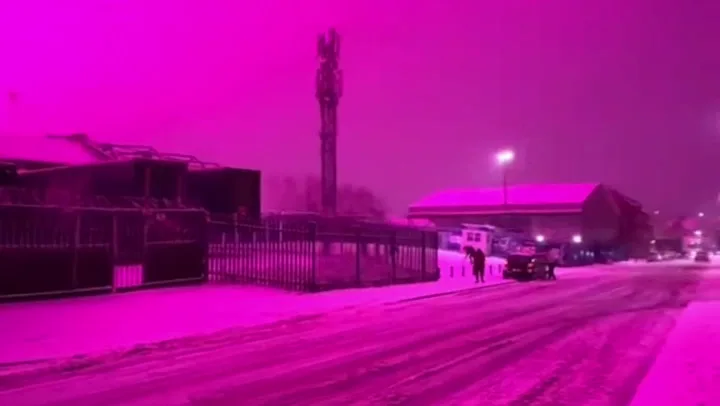
The first named storm of 2026, Storm Goretti, has not only brought widespread disruption across the UK but also an unexpected visual spectacle over the West Midlands. Residents in Birmingham were left baffled on Friday as the sky above the city took on a strange purple and pink hue, sparking a flurry of rumours and theories online.
The Source of the Spectacle
The mystery has now been conclusively solved. Aerial photographs of the city have revealed that the unusual glow was not a meteorological phenomenon, but was emanating from Birmingham City Football Club's St Andrew's stadium. The intense pink light was produced by the powerful LED grow lights used by the club's ground staff to maintain the pitch grass, a common practice in modern football. The lights, amplified by the low cloud and snowy conditions brought by the storm, projected the vivid colour across the night sky.
Nationwide Havoc from Storm Goretti
While Birmingham witnessed an eerie light show, the rest of the country grappled with the storm's severe impacts. National Rail warned of potential weekend disruptions across England, Wales, and Scotland. Power outages were a significant issue, with around 30,000 properties without power in the South West at 6am on Saturday, alongside nearly 1,700 in the West Midlands and 150 in the East Midlands. Downing Street confirmed support was being offered to affected households.
The Met Office issued a series of yellow warnings for snow and ice. Significant snowfall was recorded, including 27cm at Altnaharra in Sutherland, Scotland, and 15cm at Lake Vyrnwy in Powys. The highest rainfall was in Cornwall, with 61.8mm at Colliford Dam. Forecasters have warned that the combination of melting snow and further rain increases the flood risk in the coming days.
Ongoing Warnings and Forecast
Meteorologist Dan Stroud stated the weather would remain "unsettled and cold" over the weekend. A yellow warning for snow and ice remained in force for much of Scotland, the Midlands, north-east and north-west England, and Yorkshire until 3pm on Sunday, with a further 2-5cm of snow likely and up to 10-20cm possible above 200 metres.
"Sunday will start dry in the east, but cloud and rain already present in the west will move steadily eastwards," Stroud explained. "The rain will fall as snow inland across the north Midlands and areas further north. However, temperatures will rise through the day, meaning the snow will become increasingly confined to higher ground by the afternoon."
The storm's effects have been far-reaching, from fallen trees in Cornwall to disrupted travel nationwide, underscoring the powerful and unpredictable nature of the UK's winter weather.