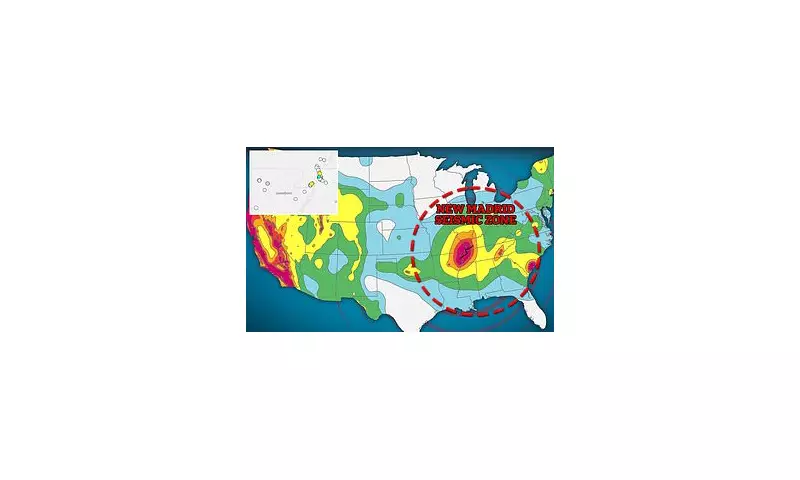
A significant seismic zone in the central United States has experienced a notable uptick in activity, with dozens of small earthquakes recorded over the past month, stoking concerns that a catastrophic natural disaster could be on the horizon.
A Swarm of Activity in a Historic Danger Zone
Since the middle of November, the United States Geological Survey (USGS) has detected at least 38 low-level seismic events along the boundaries of the New Madrid Seismic Zone (NMSZ). This zone spans parts of Arkansas, Kentucky, Missouri, and Tennessee. While minor tremors are common here, this fresh flurry of activity carries a chilling historical echo.
The most recent tremor, a magnitude 1.8 quake, was recorded on December 15. This occurred just one day before the 214th anniversary of the devastating 1811-1812 earthquake swarm that reshaped the region. That historic event saw three colossal quakes, each exceeding magnitude 7.0, causing damage from Cincinnati to St Louis and being felt as far away as Connecticut.

Why the New Madrid Zone is a Geological Puzzle
The 150-mile-long NMSZ is one of the most active earthquake areas east of the Rocky Mountains, yet it remains a profound geological mystery. Unlike typical hotspots like California, it is an intraplate seismic zone, sitting far from the tectonic plate boundaries that usually generate earthquakes. Instead, it lies in the middle of the stable North American plate on an ancient, buried weak point that remains unexpectedly active.
"So how is it that we have earthquakes there? A partial answer to that is, we're not really sure. There's a lot we don't understand about it," explained Eric Sandvol, a professor of geological sciences at the University of Missouri. Research indicates that massive quakes like those in the 19th century could recur every 200 to 800 years, placing the region squarely within the window for another major event.
Preparing for a Catastrophic Impact
With over 11 million Americans living within the NMSZ's danger zone, officials are urgently preparing for a potential catastrophe. A recent Geological Society of America analysis warned that a magnitude 7.6 earthquake could inflict over $43 billion in damage, with earlier studies estimating a potential death toll exceeding 80,000. The cities of St Louis and Memphis are predicted to bear the brunt of the destruction.
The region's infrastructure presents a critical vulnerability. "Midwestern infrastructure and architecture are designed with more frequent natural hazards, like tornadoes, in mind," noted Danielle Peltier of the Geological Society of America. "This means a magnitude 6 quake can have a greater impact in Missouri than somewhere like California." A modelled scenario of a magnitude 7.7 quake near Memphis projected catastrophic outcomes:
- Over 86,000 injuries or fatalities.
- Damage to 715,000 buildings.
- Power loss for 2.6 million homes.
- Total direct and indirect costs potentially reaching $600 billion.
Despite the constant background hum of minor quakes, scientists admit they cannot predict when the next 'big one' will strike. The USGS estimates a 40 percent chance of a magnitude 6.0 or greater earthquake occurring in the zone within the next 50 years, underscoring a persistent and formidable threat at the heart of the nation.