UFO Sightings Cluster Near US West Coast Underwater Canyons, Study Reveals
Fresh research has indicated that unidentified flying objects, or UFOs, may be gathering in concentrated clusters around steep underwater canyon systems along the United States coastline, particularly off the West Coast. This discovery raises intriguing new questions about whether mysterious craft could be operating from beneath the ocean's surface, rather than originating from distant planets or outer space.
Analysis of Over 80,000 Reports Uncovers Geographic Patterns
An independent study, conducted by Antoni Wędzikowski, a lawyer and researcher based in Warsaw, analyzed more than 80,000 UFO reports from the nonprofit National UFO Reporting Center (NUFORC). By comparing this data with detailed bathymetric information from the National Oceanic and Atmospheric Administration, the research identified significant spatial associations between reported sightings and deep underwater terrain features. The findings specifically highlight three regions—La Jolla, Mugu Canyon, and Monterey Canyon—where UFO sightings occurred at rates far exceeding expectations based on population density alone.
For instance, La Jolla recorded 820 sightings, compared to an expected baseline of just 55, according to the researcher's statistical model. This suggests that factors beyond mere human activity or reporting biases may be at play in these areas.

Testing the Cryptoterrestrial Hypothesis
The study was designed to test the so-called 'cryptoterrestrial hypothesis,' which proposes that unidentified aerial phenomena could stem from hidden non-human intelligence residing on Earth itself, rather than from extraterrestrial sources. Wędzikowski utilized advanced geospatial tools, including the AI tool Claude Code, to correct for confounding variables such as population density and to examine whether sightings clustered near steep submarine canyons.
He noted that the hypothesis emerged from observing that several well-known UFO hotspot areas are situated above unusually steep underwater topography. 'Rather than treat that as evidence of anything, I wanted to test it properly: population-controlled, with confound checks, temporal replication, and clear documentation of what survives scrutiny and what doesn't,' Wędzikowski explained.
Geographical Anomalies and Temporal Bursts
A striking geographical anomaly uncovered in the analysis is that clustering patterns were evident on the West Coast but absent on the East and Gulf coasts. This indicates that the phenomenon is not universal but concentrated in specific regions, primarily Puget Sound and the San Diego canyon system. Additionally, the study found that UFO sightings near these submarine canyons did not occur randomly but tended to cluster in temporal bursts over short periods, rather than being evenly distributed over time.
Wędzikowski emphasized that while the findings do not conclusively prove an underwater origin for UFOs, they provide data-driven support for growing scientific interest in objects that appear to transition between air and sea. 'First, the analysis did find a statistically significant spatial association between submarine canyon features and UAP report density along the US West Coast,' he said. 'These are not trivial numbers. The association also correctly predicted 4 out of 5 top hotspot cells.'
Historical Context and Future Research Directions
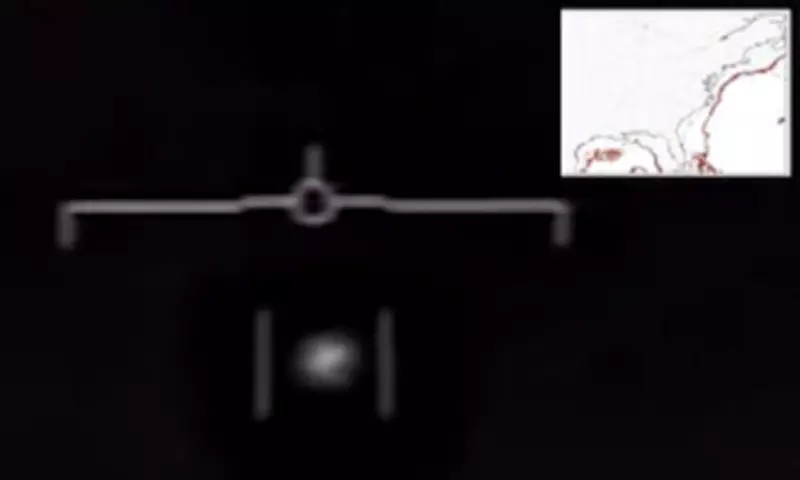
The cryptoterrestrial hypothesis has gained renewed attention in recent years due to high-profile military encounters, such as the November 2004 incident involving US Navy pilots aboard the USS Nimitz. During training exercises off Southern California, radar detected multiple unidentified objects descending from 80,000 feet in less than a second. Commander David Fravor later described seeing a white, capsule-shaped craft, nicknamed the 'Tic Tac,' that seemed to respond intelligently to pilot maneuvers.

Wędzikowski expressed surprise that no one had previously conducted such a systematic geospatial analysis of publicly available UFO data. 'I've followed the UAP topic for years, and what consistently frustrated me was the gap between the data that actually exists and the way the subject is typically discussed, which tends to rely on individual case narratives or speculation rather than systematic analysis,' he stated.
Looking ahead, he plans to publish his methodology and data for peer review and encourages other researchers to replicate the findings. Future investigations could involve comparing sonar records with UFO sighting clusters to determine whether unexplained underwater activity coincides with reported hotspots, potentially shedding more light on this enigmatic phenomenon.