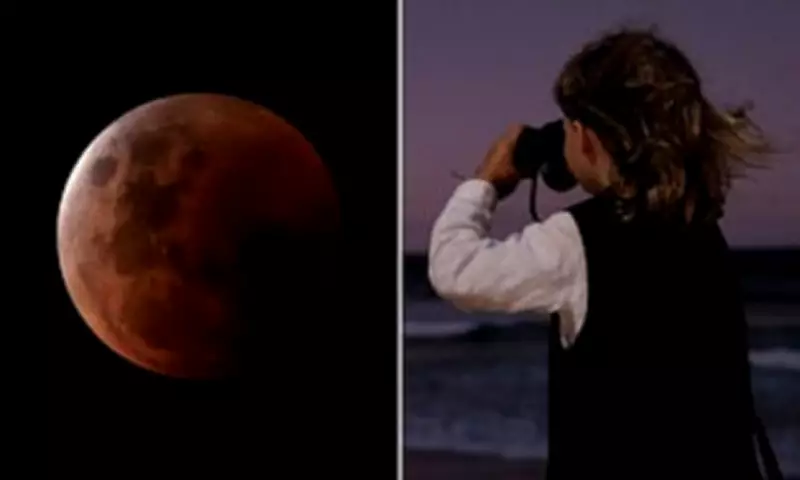
Total Lunar Eclipse to Illuminate Australian and New Zealand Skies on Tuesday
On Tuesday, March 3, a celestial spectacle will unfold as the Moon passes directly through Earth's shadow, resulting in a total lunar eclipse. This astronomical event offers prime viewing opportunities for residents of Australia and Aotearoa New Zealand, with the eclipse occurring at a convenient evening hour, eliminating the need for early morning alarms.
A Rare and Accessible Cosmic Display
As the evening progresses, a dark shadow will gradually sweep across the bright, full Moon. Once fully immersed in Earth's shadow, the Moon will adopt a striking reddish hue, a phase astronomers refer to as totality. Commonly known as a blood moon, this phenomenon captures public imagination and serves as a vivid reminder of our place in the universe. Remarkably, no special equipment is required to enjoy this show, as the Moon is typically easy to locate in the night sky.
This event represents the final chance to witness a blood moon until 2029, when another will herald the New Year in the early hours of January 1. Lunar eclipses are leisurely affairs, unfolding over several hours. For this eclipse, the partial phase will last 75 minutes as the Moon enters Earth's shadow, followed by an hour of totality with the red glow, and another 75 minutes as the Moon emerges back to full brightness.

Optimal Viewing Times and Locations
Since Earth's shadow is vast compared to the Moon, everyone on the night side of our planet experiences the eclipse simultaneously, with timing adjustments only for different time zones. Viewers are advised to seek locations away from light pollution and allow 10 to 15 minutes for their eyes to adjust to darkness for the best experience.
In Western Australia, the eclipse begins with the Moon below the horizon. As it rises, it will be partly shadowed, making initial spotting challenging against the twilight sky. However, patience will reward observers as the eclipsed Moon becomes more visible while climbing higher in the east after twilight fades.
Across the rest of Australia, the eclipse starts later in the evening with the Moon positioned in the eastern sky. In New Zealand, the event commences at 10:50 PM local time, offering superior views due to the fully dark sky and the Moon's high position in the north.
The Science Behind the Red Glow
Initially, Earth's shadow appears black against the bright Moon, but once totality is reached, the reddish blood moon glow becomes apparent. The intensity of this red hue depends entirely on Earth's atmospheric conditions at the time. A dustier atmosphere reduces light transmission, resulting in a darker, deeper red, while a clearer atmosphere allows more sunlight through, bathing the Moon in a bright orange glow.
Only red light penetrates the atmosphere because blue light, with its shorter wavelength, is scattered away—a process known as Rayleigh scattering, which also explains why the sky appears blue. During the day, scattered blue light fills the sky, but at night, this scattering allows red light to dominate during the eclipse.
Celestial Alignment and Future Eclipses
The Moon's orbit is slightly tilted relative to Earth's orbit around the Sun, meaning perfect alignment for a total lunar eclipse is rare. For the next six lunar eclipses, the Moon will only partially dip into Earth's shadow rather than being fully immersed. In fact, during the three lunar eclipses of 2027, the Moon will enter only Earth's faint outer penumbral shadow, causing a barely perceptible dimming.
This makes Tuesday's event all the more special, highlighting the marvel of celestial geometry that allows such awe-inspiring displays. With clear weather hoped for across Australia and New Zealand, this eclipse promises a memorable evening of sky-gazing before the nearly three-year wait for the next blood moon.

Viewing Schedule for Australian Cities
- Sydney, Melbourne, Canberra, and Hobart – 10:04 PM until 11:02 PM
- Brisbane – 9:04 PM until 10:02 PM
- Adelaide – 9:34 PM until 10:32 PM
- Darwin – 8:34 PM until 9:32 PM
- Perth – 7:04 PM until 8:02 PM