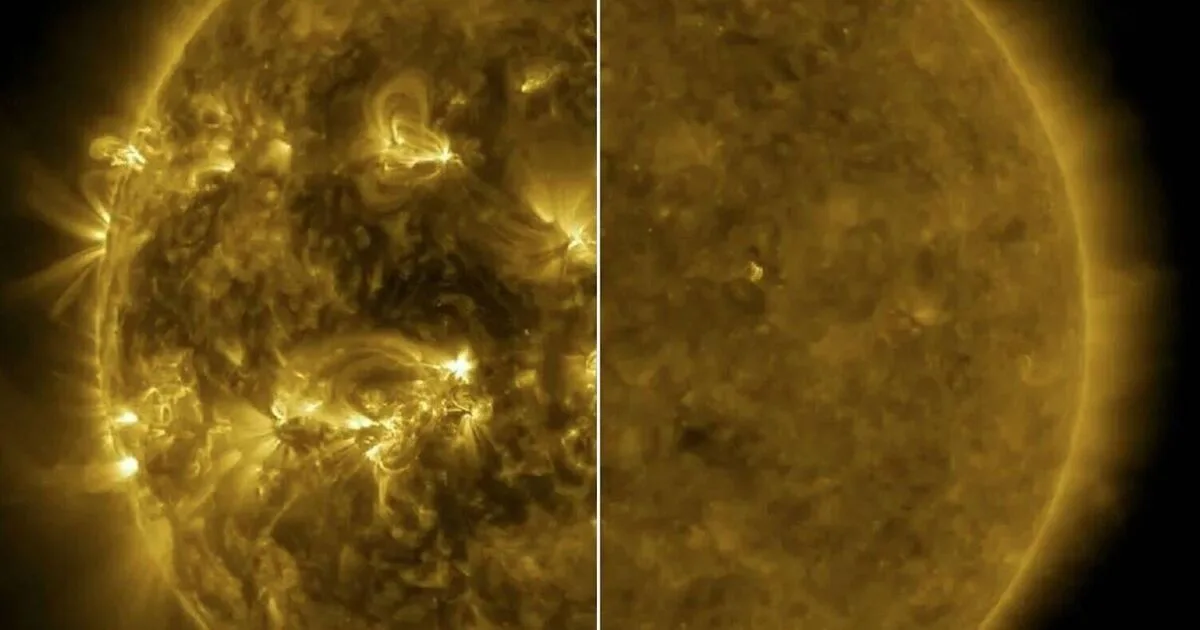
Scientists have uncovered previously hidden changes in the Sun's activity by detecting tiny sound waves within the star, offering new insights into space weather. An international team led by the University of Birmingham analysed four decades of helioseismic data from six telescopes worldwide, publishing their findings in the Monthly Notices of the Royal Astronomical Society on May 28, 2026.
Helioseismology, the study of sound wave oscillations in the Sun, allowed researchers to observe that solar magnetic activity is becoming confined to an increasingly shallow layer beneath the visible surface. This suggests long-term shifts in the Sun's behaviour, with each solar cycle showing more tightly confined magnetic activity near the surface.
Lead author Bill Chaplin from the University of Birmingham stated: 'The Sun has its own active biorhythm creating rising and falling magnetic activity that shapes space weather. However, traditional surface measures don't capture the full story - that the Sun may be entering a different mode of behaviour unfolding over decades.'

The study also found that the current solar cycle, Cycle 25, is more powerful than conventional surface measurements indicate. This has implications for predicting space weather, which can disrupt satellites, GPS, communications, and power grids on Earth, as well as cause radio blackouts and aurorae.
Co-author Sarbani Basu from Yale University explained: 'We discovered that the relationship between internal solar oscillations and surface activity has evolved over the past few cycles. This trend cannot be explained simply by weaker magnetic fields. Instead, it indicates a structural reorganisation of how the Sun's magnetic activity is stored beneath the surface.'
The researchers call for further analysis to understand whether these observed shifts signal a systemic transformation in the Sun's activity and to better predict future cycles.