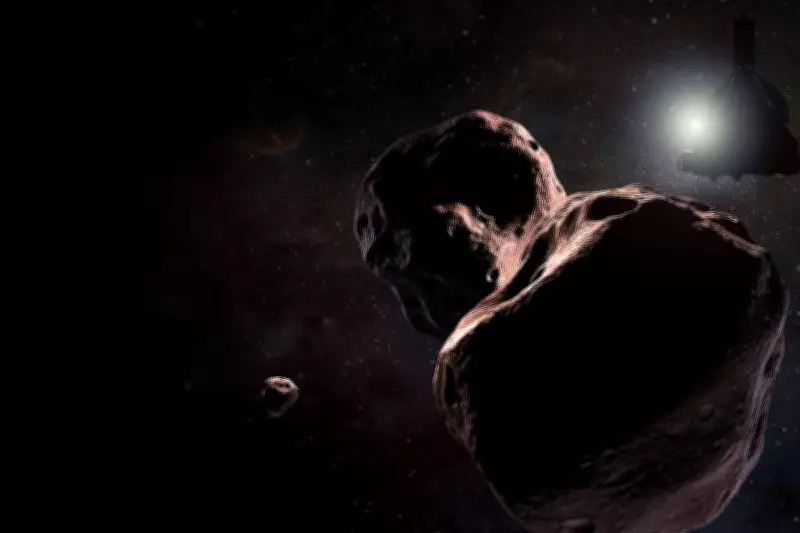
Student Cracks Cosmic Code of Icy 'Snowmen' in Distant Solar System
A graduate student has successfully unraveled one of astronomy's most enduring cosmic mysteries concerning peculiar icy 'snowmen' objects that populate the solar system's outermost regions. These celestial formations, known scientifically as contact binaries, have puzzled researchers for decades with their distinctive two-lobed shapes resembling stacked spheres.
The Kuiper Belt's Frozen Relics
These remarkable celestial 'snowmen' inhabit the Kuiper Belt, a vast expanse beyond Neptune filled with icy remnants dating back to the solar system's formation approximately 4.6 billion years ago. Unlike the turbulent asteroid belt between Mars and Jupiter, this distant region preserves ancient building blocks called planetesimals that have remained largely undisturbed for eons. Approximately one in ten of these primordial objects displays the characteristic contact binary configuration.
The central mystery has always been how such delicate, connected structures could form without violent collisions that would typically shatter or merge them completely. Earlier theories suggested rare cosmic events or exotic conditions might be necessary, but these explanations failed to account for the apparent abundance of these formations.

Breakthrough Through Simulation
Jackson Barnes, a graduate student at Michigan State University, has developed the first comprehensive computer simulation demonstrating how gravitational collapse naturally produces these two-lobed shapes. This process occurs when matter contracts under its own gravity, overcoming forces that would otherwise pull it apart. The groundbreaking research has been published in the prestigious Monthly Notices of the Royal Astronomical Society.
"If we think 10 percent of planetesimal objects are contact binaries, the process that forms them can't be rare," explained Earth and Environmental Science assistant professor Seth Jacobson, the study's senior author. "Gravitational collapse fits nicely with what we've observed."
Previous computer models treated colliding objects as fluid-like blobs that quickly merged into single spheres, making it impossible to recreate contact binaries. Using advanced high-performance computing facilities, Barnes' simulations instead allow objects to retain their structural integrity and settle gently against one another.
Historical Context and Future Implications
Contact binaries first gained detailed scientific attention in January 2019 when NASA's New Horizons spacecraft flew past a Kuiper Belt object later nicknamed Ultima Thule. The stunning images prompted astronomers to re-examine other distant bodies, revealing that approximately 10 percent of planetesimals share this distinctive snowman configuration.
Barnes' simulation reveals that as a rotating cloud of dust and pebble-sized material collapses inward under gravity, it can naturally split into two separate bodies that begin orbiting each other. Such binary planetesimals are commonly observed throughout the Kuiper Belt. Over immense timescales, their orbits gradually spiral closer until the pair gently touches and fuses, preserving their individual rounded shapes.
The reason these fragile-looking structures survive for billions of years comes down to simple probability. In the sparsely populated Kuiper Belt, collisions are exceptionally rare. Without significant impacts, there's little to pull the two bodies apart, and many contact binaries show few if any impact craters on their surfaces.
"We're able to test this hypothesis for the first time in a legitimate way," Barnes emphasized. "That's what's so exciting about this paper." He believes the model could also help researchers understand more complex systems involving three or more bodies, with the team already working on enhanced simulations that better capture the nuances of the collapse process.
As future space missions venture deeper into the outer solar system, researchers anticipate the familiar snowman shape may prove far more common than previously imagined. These findings not only solve a specific astronomical puzzle but also provide crucial insights into the fundamental processes that shaped our solar system during its earliest formation stages.