Six Planets Set to Parade Across Night Sky in Rare Celestial Spectacle
Astronomers are eagerly awaiting a rare celestial event this weekend, as six planets in our solar system will align in a stunning parade across the night sky. The alignment includes Jupiter, Saturn, Venus, Mercury, Neptune, and Uranus, with four of these planets visible to the naked eye, offering a unique opportunity for stargazers worldwide.
Visibility and Timing Details
For the next few days, starting from late February, all six planets will be visible simultaneously. However, spotting Neptune and Uranus will require binoculars or a telescope due to their faintness. In celebration, NASA has released new sonifications, translating astronomical data from its Chandra X-ray Observatory into sound for Jupiter, Saturn, and Uranus, adding an auditory dimension to this visual feast.
Dr. Megan Argo, a reader in astrophysics at the University of Lancashire, explained that this alignment is a rare phenomenon. "We're seeing this alignment now because the planets' orbits have brought them into roughly the same area of the sky from our perspective on Earth. Since each planet circles the sun at a different speed, they constantly shift position against the backdrop of stars. Only occasionally do their paths line up in a way that places several of them together in our night sky," she said.

Argo noted that while it's fairly common to spot four or five planets at once, seeing six is much rarer. "All seven were visible together last year, but the next full lineup won't occur again until 2040." She added that Mercury will become harder to spot by midweek, although Jupiter and Venus will remain easily visible for months.
How to Observe the Planetary Parade
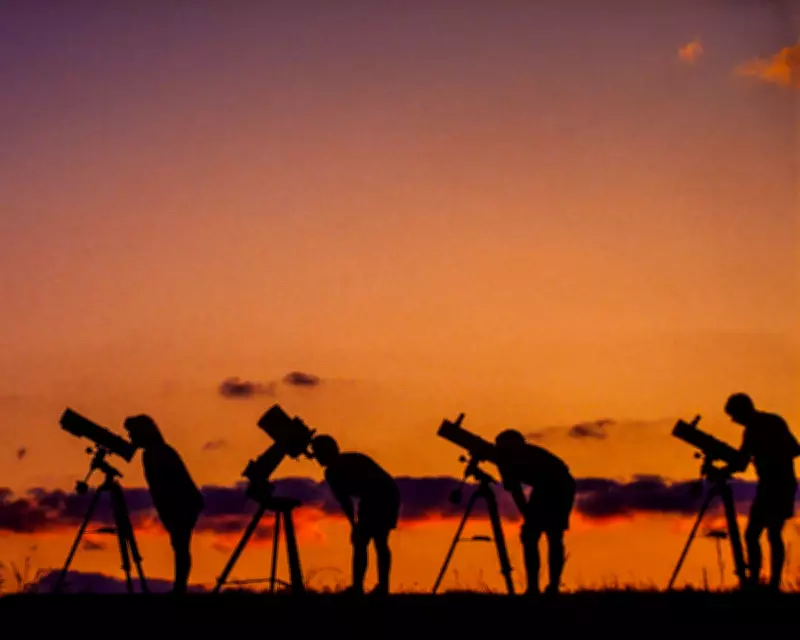
To catch a glimpse of this celestial spectacle, head outside in the early evening local time—around 5:45 PM in the UK and 6:00 PM in the US. Find a spot with a clear view to the west, preferably on a hill with an unobstructed vista. The planets will appear in a curved line across the sky.
In the northern hemisphere, Jupiter will be visible high in the southeast, while Mercury, Saturn, Neptune, and Venus will cluster near the horizon in the western sky. Venus will be the brightest, with Mercury much fainter to its right, and Saturn and Neptune slightly above. Uranus will be faint, sitting below the group of stars known as the Seven Sisters; a stargazing app on your phone can help locate it.
Argo emphasized safety, warning never to look at the sun through binoculars or a telescope, as it could cause permanent eye damage.
Global Visibility and Additional Celestial Features
Dr. Ed Bloomer, an astronomer at the Royal Observatory in Greenwich, confirmed that the event will also be visible in the southern hemisphere, with a similar pattern but reversed compared to the north. In Australia, Jupiter will appear in the north, and Uranus will be visible in the northwest just above the Seven Sisters. However, Mercury is unlikely to be visible in Australia due to its proximity to the horizon at sunset, and Venus will set by 7:15 PM local time, requiring quick observation.
Argo added, "We've also got the moon in the mix actually tonight and over the next couple of days. So we get quite a lot of the visible solar system." This alignment offers a rare chance to witness multiple celestial bodies in harmony, making it a must-see for astronomy enthusiasts and casual observers alike.