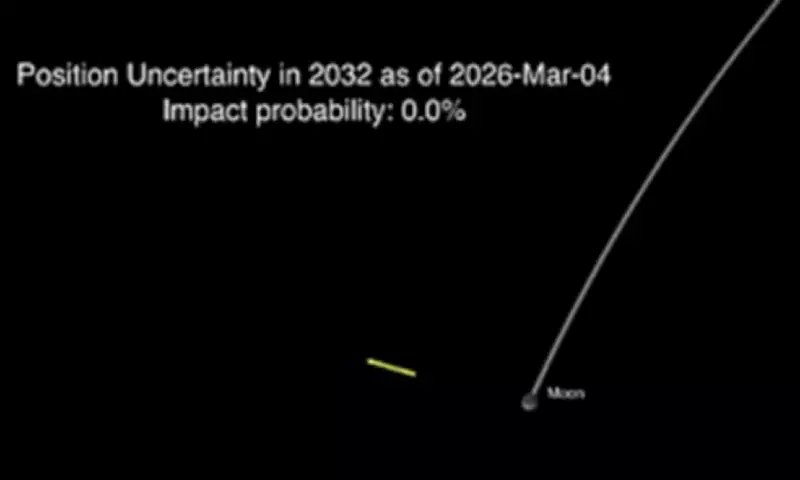
In a significant development for planetary defense, NASA has officially confirmed that asteroid 2024 YR4, previously identified as a potential lunar threat, will safely miss the moon during its upcoming flyby in 2032. This announcement comes after months of intensive tracking and analysis by international space agencies, providing relief from earlier concerns about a possible collision.
From Alarm to Assurance: The Tracking Journey
Since its initial detection in December 2024, the 220-foot asteroid, often categorized as a 'city-killer' due to its size, has been under close surveillance. Early measurements indicated a concerning one in 32 probability of impacting Earth in 2032, which later shifted to a four per cent chance of striking the moon by the end of that year. These assessments triggered widespread alarm within the scientific community, prompting enhanced monitoring efforts.
Critical Observations from James Webb Space Telescope
The turning point arrived with data collected by NASA's James Webb Space Telescope on February 18 and 26. Experts from NASA's Center for Near-Earth Object Studies at the Jet Propulsion Laboratory in Southern California utilized this information to refine the asteroid's orbit with unprecedented precision. This analysis conclusively ruled out any chance of lunar impact on December 22, 2032, confirming instead that 2024 YR4 will pass by the lunar surface at a safe distance of 13,200 miles, equivalent to 21,200 kilometers.

Overcoming Observational Challenges
The asteroid had been unobservable from Earth since spring of last year, with expectations set that it would not reappear until 2028. However, an international team led by researchers at Johns Hopkins University identified two narrow windows last month when the James Webb Telescope could capture it from its unique vantage point in space. The European Space Agency highlighted the complexity of this task, noting it involved using one of humanity's most advanced machines to track a nearly invisible object millions of kilometers away and predict its position nearly seven years into the future.
By meticulously comparing the asteroid's position against background stars, researchers accurately measured its orbit, solidifying the prediction of a safe passage. The Moon is safe, 2024 YR4 poses no danger, but the work continues, cautioned ESA, emphasizing ongoing efforts by its Planetary Defence team to detect and track near-Earth objects to prevent future surprises.
Potential Consequences of a Lunar Impact
Had the asteroid collided with the moon, the consequences would have been severe, though not as catastrophic as an Earth impact. Traveling at over 29,000 miles per hour, it would have released an explosion 500 times more powerful than the atomic bomb dropped on Hiroshima, ejecting approximately 10,000 tonnes of rock into space. In a worst-case scenario, Earth's gravity could have funneled 10 to 30 per cent of this material toward our planet, potentially devastating satellites in low-Earth orbit that are crucial for communications and navigation services.
Richard Moissl, head of planetary defence at ESA, previously stated that while a lunar collision posed no direct risk to people on Earth, it could pose a potential threat for space-based infrastructure. This underscores the importance of continuous monitoring and preparedness.
Key Facts About Asteroid 2024 YR4
- First Detected: December 27, 2024
- Estimated Size: 174–220 feet (53–67 metres)
- Speed Relative to Earth: 30,000 mph
- Date of Moon Flyby: December 22, 2032
- Probability of Impacting the Moon: 0% (confirmed)
Broader Implications for Planetary Defense
While 2024 YR4 is no longer a concern, this event highlights the persistent threats from near-Earth objects. Statistics indicate that an asteroid the size of a football field strikes Earth approximately every 2,000 years, causing significant local damage. Moreover, every few million years, an object large enough to threaten civilization emerges, such as the dinosaur-killing asteroid 66 million years ago.

NASA reassures that no known asteroids larger than 140 meters pose a significant threat to Earth within the next century. However, only about 40 per cent of such asteroids have been detected to date, leaving a substantial gap in our planetary defense network. This incident reinforces the need for ongoing vigilance and investment in detection technologies.
Methods for Asteroid Threat Mitigation
Various strategies have been proposed to deflect hazardous asteroids, including:
- Multiple Bumps: Using successive impacts to alter an asteroid's course, particularly effective for carbon-rich asteroids like Bennu.
- Nuclear Option: Detonating a nuclear explosive near an asteroid, though this risks creating dangerous fragments.
- Ion Beam Deflection: Directing thruster plumes from a space probe to gently push the asteroid's surface.
- Gravity Tractor: Utilizing a spacecraft's gravitational field to tow an asteroid away without physical contact.
Professor Colin Snodgrass of the University of Edinburgh notes that kinetic impactors remain the simplest technology for deflecting asteroids with warning times of years to decades, as demonstrated in missions like DART.
In summary, the successful tracking and analysis of asteroid 2024 YR4 exemplify the advancements in planetary defense, offering a blueprint for future efforts to safeguard Earth and its celestial neighbors from potential cosmic threats.