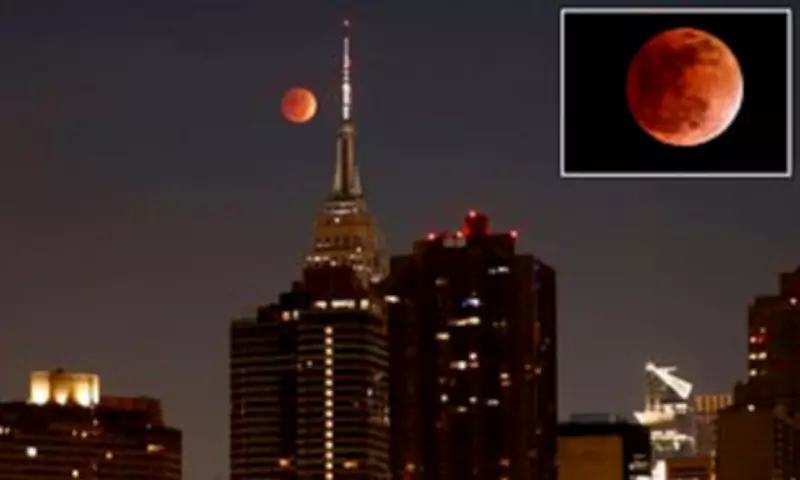
Total Lunar Eclipse to Paint Moon Copper-Red on March 3
A spectacular total lunar eclipse is set to occur on March 3, transforming the moon into a dramatic copper-red spectacle commonly known as a blood moon. This celestial event will be visible across North America, offering observers a striking visual display as Earth passes directly between the sun and the moon, casting its shadow onto the lunar surface.
The Science Behind the Blood Moon Phenomenon
During a total lunar eclipse, sunlight filters through Earth's atmosphere, scattering blue light and allowing red wavelengths to illuminate the moon. This atmospheric filtering creates the signature red hue that gives the blood moon its name. The eclipse follows a precise timeline, beginning with the moon entering Earth's outer shadow at 3:44 AM Eastern Time, causing initial subtle dimming.
The partial eclipse phase commences at 4:50 AM ET as the moon moves into Earth's main shadow, creating the appearance of a dark "bite" being taken from the lunar surface. Totality begins at 6:04 AM ET when the entire moon is immersed in Earth's shadow, taking on its deepest copper-red coloration. This totality phase lasts until 7:03 AM ET, after which the partial eclipse concludes at 8:17 AM ET, with the entire event ending by 9:23 AM ET.

Viewing Recommendations and Global Visibility
NASA emphasizes that no special equipment is required to observe the lunar eclipse, though binoculars or a telescope can significantly enhance the viewing experience. Photographers are advised to use tripods with exposures of several seconds to properly capture the spectacle. The eclipse will be visible in its totality across eastern Asia and Australia during evening hours, throughout the night in the Pacific region, and in early morning hours across North America, Central America, and far western South America.
Partial visibility will occur in central Asia and much of South America, while the eclipse will not be visible at all in Africa or Europe. This alignment represents a relatively rare occurrence, with total lunar eclipses happening approximately every 2.5 years, requiring precise positioning of the sun, Earth, and moon during a full moon phase when the moon crosses Earth's orbital plane at specific nodes.
Biblical Prophecy Connections Fuel Online Speculation
While scientists celebrate the natural beauty of this astronomical event, the blood moon has sparked significant apocalyptic speculation across social media platforms. Numerous users have suggested this particular eclipse could represent "the one mentioned in the Bible," specifically referencing Joel 2:31 which states: "The sun shall be turned into darkness, and the moon into blood, before the great and terrible day of the LORD come."
One social media user posted: "Do you guys think that this upcoming blood moon on March 3rd is the one that is in the Bible? Joel 2:31 I'm pretty sure." This verse, along with similar passages in Acts 2:20 and Revelation 6:12, describes the moon turning red as signaling cosmic disturbances and divine judgment. Many believers interpret these biblical references as warnings of impending danger for the wicked and potential salvation for the faithful, lending the March eclipse heightened spiritual significance for some observers.
Historical Context and Cultural Significance
Blood moons have long been associated with biblical prophecy and are frequently viewed as omens of cosmic upheaval or divine intervention. The phenomenon's rarity and dramatic visual impact have historically contributed to its symbolic weight across various cultures and religious traditions. Whether interpreted through scientific explanation or spiritual lens, the March 3 blood moon promises to captivate viewers and stimulate conversation about the intersection of astronomy, faith, and cultural interpretation.
The event represents both a predictable astronomical occurrence and a culturally significant moment that highlights how natural phenomena continue to inspire diverse interpretations in the modern digital age, where scientific understanding coexists with longstanding religious and prophetic traditions.