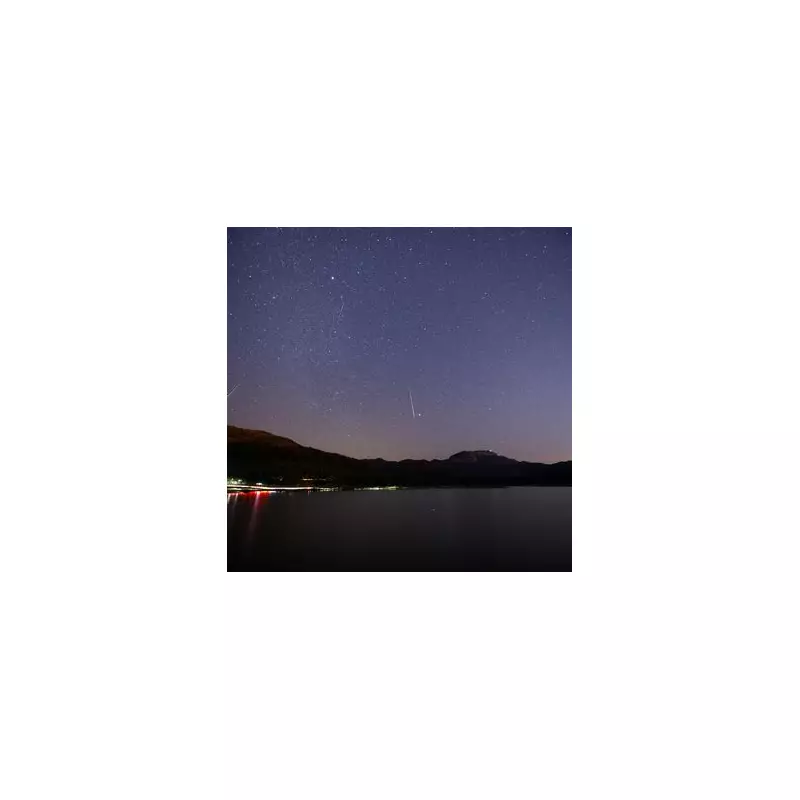
Stargazers across the United Kingdom have one final opportunity this week to witness one of the year's most spectacular celestial displays, the Quadrantid meteor shower.
Your Final Chance to Witness the Quadrantids
The shower, which delivered its most intense display on January 4, remains active and visible in the night sky until Monday, January 12. According to Dr Shyam Balaji, a research fellow at King's College London, this presents a last-ditch chance for many Britons to catch the event, provided local weather and light conditions cooperate.
"The Quadrantids are one of the year’s strongest meteor showers, often producing 60 to 120 meteors per hour under dark skies," Dr Balaji explained. "However, the peak is brief, lasting only a few hours."

How and When to Spot the Shooting Stars
Successfully viewing the meteor shower depends heavily on location and preparation. The best strategy is to find a dark location with a wide, open view of the sky, away from the intrusive glow of town and city lights.
"To watch the meteor shower, find a dark location with an open view of the sky, lie back, and look up without binoculars or telescopes," Dr Balaji advises. "The best time is after midnight and before dawn when the radiant, near the constellation Boötes, is highest."
The Royal Museums Greenwich echoes this guidance, recommending patience and comfort. "Hunting for meteors, like the rest of astronomy, is a waiting game, so it's best to bring a comfy chair to sit on and to wrap up warm as you could be outside for a while," they suggest. Allow your eyes at least 15 minutes to adjust to the darkness for optimal viewing. They also note that in 2026, a full Moon will interfere with visibility during the peak, making these final, post-peak nights potentially clearer for spotting fainter meteors.
The Science Behind the Spectacle
This annual light show originates from cosmic debris. "The shower originates from dust and debris left by a near-Earth asteroid or extinct comet known as 2003 EH1," said Dr Balaji. "The Quadrantids happen at the same time every year, as Earth crosses the same stream of particles at roughly the same point in its orbit each January. As these particles enter the atmosphere at high speed, they burn up and produce meteors."
The shower's name comes from the now-obsolete constellation Quadrans Muralis, which historically occupied that patch of sky.
If you miss this celestial event, the astronomical calendar for 2026 still holds remarkable sights. Dr Balaji highlights an upcoming annular solar eclipse on February 17, which will create a stunning 'ring of fire' effect. He cautions that it is never safe to look directly at the Sun without proper solar filters, even during an eclipse, as the bright ring can cause permanent eye damage. The full 'ring of fire' path will cross the southern Atlantic, with a partial eclipse visible over a broader region; major observatories are expected to provide live webcasts.