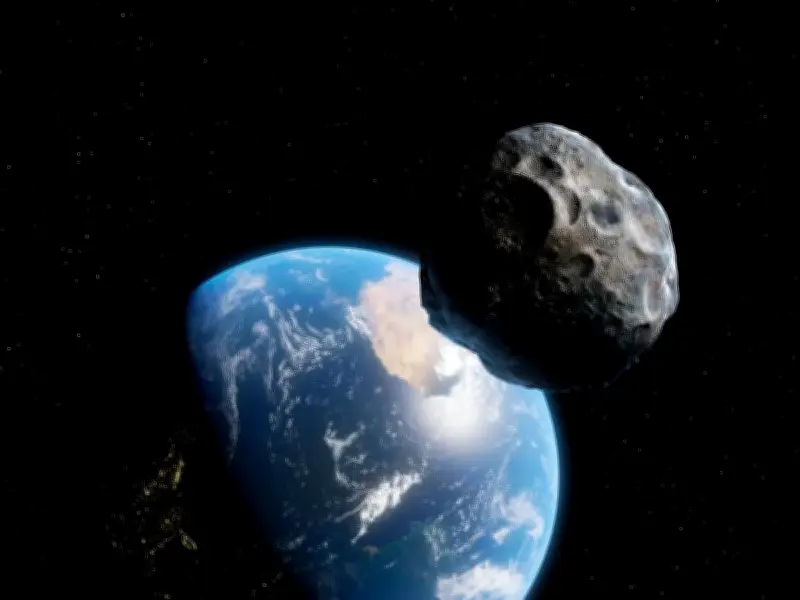
A newly discovered 'lilliputian' mini-moon, now known as Asteroid 2026 QQ8, has been pulled into Earth's orbit by the planet's gravitational pull and is expected to remain until January 2027, just in time for Christmas.
The asteroid was first noticed in August by Hungarian astronomer and self-proclaimed asteroid hunter Kriztián Sárneczky, but it is believed to have been stuck in Earth's orbit since April. Initially, astronomers were unsure whether the object was a genuine asteroid or a collection of space junk.
Asteroid's size and distance
QQ8 is believed to come around 568,000 kilometres (353,000 miles) close to Earth, roughly 110,000 miles (177,000 km) further away than the average distance between Earth and the Moon. With a diameter of about 1 metre, scientists do not believe it will pose a risk to life on Earth, as the atmosphere would likely destroy it before it could cause any real damage.
The giant rock comes close to Earth around every ten years, but this is the first time it has ever been captured by our gravitational pull. Astronomers have recreated QQ8's orbital path and found that it takes 359 days to orbit the Sun.
Not the first mini-moon
This is not the first time Earth has hosted additional celestial bodies. Research suggests that as many as six mini-moons could be orbiting our planet at any given time. Many of these moons, more accurately called satellites, are actually fragments of our known original moon.
Although QQ8 is smaller than one might expect, it is reportedly larger than the average mini-moon. Modelling undertaken earlier this year suggests that the average size of a temporary satellite is around 75 centimetres across.
The International Astronomical Union's Minor Planet Centre officially confirmed the mini-moon's presence on 29 October.