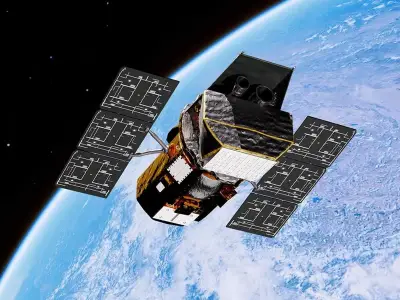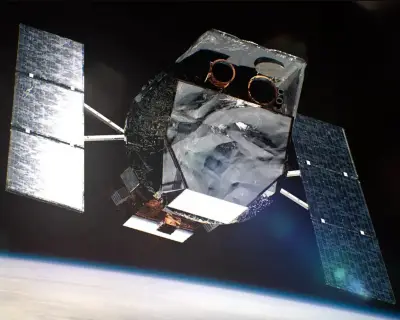
A nearly 1,500kg Nasa spacecraft has a one-in-2,500 chance of injuring someone as it plunges back to Earth within the next few hours. The US space agency's Neil Gehrels Swift Observatory is careening back to Earth after spending 22 years in space, with reentry expected imminently.
The Aerospace Corporation, a nonprofit, predicts the craft will crash at around 10.19am, give or take a couple of hours, while the US Space Force forecast reentry for 9.42am. Nasa estimates there is a very slim chance that scraps of Swift will injure anyone, but for most people, the risk is zero.
Where will the Swift Observatory crash?
Swift's orbit is angled at 20.6° to the Equator, a line stretching Earth's midpoint. It is not yet clear exactly where Swift will crash, but it will be somewhere between 20.6° south latitude and 20.6° north latitude. Space officials say anyone more than 1,420 miles above or below that zone probably will not have a telescope falling on their heads today.
The observatory's trajectory passes over swathes of Africa, Central and South America, Asia and Australia, according to the Aerospace Corporation. However, this includes even larger stretches of the ocean, stresses Dr Alfredo Carpineti, an astrophysicist and author, speaking to Metro.
'It won't land in your garden,' says the space and physics editor at IFLScience, a science and technology news outlet. 'It will mostly burn in the atmosphere. Some surviving bits will fall within 21° of the equator.'
Two decades of discoveries
Launched on November 20, 2004, Swift was originally meant to have a two-year stint in space. Officials designed the instrument to observe gamma-ray bursts, the afterglow of some of the most violent explosions in the universe, such as two stars colliding. These rays are a form of light but, unlike the light from a lamp or phone, they contain huge amounts of energy.
It wound up spending more than two decades circling about 370 miles above the surface before slowly falling back to Earth. Nasa tried to save the one-of-a-kind telescope using a fridge-sized spacecraft launched from Kwajalein Atoll in the middle of the Pacific Ocean, only for it to run into bad weather and malfunction. Now Swift is being torn apart by Earth's atmosphere into a trail of flaming debris.
Swift's end brings mixed feelings for Dr Carpineti. 'It is very sad that Swift was not saved, but what a ride it has been,' he says. 'Just short of 22 years in space, even though it was planned to operate for just 2; over 7,000 papers coming from its observations! And what incredible observations: 2,000 gamma-ray bursts, over 1,400 supernovae, stars being ripped by black holes, asteroids, and even interstellar comets!'