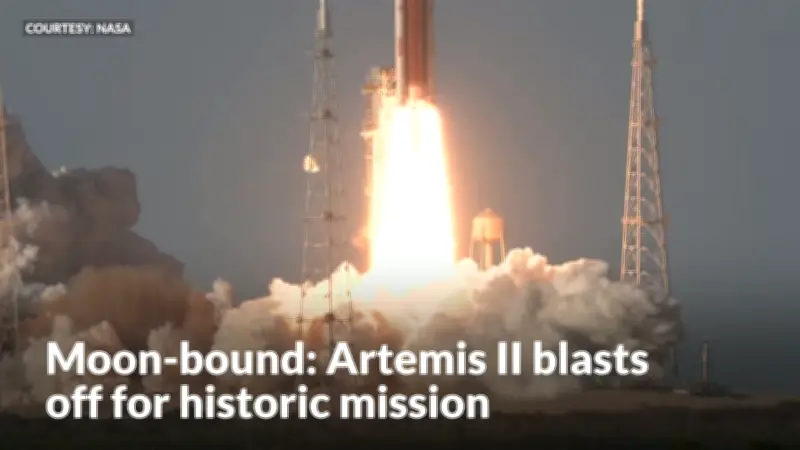
NASA's Artemis II Moon mission in April ripped two enormous holes in Earth's upper atmosphere, potentially increasing the risk of car crashes, a new study has found. The powerful rocket launch caused major disturbances in a layer of the atmosphere that plays a crucial role in how GPS works.
The holes stretched around 3,100 miles (5,000km) across the US and could cause GPS devices to miscalculate their positions by several metres - potentially enough to send self-driving vehicles into the wrong lane.
Study Details and Findings
The study was carried out by researchers at National Cheng Kung University in Taiwan, who examined data from high-precision GPS receivers stationed across America. Although the disturbances were detected over North America, similar changes to Earth's atmosphere could potentially affect GPS accuracy elsewhere in the world, including the UK.
There's currently no evidence that the Artemis II launch caused GPS disruption or impacted drivers in Britain. Scientists say the disturbances could have serious consequences for autonomous vehicles, with even a small positioning error enough to throw self-driving cars off track.
Potential Impact on Autonomous Vehicles
"A positioning error of a couple of metres is enough to cause an autonomous car to change lanes," Charles Lin, an earth science professor at National Cheng Kung University, and co-author of the study, told Space.com. "It could have a strong impact not only on self-driving cars but also on drone positioning."
The study found that NASA's powerful Space Launch System (SLS) rocket created two huge gaps in the ionosphere - an electrically charged layer of Earth's atmosphere which GPS signals must pass through to reach the ground. One was caused by the rocket's 212ft (65 metre) central stage as it travelled through the atmosphere. The second was linked to two thruster burns from its upper stage.
Significance and Future Missions
The disturbances were among the most significant ever recorded following a rocket launch, and up to 10 times more intense than those observed after test flights of SpaceX's Starship. The upper-stage engine burns, which helped propel the Orion spacecraft out of Earth's orbit and towards the Moon, caused the most significant disturbance 115 miles (185km) above Earth.
Artemis II marked the first time astronauts had travelled around the Moon in more than 50 years. NASA hopes the mission will pave the way for future lunar landings and eventually a permanent human presence on the Moon.
Rocket launches can cause temporary changes in the atmosphere, but scientists are now warning these effects could become increasingly vital as more missions travel to the Moon and Mars. Lin said the impact of engines firing during an orbital manoeuvre on an interplanetary mission was something scientists had not previously observed in this way.
"Rocket launches from the ground to space produce that kind of effect, but we have never seen this kind of orbital maneuver in an interplanetary mission," said Lin. "In the future, as we are going to see many more missions going to the moon and to Mars, these space weather effects will become much more significant."