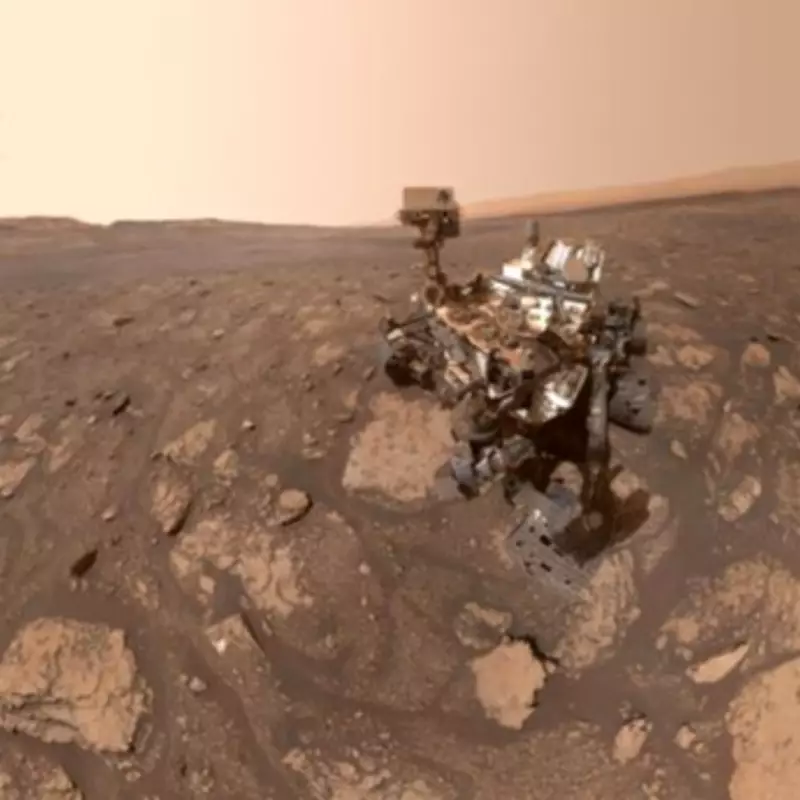
NASA's Curiosity Rover Uncovers Ancient Organic Compounds on Mars in Groundbreaking Discovery
NASA's Curiosity rover has made a monumental discovery on the Red Planet, uncovering a diverse array of organic compounds that represent the most compelling evidence yet for the potential existence of ancient life on Mars. The nuclear-powered robot, which has been exploring the Martian surface since 2012, has identified chemicals that planetary scientists consider fundamental building blocks for the origin of life as we know it on Earth.
Preserved Organic Matter Dating Back 3.5 Billion Years
According to study leader Professor Amy Williams from the University of Florida, who serves as a scientist on both the Curiosity and Perseverance Mars rover missions, the newly discovered organic matter appears to have been preserved on Mars for approximately 3.5 billion years. This remarkable preservation demonstrates that the Martian surface can maintain the types of molecules that could serve as indicators of ancient biological activity.
"We think we're looking at organic matter that's been preserved on Mars for 3.5 billion years," Professor Williams explained. "It's really useful to have evidence that ancient organic matter is preserved, because that is a way to assess the habitability of an environment. And if we want to search for evidence of life in the form of preserved organic carbon, this demonstrates it's possible."

Groundbreaking Chemical Experiment on Another World
The discovery resulted from a chemical experiment conducted for the first time on another planetary body. Using the Sample Analysis at Mars (SAM) instrument suite, researchers employed a chemical called TMAH to break apart larger organic molecules so they could be analyzed by Curiosity's onboard instruments. This innovative approach has yielded unprecedented insights into Martian chemistry.
Among the more than twenty chemicals identified in this groundbreaking experiment, Curiosity detected:
- A nitrogen-bearing molecule with a structure similar to DNA precursors, never before observed on Mars
- Benzothiophene, a large, double-ringed, sulphurous chemical often delivered to planets by meteorites
- A diverse mix of organic compounds that could serve as potential indicators of past biological activity
Professor Williams noted the significance of these findings: "The same stuff that rained down on Mars from meteorites is what rained down on Earth, and it probably provided the building blocks for life as we know it on our planet."
Funding Crisis Threatens Future Mars Exploration
Despite this scientific breakthrough, NASA's ability to conduct further research and retrieve additional samples faces significant challenges due to proposed budget cuts from the Trump administration. The Mars Sample Return (MSR) programme, which was designed to bring Martian rock samples back to Earth for detailed analysis, was cancelled in January following congressional approval of a compromise spending bill that aligned with the administration's priorities.
Planetary scientist Victoria Hamilton from the Southwest Research Institute, who chairs NASA's Mars Exploration Program Analysis Group, expressed deep disappointment at this development: "When we've got memos coming out saying we want to be the dominant power in space, I wonder how we leave something this ambitious behind."
The Trump administration has attempted to reduce NASA's budget by approximately 23 percent, a move that would severely impact the agency's ability to conduct future planetary exploration missions. While an earlier attempt at such cuts was rejected, officials are now pursuing this reduction again, creating uncertainty for ongoing and planned scientific investigations.
Strategic Sampling in Clay-Rich Regions
Curiosity conducted its groundbreaking experiment in 2020 within the Glen Torridon region of Gale crater, an area particularly rich in clay minerals that indicate the presence of water in Mars' distant past. Professor Williams explained that clay minerals are especially effective at preserving organic chemicals compared to other geological formations, making them prime targets for astrobiological research.

The success of the experiment required meticulous planning, as Curiosity carried only two cups of the TMAH chemical needed for the analysis. Researchers carefully selected the most promising location to maximize the scientific return from this limited resource.
Implications for Future Space Exploration
The promising results, published in the prestigious journal Nature Communications, come at a critical juncture for planetary science. Future missions, including the Rosalind Franklin mission to Mars and the Dragonfly expedition to Saturn's moon Titan, plan to incorporate similar TMAH experiments to search for organic compounds on other celestial bodies.
Professor Williams emphasized the broader implications of Curiosity's discovery: "We now know that there are big complex organics preserved in the shallow subsurface of Mars, and that holds a lot of promise for preserving large complex organics that might be diagnostic of life."
While the current experiment cannot definitively distinguish between organic compounds formed through biological processes versus those created through geological activity or delivered by meteorites, it represents a significant step forward in our understanding of Mars' potential habitability and the preservation of organic materials in extraterrestrial environments.