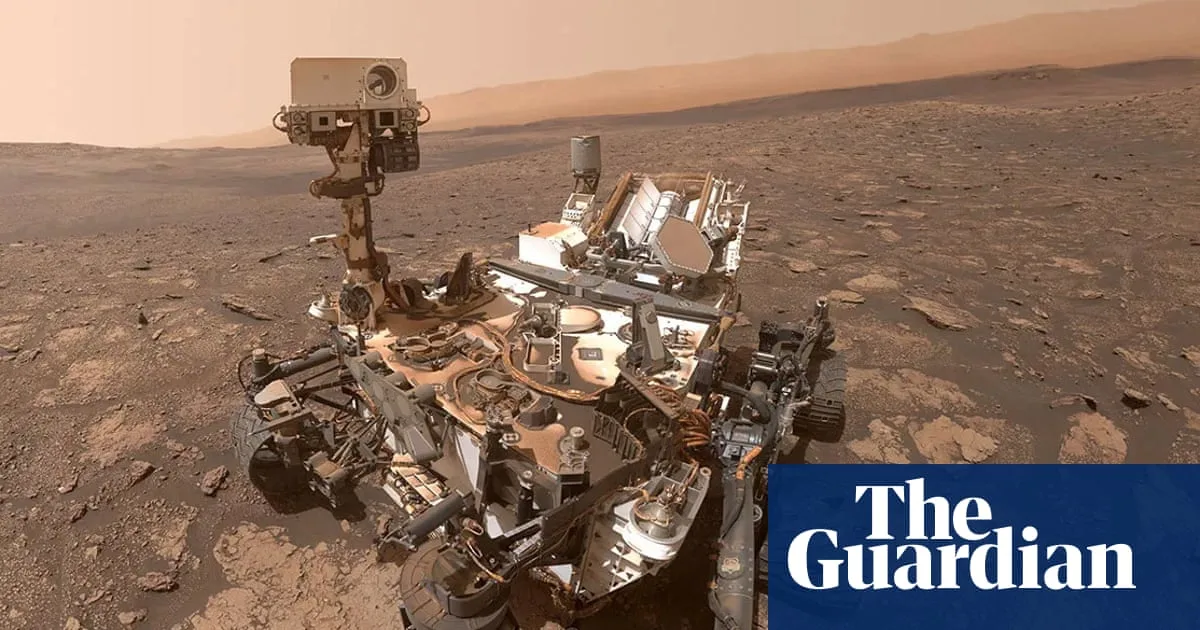
NASA's Curiosity Rover Uncovers Organic Molecules on Mars, Offering Clues to Life's Beginnings
In a groundbreaking discovery, NASA's Curiosity rover has identified a range of organic molecules on Mars that have never been seen before on the Red Planet. These compounds are widely regarded as the fundamental building blocks for the origin of life on Earth, preserved in the Martian surface for billions of years.
Diverse Organic Mix Includes DNA Precursors
The rover detected a diverse mix of organic molecules, including a nitrogen-bearing substance with a structure similar to DNA precursors. These are the raw components necessary for constructing genetic material, marking the first time such molecules have been found on Mars. Additionally, Curiosity identified benzothiophene, a large, double-ringed, sulphurous chemical often delivered to planets via meteorites.
The findings stem from a chemical experiment conducted in the Glen Torridon region of Mars' Gale crater, an area that likely once contained water. This experiment, performed using the Sample Analysis at Mars (SAM) instrument suite, is the first of its kind ever executed on another world.
Insights from Scientific Experts
Amy Williams, a professor of geological sciences at the University of Florida and a scientist on both the Curiosity and Perseverance Mars rover missions, commented on the significance. 'The same stuff that rained down on Mars from meteorites is what rained down on Earth, and it probably provided the building blocks for life as we know it on our planet,' she said. 'We now know that there are big complex organics preserved in the shallow subsurface of Mars, and that holds a lot of promise for preserving large complex organics that might be diagnostic of life.'
Professor Williams added, 'We think we're looking at organic matter that's been preserved on Mars for 3.5 billion years. It's really useful to have evidence that ancient organic matter is preserved, because that is a way to assess the habitability of an environment. If we want to search for evidence of life in the form of preserved organic carbon, this demonstrates it's possible.'
Curiosity's Mission and Technical Details
Curiosity landed on Mars in 2012 with the primary goal of finding evidence that the planet had conditions capable of supporting microbial life billions of years ago. The rover, part of the Mars Science Laboratory (MSL) mission, was launched from Cape Canaveral, Florida, on November 26, 2011, and touched down on August 5, 2012.
Key specifications of the Curiosity rover include:
- Weight: 899 kg (1,982 lb), with 80 kg (180 lb) of scientific instruments.
- Dimensions: 2.9 metres long by 2.7 metres wide by 2.2 metres in height.
- Power source: Plutonium fuel.
- Initial mission duration: Two years, extended indefinitely due to success.
The experiment used a chemical called TMAH to break apart larger organic molecules for analysis by SAM. With only two cups of TMAH onboard, careful planning was required to select the optimal sampling location.
Limitations and Future Missions
While the experiment confirms that the Martian surface can preserve these organic molecules, it cannot distinguish between compounds from potential past life and those formed through geologic processes or meteorite delivery. Definitively identifying signs of past life would necessitate returning rock samples to Earth for detailed analysis.
The promising results, published in the journal Nature Communications, come as future missions plan to incorporate the TMAH test. These include the Rosalind Franklin mission to Mars and the Dragonfly expedition to Saturn's moon Titan, aimed at searching for organic compounds.
Related Discoveries and Context
Last year, NASA announced that a sample collected by the Perseverance rover, which landed in 2021 to search for signs of ancient life, showed the 'clearest sign of life' ever found on Mars. Researchers observed unusual features in ancient Martian rocks, such as 'poppy seeds' and 'leopard spots,' which might indicate tiny life forms from the distant past.
Nicky Fox, NASA's Associate Administrator, noted, 'This is the kind of signature that we would see that was made by something biological.' The rover's tools detected chemicals like iron and phosphorus in these features, consistent with microbial activity on Earth.
Separately, scientists have identified two dozen minerals in the Jezero crater, suggesting multiple episodes of fluid alteration and habitable environments over time. Eleanor Moreland, a Rice University graduate student, stated, 'The minerals we find in Jezero support multiple, temporally distinct episodes of fluid alteration. This indicates there were several times in Mars' history when these particular volcanic rocks interacted with liquid water and therefore more than one time when this location hosted environments potentially suitable for life.'
The Perseverance rover, part of NASA's Mars 2020 mission, continues to explore the Jezero Crater, an ancient river delta that once held a deep lake, in search of evidence of microbial life from 3.5 to 3.9 billion years ago. This mission aims to collect samples for eventual return to Earth, enhancing our understanding of life's evolution in the solar system.